
 Aug 05, 2026
 Category: Concrete Mixer Wear Parts
Author: FH® Alloy
Company: Wuxi Junteng Fanghu Alloy Technology Co., Ltd.
Target Market: Global B2B Buyers
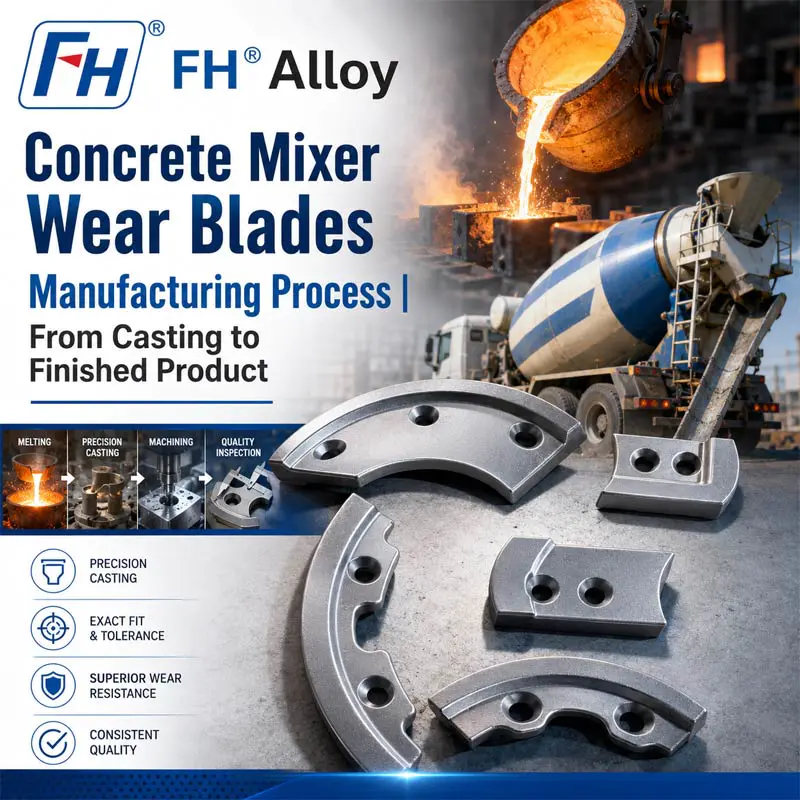
Concrete Mixer Wear Blades Manufacturing Process | FH® Alloy Factory
Concrete mixer wear blades are critical components in concrete production equipment. They operate under continuous abrasion and impact from cement, sand, gravel, and aggregates.
To achieve long service life, mixer blades require more than just wear-resistant materials. The entire manufacturing process, including alloy composition, casting technology, heat treatment, and machining accuracy, directly affects final performance.
A professional concrete mixer wear blades manufacturer must control every production stage to ensure stable quality and reliable operation.
Wuxi Junteng Fanghu Alloy Technology Co., Ltd. (FH®) specializes in manufacturing high-performance concrete mixer wear blades using advanced alloy casting technology for global customers.
1. Engineering Design and Technical Confirmation
Before production begins, engineers analyze customer requirements and confirm product specifications.
The evaluation includes:
OEM Drawing Review
For customized mixer blades, customers usually provide:
FH® Alloy engineers review the design to ensure:
2. Alloy Material Selection
Material selection is one of the most important steps in manufacturing wear-resistant mixer blades.
Different applications require different alloy solutions.
High Chromium Alloy
High chromium alloy is widely used for severe abrasion conditions.
Key characteristics:
Suitable for:
Ni-hard Cast Iron
Ni-hard is a nickel-chromium alloy cast iron designed for wear applications.
Advantages:
Suitable for:
3. Alloy Melting Process
After material selection, alloy materials are melted under controlled conditions.
The melting process determines:
Important parameters include:
A stable melting process helps ensure consistent performance between production batches.
4. Precision Casting Process
Casting is a key step in manufacturing concrete mixer wear blades.
FH® Alloy uses professional casting technology to produce complex blade geometries.
The casting process includes:
Mold Preparation
The mold is prepared according to:
Alloy Pouring
The molten alloy is carefully poured into the mold.
Controlled pouring helps achieve:
Cooling and Solidification
Controlled cooling improves:
5. Heat Treatment Process
Heat treatment is essential for improving wear performance.
It helps optimize:
Proper heat treatment provides:
Without proper heat treatment, even high-quality alloy materials may not achieve expected performance.
6. Machining and Surface Finishing
After casting and heat treatment, mixer blades undergo machining processes.
These processes ensure:
Machining operations may include:
Accurate machining helps prevent:
7. Quality Inspection Before Shipment
Quality inspection is the final step before delivery.
FH® Alloy performs inspection including:
Chemical Composition Testing
Ensures alloy elements meet requirements.
Hardness Testing
Confirms:
Dimension Inspection
Checks:
Surface Inspection
Identifies:
Only qualified products are prepared for shipment.
8. Types of Concrete Mixer Wear Blades Manufactured by FH® Alloy
FH® Alloy produces various customized blade designs.
Arc Type Mixer Wear Blades
Features:
Curved Mixer Wear Blades
Advantages:
Block Type Mixer Wear Blades
Designed for:
Segment Type Mixer Wear Blades
Benefits:
9. Why Manufacturing Process Matters
Many buyers focus only on material grade. However, the final performance of mixer blades depends on the complete manufacturing process.
Two products using the same alloy may have different service life because of differences in:
A professional manufacturer controls the entire process from raw material to finished product.
10. FH® Alloy Manufacturing Advantages
Wuxi Junteng Fanghu Alloy Technology Co., Ltd. (FH®) provides complete OEM manufacturing solutions.
Our advantages include:
Professional Alloy Casting Capability
FH® Alloy specializes in:
OEM Custom Production
We manufacture according to:
Complete Production Control
From:
Material selection
↓
Alloy melting
↓
Casting
↓
Heat treatment
↓
Machining
↓
Inspection
FH® Alloy controls each stage to ensure stable quality.
Global Supply Experience
FH® Alloy supplies industrial customers worldwide, including:
Conclusion
The manufacturing process of concrete mixer wear blades directly determines their durability, wear resistance, and operating performance.
A reliable manufacturer must combine:
With professional alloy casting experience, FH® Alloy manufactures high-performance concrete mixer wear blades and customized wear-resistant components for global customers.
About FH® Alloy
Wuxi Junteng Fanghu Alloy Technology Co., Ltd. (FH®) is a professional manufacturer specializing in:
FH® Alloy provides OEM wear-resistant solutions for concrete equipment manufacturers and industrial users worldwide.
Related Articles
 CategoryRecent Post

Focus on Designing and Manufacturing Alloy Steel Parts since 2006
 Tel: 0510-83310100
  E-mail: info@alloy-casting.com
  Office Add: Room 1105,Building 6, Jiaye Wealth Center,Wuxi, Jiangsu, P.R.China P.C.:214000.
  Privacy

 English
 Español
 italiano
 Deutsch
 0086-13338774804
