
 Aug 06, 2026
 Content
Technical Guide
Every concrete batching plant loses money the moment a mixer blade starts wearing thin — long before it actually breaks. Mixing efficiency drops, cycle times stretch, and concrete consistency becomes harder to control. Instead of reacting after a blade fails, forward-thinking plant operators track wear rate as a measurable number and use it to plan replacement before downtime happens. This guide breaks down the data behind blade wear, compares materials side by side, and shows how to turn raw operating hours into a practical replacement schedule.
Wear is gradual, which is exactly why it is dangerous. A blade that has lost fifteen percent of its original thickness may still look functional on a quick visual check, yet it is already mixing less efficiently, consuming more energy, and pushing unmixed material toward the discharge point. Plants that only replace blades after a breakdown typically pay for that decision three times over: once in unplanned downtime, once in inconsistent batch quality, and once in emergency parts shipping.
Wear rate is not a fixed number — it changes with material hardness, aggregate type, mixing frequency, and moisture content. The following factors have the biggest measurable impact on how quickly a blade loses thickness.
Granite and basalt aggregates create far more abrasive friction than limestone or river gravel, directly accelerating surface material loss.
Larger, sharper particles concentrate impact force on a smaller contact area, causing localized pitting rather than even surface wear.
Plants running continuous multi-shift production accumulate wear hours far faster than intermittent or seasonal operations.
Wetter mixes change friction behavior and can accelerate corrosion-assisted wear on lower-grade steel components.
The chart below illustrates typical cumulative wear (thickness loss in millimeters) across roughly 5,000 operating hours for four common blade materials under comparable abrasive conditions. The gap between plain carbon steel and cast alloy materials widens sharply as operating hours accumulate.
Illustrative wear pattern based on typical field ranges under moderate-abrasion aggregate conditions. Actual wear depends on mix design, particle hardness, and duty cycle.
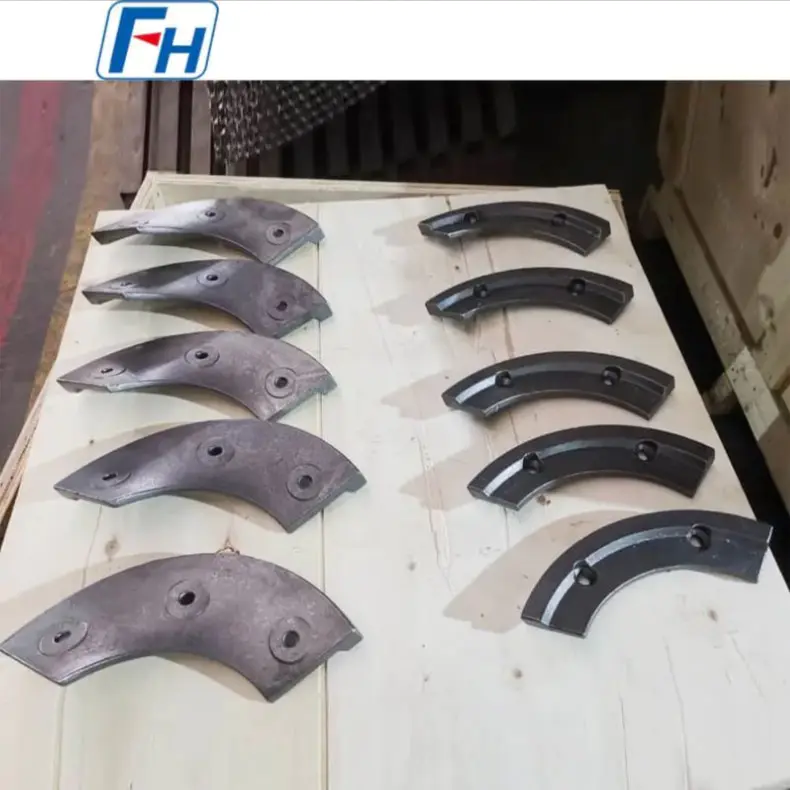
Each design below is engineered for a specific mixer configuration, from twin-shaft plants to heavy mining-grade batching lines.
High Wear-Resistant Alloy Mixer Blades
Ni-Hard CastingIndustrial Batching Plant Wear Blades
High-Strength PartsCustom Mining-Grade Mixer Blades
Long-Life Wear PartsAggregate Mixing Blades
OEM Wear PartsNi-Hard Cast Iron Mixer Blades
Heavy-Duty CastingsHardness alone does not tell the whole story. Impact resistance, relative cost, and expected service life all factor into the right material decision for a given plant.
Turning wear data into a maintenance schedule takes four steps. Plants that follow this sequence typically catch blade replacement before it affects output quality.
Record the original blade thickness at installation as the reference point for every future inspection.
Log actual mixing hours rather than calendar time, since wear correlates with cycles, not days.
Measure remaining thickness every few hundred hours and plot the trend line against the material's known wear curve.
Replace blades once thickness loss reaches roughly 60-70 percent of original dimension, before geometry distortion affects mixing quality.
Lower unit price does not always mean lower cost. When replacement frequency, labor, and downtime are combined into a single annual cost index, premium alloy blades consistently come out ahead.
Index values represent relative annual cost (replacements, labor, and downtime combined), with plain carbon steel set at 100 as the baseline.
The wear resistance of Ni-Hard cast iron comes from a carefully balanced alloy structure. The chart below shows the approximate composition ratio used in mixer-grade castings.
Do not wait for a full inspection cycle if any of the following signs appear during routine plant checks.
Slight edge rounding visible on close inspection, with mixing performance still stable.
Noticeably thinner blade profile, longer mixing cycles needed to reach the same batch consistency.
Visible cracking, chipped edges, or exposed mounting bolts indicate imminent failure risk.
Most batching plants inspect blades every 300 to 500 operating hours, adjusting the interval based on aggregate hardness and production volume.
Minor surface regrinding can restore geometry once, but blades that have lost significant thickness should be replaced rather than reground repeatedly, since remaining wear allowance shrinks quickly.
Yes. A poorly matched profile concentrates stress on specific contact points, accelerating localized wear even when the base material is high quality.
Controlled chemical composition and heat treatment deliver consistent hardness batch after batch.
Blades manufactured to match specific mixer models, arm dimensions, and mounting patterns.
Supplying batching plants and equipment manufacturers across Europe, North America, and Southeast Asia.
Every batch tracked from raw material chemistry through casting, heat treatment, and final inspection.
Ready to Reduce Blade Replacement Costs?
Send your mixer model or drawing to FH Alloy Technology for a material and service-life recommendation tailored to your plant.
Request a Quotation CategoryRecent Post

Focus on Designing and Manufacturing Alloy Steel Parts since 2006
 Tel: 0510-83310100
  E-mail: info@alloy-casting.com
  Office Add: Room 1105,Building 6, Jiaye Wealth Center,Wuxi, Jiangsu, P.R.China P.C.:214000.
  Privacy

 English
 Español
 italiano
 Deutsch
 0086-13338774804
