
 Nov 23, 2026
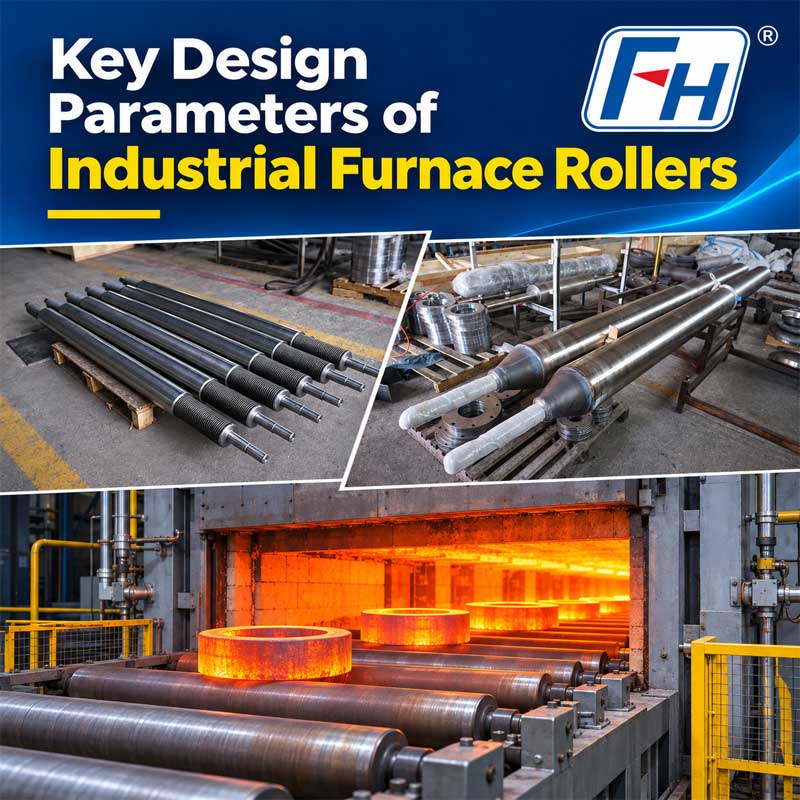
Furnace roller design is an important consideration in continuous industrial heating systems.
A roller must provide sufficient mechanical support, maintain stable rotation, and withstand the thermal and chemical conditions inside the furnace.
Selecting a furnace roller based only on its outer diameter or material grade is not sufficient. Its complete geometry and operating environment must be evaluated together.
This guide explains the key design parameters used when specifying industrial furnace rollers.
1. Outer Diameter (OD)
The outer diameter determines the roller's contact surface and contributes to its structural performance.
It also affects:
The required diameter should be determined according to the original equipment design and workpiece dimensions.
2. Inner Diameter (ID) and Wall Thickness
Many industrial furnace rollers are hollow.
For a hollow cylindrical roller, wall thickness is determined by the difference between its outer and inner diameters.
Wall Thickness = (OD - ID) / 2
Wall thickness influences:
An appropriate wall thickness should be established through engineering evaluation rather than selected solely to minimize material consumption.
3. Overall Length and Support Span
Roller length and support arrangement are important for load distribution.
A longer roller may experience greater bending under the same loading conditions, depending on its support configuration and structural geometry.
Important design information includes:
These parameters should be evaluated together.
4. Operating Load
The roller must support the expected workpiece load under operating conditions.
Important considerations include:
Uneven loading may result in localized stress and increased deformation risk.
5. Operating Temperature
Temperature affects material strength, creep resistance, oxidation behavior, and thermal expansion.
When specifying a furnace roller, distinguish between:
The actual roller temperature may differ from the furnace atmosphere temperature.
6. Furnace Atmosphere
Furnace atmosphere can significantly affect alloy performance.
Different conditions may include:
Material selection should consider the chemical interaction between the alloy and the actual furnace atmosphere.
7. Straightness and Runout
Dimensional accuracy is essential for stable roller operation.
Important inspection parameters may include:
| Parameter | Description |
| Outer diameter | Diameter of the roller working surface |
| Inner diameter | Internal diameter of hollow sections |
| Wall thickness | Thickness of the roller wall |
| Overall length | Total roller length |
| Straightness | Deviation of the roller axis from a straight line |
| Runout | Variation in radial position during rotation |
| Surface finish | Condition of the machined surface |
Acceptance tolerances should be agreed upon according to the equipment requirements and technical drawings.
8. Thermal Expansion and Installation
Furnace rollers expand as their temperature increases.
The installation design must allow for thermal expansion without creating excessive axial restraint or interference.
Engineers should consider:
Ignoring thermal expansion may cause additional mechanical stress or installation problems.
9. Material Selection
Heat-resistant cast alloys are commonly considered for furnace roller applications.
The choice depends on temperature, atmosphere, loading, thermal cycling, and required service life.
Common grades include 1.4848, 1.4849, 1.4852, and 2.4879.
The correct material should be confirmed against applicable specifications and actual operating requirements.
10. Information Required for Custom Furnace Roller Design
When requesting a quotation, buyers should provide:
Complete technical information helps reduce design uncertainties and quotation delays.
FH® Custom Manufacturing
FH® provides heat-resistant alloy casting and custom industrial furnace component manufacturing.
Our furnace roller solutions can be developed according to customer drawings, dimensional requirements, and operating conditions.
Learn more about FH® Furnace Rollers or send your drawings for technical evaluation.
Frequently Asked Questions
What determines furnace roller wall thickness?
Wall thickness depends on roller geometry, loading, material properties, operating temperature, and structural requirements.
Why is roller straightness important?
Poor straightness may cause uneven rotation, unstable workpiece transportation, and additional mechanical loading.
Does furnace temperature determine the roller material?
It is an important factor, but furnace atmosphere, mechanical loading, thermal cycling, and actual roller temperature must also be considered.
Can furnace roller dimensions be customized?
Yes. Rollers can be manufactured according to approved technical drawings and application requirements.
Request a Custom Furnace Roller Quotation
Contact FH® with your roller drawings and operating specifications to discuss material selection, dimensions, and manufacturing requirements.
 CategoryRecent Post
Mon 11, 2026

Focus on Designing and Manufacturing Alloy Steel Parts since 2006
 Tel: 0510-83310100
 E-mail: info@alloy-casting.com
 Office Add: Room 1105,Building 6, Jiaye Wealth Center,Wuxi, Jiangsu, P.R.China P.C.:214000.
 Privacy

 English
 Español
 italiano
 Deutsch
 0086-13338774804
