 Aug 04, 2026
 Category: Concrete Mixer Wear Parts
Author: FH® Alloy
Company: Wuxi Junteng Fanghu Alloy Technology Co., Ltd.
Target Market: Global B2B Buyers
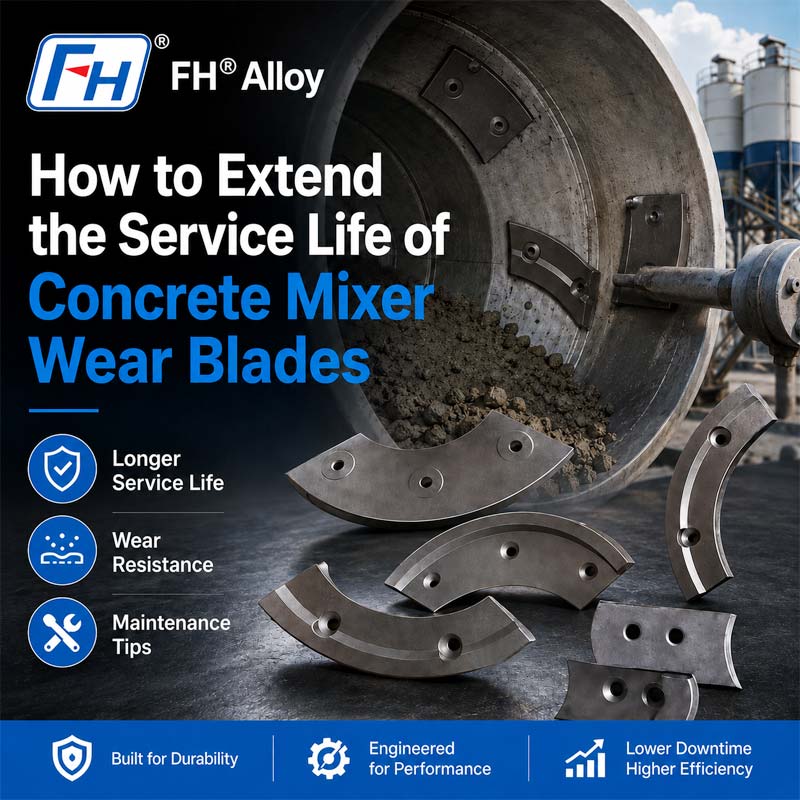
How to Extend Concrete Mixer Blade Life | Wear Reduction Tips
Concrete mixer wear blades are among the most important consumable components in concrete production equipment. During operation, blades are continuously exposed to cement, sand, gravel, and aggregates, resulting in constant abrasion and impact.
For concrete batching plants, replacing mixer blades too frequently can increase:
Choosing the right concrete mixer wear blades and applying proper maintenance practices can significantly extend service life.
This article explains the key methods used by professional concrete operators to improve blade durability and reduce replacement frequency.
1. Choose the Correct Wear Resistant Material
The first factor affecting blade lifespan is material selection.
Different working conditions require different alloy solutions.
High Chromium Alloy Mixer Blades
High chromium alloy is widely used for severe abrasion applications.
Advantages:
Recommended for:
Ni-hard Concrete Mixer Blades
Ni-hard cast iron provides a balance between wear resistance and impact toughness.
Advantages:
Recommended for:
Choosing the correct alloy material according to actual working conditions is the first step to improving service life.
2. Select the Correct Blade Design
Material alone does not determine performance.
The blade geometry also affects wear rate and mixing efficiency.
FH® Alloy manufactures different designs according to mixer requirements.
Arc Type Mixer Wear Blades
Advantages:
Curved Mixer Wear Blades
Advantages:
Block Type Mixer Wear Blades
Advantages:
Segment Type Mixer Wear Blades
Advantages:
Using the correct blade design helps distribute wear more evenly and prevents premature failure.
3. Install Mixer Blades Correctly
Incorrect installation is one of the common reasons for premature blade failure.
Installation problems may cause:
Important installation checks include:
Check Mounting Position
Ensure blades are installed according to:
Tighten Fasteners Properly
Loose bolts may cause:
Confirm Blade Alignment
Proper alignment helps:
4. Monitor Wear Condition Regularly
Regular inspection allows operators to replace blades before serious damage occurs.
Recommended inspection points:
Blade Thickness
Monitor:
Surface Condition
Check for:
Mounting Area
Inspect:
Early detection helps prevent damage to other mixer components.
5. Avoid Overloading the Mixer
Operating conditions directly affect blade wear.
Excessive loading may increase:
Recommended practices:
A properly operated mixer significantly extends component life.
6. Optimize Concrete Material Conditions
The materials being mixed have a major impact on wear.
Factors include:
Aggregate Hardness
Hard materials such as:
will accelerate blade wear.
Aggregate Size
Moisture Content
Understanding material conditions helps select the correct wear blade solution.
7. Purchase from a Professional Wear Parts Manufacturer
The supplier you choose directly affects product reliability.
A professional manufacturer provides:
Cheap low-quality blades often result in:
FH® Alloy Concrete Mixer Wear Blade Manufacturing
Wuxi Junteng Fanghu Alloy Technology Co., Ltd. (FH®) specializes in manufacturing high-performance alloy wear-resistant components.
Our production capabilities include:
Alloy Material Control
Ensuring:
Precision Casting
Providing:
Heat Treatment
Improving:
OEM Customization
FH® Alloy supports:
Applications of FH® Alloy Mixer Wear Blades
Our wear blades are used in:
Practical Checklist: How to Maximize Blade Life
Before operation:
During operation:
Before replacement:
Conclusion
Extending the service life of concrete mixer wear blades requires more than choosing a wear-resistant material.
The best results come from combining:
By selecting high-performance alloy mixer blades from FH® Alloy, concrete plants can reduce downtime, lower maintenance costs, and achieve more stable production.
About FH® Alloy
Wuxi Junteng Fanghu Alloy Technology Co., Ltd. (FH®) is a professional manufacturer specializing in:
FH® Alloy provides OEM wear-resistant solutions for global customers.
Related Articles
 CategoryRecent Post

Focus on Designing and Manufacturing Alloy Steel Parts since 2006
 Tel: 0510-83310100
  E-mail: info@alloy-casting.com
  Office Add: Room 1105,Building 6, Jiaye Wealth Center,Wuxi, Jiangsu, P.R.China P.C.:214000.
  Privacy

 English
 Español
 italiano
 Deutsch
 0086-13338774804
