
 Jul 22, 2026
 Category: Concrete Mixer Wear Parts
Author: FH® Alloy Technology
Company: Wuxi Junteng Fanghu Alloy Technology Co., Ltd.
Target Market: USA / Europe / Global B2B Buyers
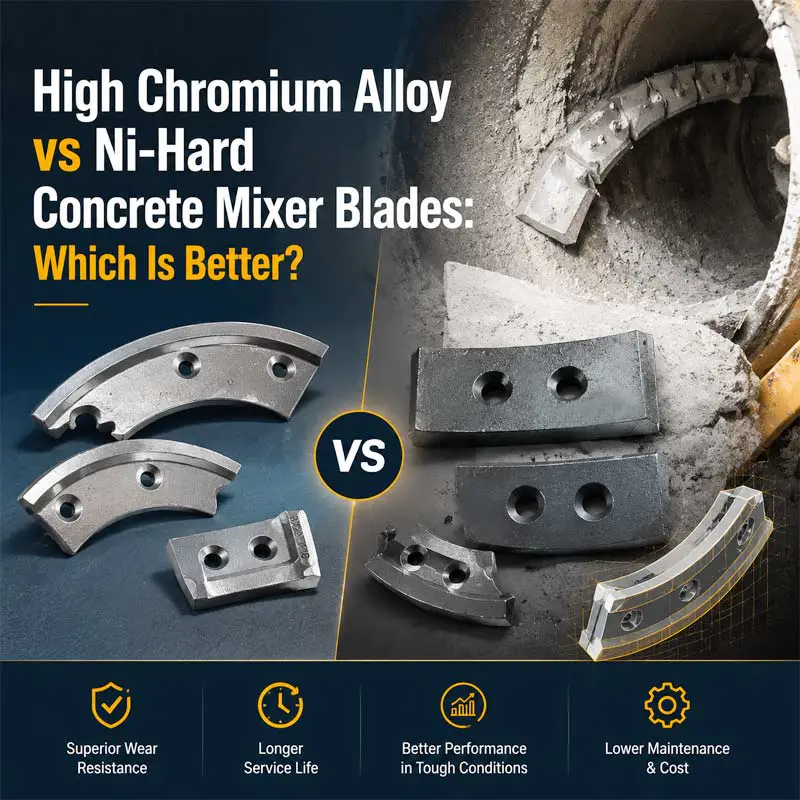
High Chromium vs Ni-Hard Concrete Mixer Blades | Wear Resistance Comparison
Concrete mixer wear blades are exposed to continuous abrasion, impact, and friction during concrete production. Selecting the right blade material is critical for reducing maintenance costs, extending equipment life, and improving production efficiency.
Among industrial wear-resistant materials, high chromium alloy and Ni-Hard cast iron are two of the most commonly used materials for concrete mixer wear blades.
But which material is better for your concrete mixing application?
The answer depends on operating conditions, aggregate characteristics, impact levels, and required service life.
This guide compares High Chromium Alloy Mixer Blades vs Ni-Hard Concrete Mixer Blades to help concrete plant operators and equipment manufacturers make the right choice.
1. Why Material Selection Matters for Concrete Mixer Blades
Inside a concrete mixer, blades experience extremely harsh conditions:
A poor material choice can result in:
For this reason, professional concrete plants usually choose alloy wear-resistant materials instead of conventional carbon steel.
2. What Are High Chromium Alloy Mixer Blades?
High chromium alloy is one of the most widely used wear-resistant materials in industrial applications.
It contains a high percentage of chromium, which forms hard chromium carbides inside the metal structure.
These carbides provide excellent resistance against abrasive wear.
Advantages of High Chromium Alloy Blades
1. Excellent Abrasion Resistance
High chromium alloy performs extremely well when exposed to:
This makes it ideal for concrete mixing environments.
2. High Surface Hardness
Typical hardness:
Higher hardness helps reduce material loss during continuous operation.
3. Long Service Life
Compared with standard steel blades, high chromium alloy blades can significantly extend replacement intervals.
Benefits include:
4. Stable Performance Under Continuous Wear
High chromium alloy is suitable for:
3. What Are Ni-Hard Concrete Mixer Blades?
Ni-Hard is a nickel-chromium alloy cast iron developed specifically for wear-resistant applications.
The addition of nickel improves toughness while chromium provides wear resistance.
Ni-Hard materials are commonly used in:
Advantages of Ni-Hard Mixer Blades
1. Good Combination of Wear Resistance and Toughness
Compared with some harder materials, Ni-Hard provides better impact resistance.
This makes it suitable for applications with:
2. Excellent Abrasion Performance
Ni-Hard blades can withstand continuous contact with abrasive materials.
Typical applications include:
3. Reliable Performance in Heavy-Duty Conditions
Ni-Hard is often selected when equipment experiences both:
4. High Chromium Alloy vs Ni-Hard Mixer Blades Comparison
| Feature | High Chromium Alloy | Ni-Hard Cast Iron |
| Wear Resistance | Excellent | Very Good |
| Hardness | Higher | High |
| Impact Resistance | Good | Excellent |
| Abrasion Resistance | Excellent | Excellent |
| Service Life | Very Long | Long |
| Heavy Impact Applications | Good | Better |
| Concrete Mixing Applications | Excellent | Excellent |
| Cost Performance | High | High |
5. Which Material Is Better for Concrete Mixer Wear Blades?
There is no single material that is perfect for every application.
The best choice depends on operating conditions.
Choose High Chromium Alloy When:
Your operation requires:
Examples:
Choose Ni-Hard When:
Your application requires:
Examples:
6. How FH® Manufactures Wear Resistant Mixer Blades
At Wuxi Junteng Fanghu Alloy Technology Co., Ltd. (FH®), we manufacture concrete mixer wear blades using advanced alloy casting technology.
Our production process includes:
Step 1: Material Selection
Selecting suitable alloy composition according to customer application.
Step 2: Precision Casting
Advanced casting technology ensures:
Step 3: Heat Treatment
Controlled heat treatment improves:
Step 4: Quality Inspection
Each batch is inspected for:
7. How to Select the Right Mixer Blade Material?
Before purchasing, consider:
1. Aggregate Type
Harder aggregates require stronger wear resistance.
2. Mixer Operating Hours
Continuous operation requires longer-life materials.
3. Impact Level
High-impact applications require better toughness.
4. Maintenance Cost
A cheaper blade may increase long-term costs due to frequent replacement.
8. FH® Recommended Solution for Global Concrete Plants
FH® provides customized solutions for:
Available materials:
We manufacture:
according to customer drawings and mixer models.
Conclusion
Both High Chromium Alloy Mixer Blades and Ni-Hard Concrete Mixer Blades provide excellent wear resistance compared with traditional steel components.
For extreme abrasion conditions, high chromium alloy is often the preferred choice due to its superior hardness and wear resistance.
For applications requiring a balance between abrasion resistance and impact toughness, Ni-Hard remains an excellent solution.
Choosing the right material helps concrete producers:
About FH®
Wuxi Junteng Fanghu Alloy Technology Co., Ltd. (FH®) is a professional manufacturer specializing in high-performance alloy wear-resistant castings.
We provide OEM concrete mixer wear blades and industrial wear parts for customers worldwide.
Contact FH® for customized alloy mixer blade solutions.
Related Articles
 CategoryRecent Post

Focus on Designing and Manufacturing Alloy Steel Parts since 2006
 Tel: 0510-83310100
  E-mail: info@alloy-casting.com
  Office Add: Room 1105,Building 6, Jiaye Wealth Center,Wuxi, Jiangsu, P.R.China P.C.:214000.
  Privacy

 English
 Español
 italiano
 Deutsch
 0086-13338774804
