
 Jul 22, 2026
 Category: Concrete Mixer Wear Parts
Author: FH® Alloy Technology
Company: Wuxi Junteng Fanghu Alloy Technology Co., Ltd.
Target Market: USA / Europe / Global B2B Buyers
Concrete Mixer Wear Blades Guide | Types, Materials & Benefits
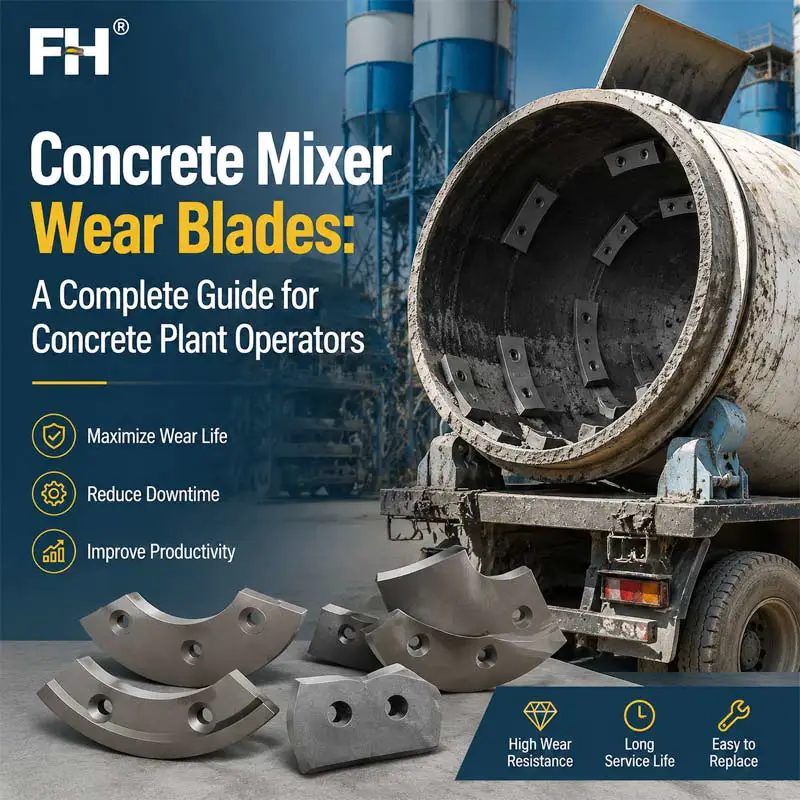
Concrete mixers operate under some of the most demanding industrial conditions. Every day, cement, sand, gravel, and other aggregates create continuous abrasion and impact inside mixing chambers. Among all mixer components, concrete mixer wear blades are one of the most important wear parts that directly influence mixing efficiency, equipment uptime, and maintenance costs.
For concrete batching plants, choosing the right wear resistant mixer blades can significantly improve production stability and reduce unexpected downtime.
As a professional alloy casting manufacturer, Wuxi Junteng Fanghu Alloy Technology Co., Ltd. (FH®) specializes in manufacturing high-performance concrete mixer wear blades using advanced alloy casting technology for global customers.
1. What Are Concrete Mixer Wear Blades?
Concrete mixer wear blades are replaceable components installed on mixing arms or shafts to move and mix concrete materials.
During operation, these blades continuously contact:
Because of constant friction and impact, standard steel components can wear quickly. Therefore, industrial mixers typically use high chromium alloy or Ni-Hard cast iron wear blades to achieve longer service life.
The main functions of mixer wear blades include:
2. Why Do Concrete Mixer Wear Blades Wear Out?
Concrete mixing creates one of the harshest environments for mechanical components.
The main causes of blade wear include:
2.1 Aggregate Abrasion
Sand and stone particles continuously slide against the blade surface, causing gradual material loss.
The larger and harder the aggregate, the faster the wear rate.
2.2 Impact Damage
During high-speed mixing, large stones can hit the blade surface repeatedly.
Poor-quality materials may experience:
2.3 Continuous Operation
Large concrete plants often operate for many hours every day.
Long operating cycles accelerate:
3. Common Types of Concrete Mixer Wear Blades
Different mixers require different blade designs. FH® manufactures various shapes according to equipment models and customer drawings.
3.1 Arc Type Concrete Mixer Wear Blades
Arc-shaped blades are widely used in industrial concrete mixers.
Advantages:
Suitable for:
3.2 Curved Concrete Mixer Blades
Curved blades are designed for optimized material flow.
Benefits:
3.3 Block Type Mixer Wear Blades
Block-type blades feature a stronger structure for heavy-duty applications.
Advantages:
3.4 Segment Type Mixer Wear Blades
Segment designs allow easier replacement and maintenance.
Benefits:
4. Best Materials for Concrete Mixer Wear Blades
Material selection is one of the most important factors affecting blade performance.
The most common wear-resistant materials include:
High Chromium Alloy
High chromium alloy is widely used for severe abrasion environments.
Advantages:
Typical applications:
Ni-Hard Cast Iron
Ni-Hard is a nickel-chromium alloy cast iron designed for wear applications.
Advantages:
5. How to Choose the Right Concrete Mixer Wear Blades?
When selecting mixer blades, buyers should consider:
5.1 Mixer Type
Different equipment requires different blade designs:
Always confirm the correct dimensions before ordering.
5.2 Working Conditions
Consider:
Heavy-duty plants require higher wear-resistant materials.
5.3 Material Quality
Low-cost blades may reduce initial investment but often lead to:
High-quality alloy blades provide better long-term value.
5.4 OEM Manufacturing Capability
A reliable supplier should provide:
6. Benefits of Using High-Quality Mixer Wear Blades
Choosing premium wear-resistant blades helps concrete producers achieve:
Longer Service Life
High chromium alloy materials reduce wear speed and extend replacement cycles.
Lower Maintenance Costs
Longer-lasting blades mean:
Improved Mixing Performance
Proper blade geometry ensures:
7. FH® Concrete Mixer Wear Blades Manufacturing Capability
Wuxi Junteng Fanghu Alloy Technology Co., Ltd. (FH®) is a professional manufacturer specializing in alloy wear-resistant castings.
Our concrete mixer wear blades feature:
We manufacture various designs including:
for customers worldwide.
8. Why Choose FH® as Your Mixer Blade Supplier?
For global concrete equipment manufacturers and batching plants, FH® provides:
Factory Direct Supply
Direct manufacturer with competitive pricing.
OEM Customization
Production based on drawings, samples, or equipment models.
Stable Quality
Strict control of:
Global Export Experience
Supporting customers across:
Conclusion
Concrete mixer wear blades are critical components that directly affect mixer performance and operating costs. Selecting the right blade design and wear-resistant material can significantly improve equipment reliability and reduce maintenance expenses.
With advanced alloy casting technology and OEM manufacturing capability, FH® provides durable concrete mixer wear blades for demanding industrial applications worldwide.
Related Products
Contact FH® Today
Looking for reliable concrete mixer wear blades manufacturer?
Wuxi Junteng Fanghu Alloy Technology Co., Ltd. (FH®) provides OEM wear-resistant alloy casting solutions for global customers.
Send your drawings or requirements for a professional quotation.
 CategoryRecent Post

Focus on Designing and Manufacturing Alloy Steel Parts since 2006
 Tel: 0510-83310100
  E-mail: info@alloy-casting.com
  Office Add: Room 1105,Building 6, Jiaye Wealth Center,Wuxi, Jiangsu, P.R.China P.C.:214000.
  Privacy

 English
 Español
 italiano
 Deutsch
 0086-13338774804
