
 Nov 24, 2026
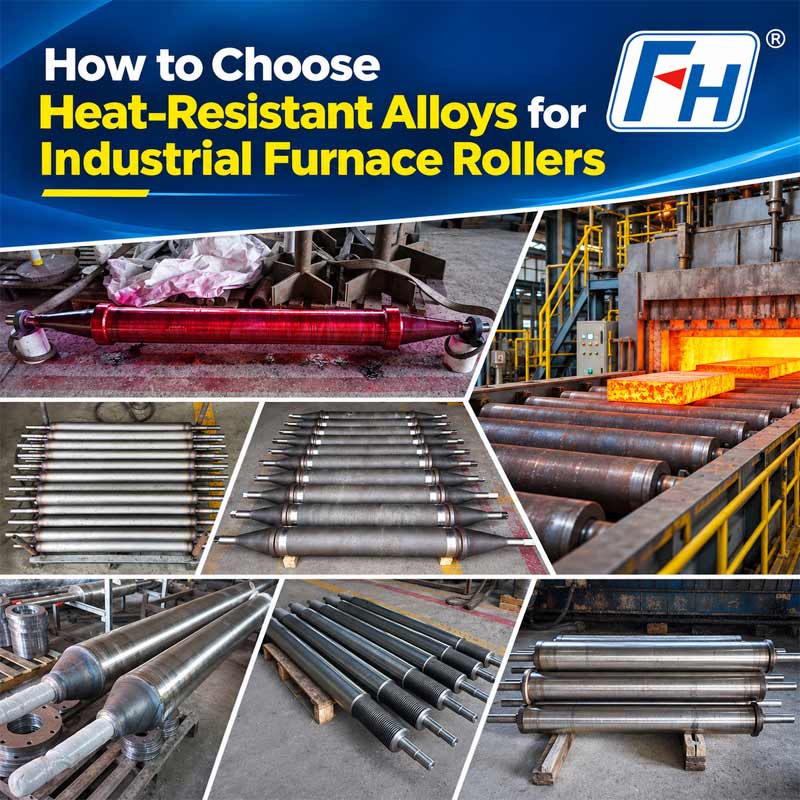
Material selection plays a critical role in the performance and service life of industrial furnace rollers.
Unlike conventional mechanical components, furnace rollers operate under elevated temperatures and may experience oxidation, thermal cycling, creep deformation, and mechanical stress.
Choosing a suitable heat-resistant alloy requires more than comparing nominal temperature ratings.
The material must be compatible with the actual furnace environment and the mechanical requirements of the roller.
1. What Are Heat-Resistant Alloys?
Heat-resistant alloys are metallic materials developed to maintain useful mechanical and surface properties under elevated-temperature conditions.
They are commonly used in:
Many furnace components are manufactured from chromium-nickel heat-resistant cast alloys.
These alloys are selected according to their oxidation resistance, high-temperature strength, and compatibility with the working environment.
2. Why Are Chromium and Nickel Important?
Chromium and nickel are important alloying elements in many heat-resistant stainless and cast alloys.
Chromium
Chromium contributes to oxidation resistance by helping form protective chromium-rich oxide scales under suitable conditions.
However, scale stability depends on temperature, atmosphere, alloy composition, and thermal cycling.
Nickel
Nickel contributes to austenitic matrix stability and influences high-temperature mechanical and corrosion-related behavior.
The appropriate nickel content depends on the required alloy properties and operating conditions.
Silicon
Silicon may contribute to oxidation resistance and is used in various heat-resistant cast alloy compositions.
Niobium
Niobium is used in certain heat-resistant cast alloys to modify carbide precipitation and high-temperature mechanical behavior.
Its effect depends on the overall alloy composition and microstructure.
3. Common Heat-Resistant Alloy Grades
Several alloy grades are commonly considered for industrial furnace components.
1.4848
A chromium-nickel-silicon heat-resistant cast alloy, generally associated with approximately 25% chromium and 20% nickel.
It is used in various high-temperature furnace components, subject to application requirements.
1.4849
A niobium-containing, high-nickel heat-resistant cast alloy. Its composition differs significantly from 1.4848.
1.4852
A niobium-containing, higher-chromium and high-nickel heat-resistant cast alloy.
2.4879
A nickel-based chromium-tungsten heat-resistant alloy used in demanding high-temperature applications.
The exact chemical composition and performance should always be confirmed against the specified standard and manufacturer's material documentation.
4. Important Properties to Evaluate
When selecting a furnace roller alloy, consider the following properties.
High-Temperature Strength
The alloy must maintain sufficient mechanical strength under operating temperature and load.
Creep Resistance
Creep resistance is particularly important when rollers operate under sustained stress at elevated temperatures.
Oxidation Resistance
The material should provide suitable resistance to oxidation under the actual furnace atmosphere.
Thermal Fatigue Resistance
Repeated heating and cooling can produce cyclic stresses. Material selection and component geometry should account for these conditions.
Atmosphere Compatibility
Carburizing, nitriding, sulfur-containing, and other furnace atmospheres can affect alloy performance differently.
5. Why Temperature Rating Alone Is Not Enough
A published maximum operating temperature should not be treated as a guaranteed service temperature for every application.
Actual performance depends on:
For example, a roller carrying a high mechanical load may require a different material and design approach from a lightly loaded furnace component operating at a similar temperature.
6. How to Select the Right Material
A practical selection process should include:
Material selection should be treated as an engineering decision rather than a simple grade substitution.
7. FH® Heat-Resistant Alloy Manufacturing
FH® focuses on heat-resistant alloy castings and industrial furnace components.
Our material control process includes chemical composition verification of incoming raw material samples before the materials proceed to subsequent production stages.
For custom furnace roller projects, alloy selection and manufacturing requirements should be evaluated together to meet the customer's application needs.
Explore FH® Furnace Rollers for more information.
Frequently Asked Questions
Which alloy is best for furnace rollers?
There is no universally best alloy. The correct choice depends on temperature, atmosphere, loading, geometry, and required service life.
Is 1.4852 suitable for furnace rollers?
1.4852 is one of the heat-resistant cast alloy grades considered for demanding high-temperature furnace applications. Suitability must be confirmed through engineering evaluation.
Does higher nickel content always mean better performance?
No. Alloy performance depends on the complete chemical composition, microstructure, atmosphere, and operating conditions.
Why is chemical composition testing important?
It helps verify that the supplied material meets the specified alloy requirements and supports consistent manufacturing quality.
Discuss Your Furnace Roller Material Requirements
Contact FH® with your furnace temperature, atmosphere, load, and technical drawings.
We can discuss suitable heat-resistant alloy options for your industrial furnace roller project.
 CategoryRecent Post
 Mon 11, 2026

Focus on Designing and Manufacturing Alloy Steel Parts since 2006
 Tel: 0510-83310100
 E-mail: info@alloy-casting.com
 Office Add: Room 1105,Building 6, Jiaye Wealth Center,Wuxi, Jiangsu, P.R.China P.C.:214000.
 Privacy

 English
 Español
 italiano
 Deutsch
 0086-13338774804
