
 Aug 07, 2026
 Content
When a buyer or design engineer asks for the stainless steel melting point, they often expect a single number they can plug into a material specification. The reality is more useful than that. For example, 304 stainless steel melts between 1400°C and 1450°C, while 316L spans roughly 1375°C to 1400°C. Those numbers sit far above the typical operating range of a heat treatment furnace, which usually runs between 850°C and 1100°C. Yet baskets, trays, and rollers still deform, crack, and fail in service. Understanding the stainless steel melting point matters, but knowing why it is not the limiting factor for furnace components is what actually prevents costly downtime.
This guide explains the melting ranges for common wrought grades, the metallurgical reasons behind those ranges, and—most importantly—why creep strength and oxidation resistance, not melting point, dictate the real service limits of heat-resistant cast alloys used in industrial furnaces.
Stainless steel does not have a single melting point like pure iron or pure nickel. It has a melting range defined by two temperatures: the solidus, where the alloy begins to melt, and the liquidus, where it is fully molten. Between these two points, the material exists as a semi-solid mixture of solid crystals and liquid phases.
The reason for this range lies in the alloy itself. Stainless steel contains iron, chromium, nickel, molybdenum, carbon, and other elements in proportions that vary within production tolerances. Even small shifts in composition—say, a 0.5% change in nickel content—move the solidus and liquidus temperatures. This is why published values for the same grade differ by 25°C to 50°C across industry references.
To put it in context, pure iron melts at 1538°C, chromium at 1890°C, and nickel at 1453°C. Adding these elements to iron does not simply average their melting points; it creates new phase equilibria that generally widen the melting interval and, in most stainless grades, push the solidus below that of pure iron.
The table below summarizes the melting ranges for widely used wrought stainless steel grades, compiled from consensus data across multiple industry references. Use these as design guidelines rather than absolute acceptance criteria.
| Grade (AISI) | EN Equivalent | Melting Range (°C) | Typical Maximum Continuous Service Temperature (°C) |
|---|---|---|---|
| 304 | 1.4301 | 1400–1450 | ~870 |
| 316 | 1.4401 | 1375–1400 | ~870 |
| 321 | 1.4541 | 1400–1425 | ~870 |
| 430 | 1.4016 | 1425–1510 | ~815 |
| 410 | 1.4006 | 1480–1530 | ~705 |
Notice that the spread between grades is less than 200°C. That is a relatively narrow band compared to the differences in their high-temperature performance. 316 has a slightly lower melting range than 304 because molybdenum, added for pitting corrosion resistance, also depresses the solidus. 321 includes titanium for creep resistance at elevated temperatures, yet its melting range stays close to 304's. The real differentiator between these grades is not where they melt—it is how quickly they lose strength and oxidize below their melting point.
Each alloying element in stainless steel shifts the melting range in a specific direction. For furnace component selection, the practical takeaway is how these shifts correlate with high-temperature capability.
Chromium is the defining element of stainless steel, present at a minimum of 10.5%. It raises the alloy's resistance to oxidation and scaling at high temperatures. In terms of melting behavior, chromium tends to raise the upper end of the melting range. Higher chromium grades like 430 (17% Cr) show a higher solidus than 304 (18% Cr, 8% Ni) because nickel's effect counterbalances chromium's.
Nickel stabilizes the austenitic structure, which gives grades like 304 and 316 their excellent toughness and weldability. However, nickel depresses the melting point. This is why austenitic grades consistently have lower melting ranges than ferritic or martensitic grades. The trade-off is worth it: nickel substantially improves high-temperature creep strength and ductility, which are far more relevant than melting point for furnace parts.
Molybdenum enhances pitting and crevice corrosion resistance. It also lowers the solidus temperature, which explains why 316 melts about 25°C to 50°C lower than 304. For high-temperature service, molybdenum's contribution is less important than its corrosion benefits, so its presence should not be a deciding factor for furnace component selection.
Carbon forms chromium carbides at grain boundaries when heated in the sensitization range (roughly 425°C to 870°C), which can harm corrosion resistance. In cast heat-resistant alloys, however, carbon content is deliberately kept higher (0.3% to 0.6%) because it significantly improves high-temperature creep strength. The effect on melting range is minor, but the effect on service life is substantial.
The broader lesson is that alloying elements widen the melting interval—the gap between solidus and liquidus grows as more elements are added. This matters in casting: a wider freezing range makes the alloy more prone to shrinkage porosity, which is why centrifugal casting is preferred for furnace rollers and other cylindrical components where soundness is critical.
A 304 stainless steel basket has a melting point around 1450°C, and a typical hardening furnace runs at 950°C. So why do baskets sag, crack, and eventually need replacement? Because metals lose mechanical strength long before they melt.
Creep is the time-dependent plastic deformation that occurs when a metal is subjected to stress at high temperature—even stress far below its room-temperature yield strength. A furnace tray loaded with 200 kg of gears at 1000°C will slowly stretch and bow over hundreds or thousands of hours. The rate of creep accelerates exponentially as temperature rises. This is why heat treatment baskets for furnace loading are designed with ribbing and support structures: the material must hold its shape under sustained load, not just resist melting.
Design engineers use creep-rupture strength, typically defined as the stress that causes failure after 10,000 or 100,000 hours at a given temperature. For 304 stainless steel, the 10,000-hour creep-rupture strength at 870°C is only a fraction of its room-temperature tensile strength. At 1050°C, that value drops so low that 304 is no longer a viable structural material. This is why the recommended maximum continuous service temperature for 304 is approximately 870°C—not because it melts at 1450°C, but because its creep strength becomes inadequate above that level.
Even without mechanical load, high temperature attacks the surface. Chromium oxide forms a protective scale, but above its effective range the scale spalls off and re-forms, gradually consuming the material cross-section. This reduces load-bearing capacity over time. For thin-walled radiant tubes and fan blades, oxidation can be the life-limiting factor before creep becomes critical.
Furnace baskets and trays cycle between hot and cold zones. Repeated expansion and contraction generate internal stresses, leading to thermal fatigue cracking. The severity depends on the temperature difference, the heating/cooling rate, and the alloy's thermal expansion coefficient. Cast alloys with higher carbon content and coarser microstructures generally handle thermal cycling better than fine-grained wrought products.
In short, a material's working temperature is set by its creep strength, oxidation limit, and thermal fatigue resistance—all of which plateau well below its melting point. For most heat-resistant alloys, the practical service ceiling sits at roughly 70% to 80% of the melting temperature in Kelvin.
Industrial furnace components are rarely made from wrought stainless steel plate or bar. Instead, they are cast from heat-resistant alloys specifically formulated for high-temperature service. These alloys have higher carbon content, a fully cast microstructure, and are designed to maintain strength at temperatures where standard austenitic grades lose all load-bearing capacity.
At FH® (Wuxi Juntenghu Alloy Casting Co., Ltd., established 2006), we produce furnace rollers, baskets, trays, radiant tubes, and fan blades from these cast alloys. The table below lists the grades most commonly specified for furnace internals, along with their approximate melting ranges and recommended maximum service temperatures.
| EN Grade | US Equivalent (ACI/AISI) | Approximate Melting Range (°C) | Recommended Max Working Temperature (°C) |
|---|---|---|---|
| 1.4837 | HH | 1350–1400 | ~1050 |
| 1.4848 | 310S (cast) | 1400–1450 | ~1100 |
| 1.4852 | HK | 1350–1400 | ~1100 |
| 1.4865 | HT | 1350–1400 | ~1150 |
| 2.4879 | Nickel-base (cast) | 1350–1400 | ~1200 |
Note the gap between melting range and working temperature: it spans 300°C to 400°C for every grade. This is not a safety margin—it is the operating reality dictated by creep and oxidation. Selecting a material by its melting point alone guarantees premature failure.
Grade 1.4848 is the workhorse for furnace components operating up to about 1100°C. It combines good oxidation resistance with adequate creep strength, and it is routinely used for 1.4848 heat-resistant cast steel furnace rollers in roller hearth furnaces. For higher temperatures, 1.4865 (HT grade) provides additional nickel for better resistance to carburizing atmospheres and thermal fatigue, while 2.4879—a nickel-base alloy—is specified where temperature and corrosion demands exceed what iron-base alloys can deliver.
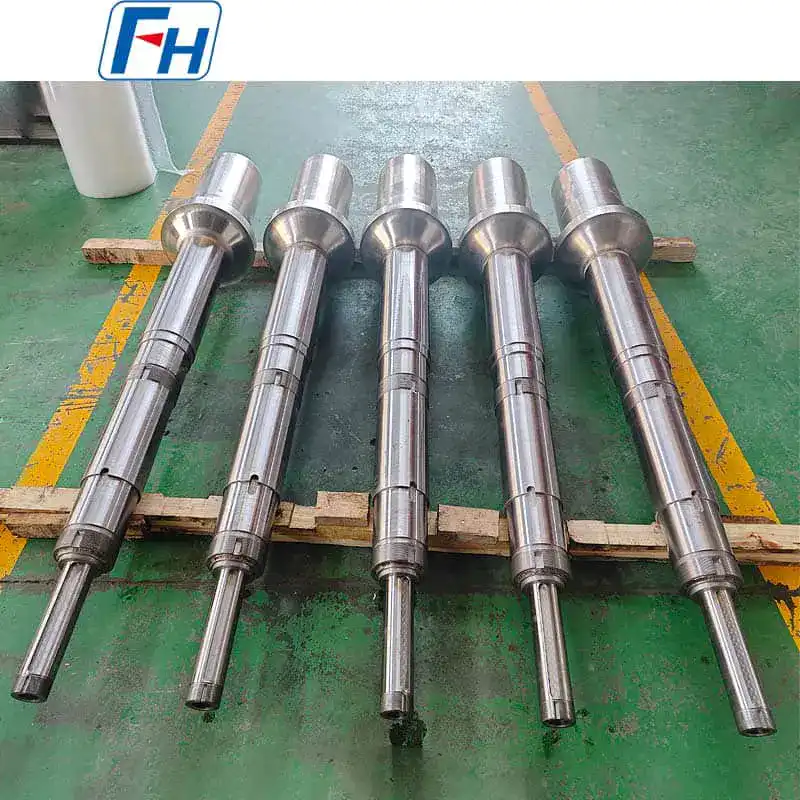
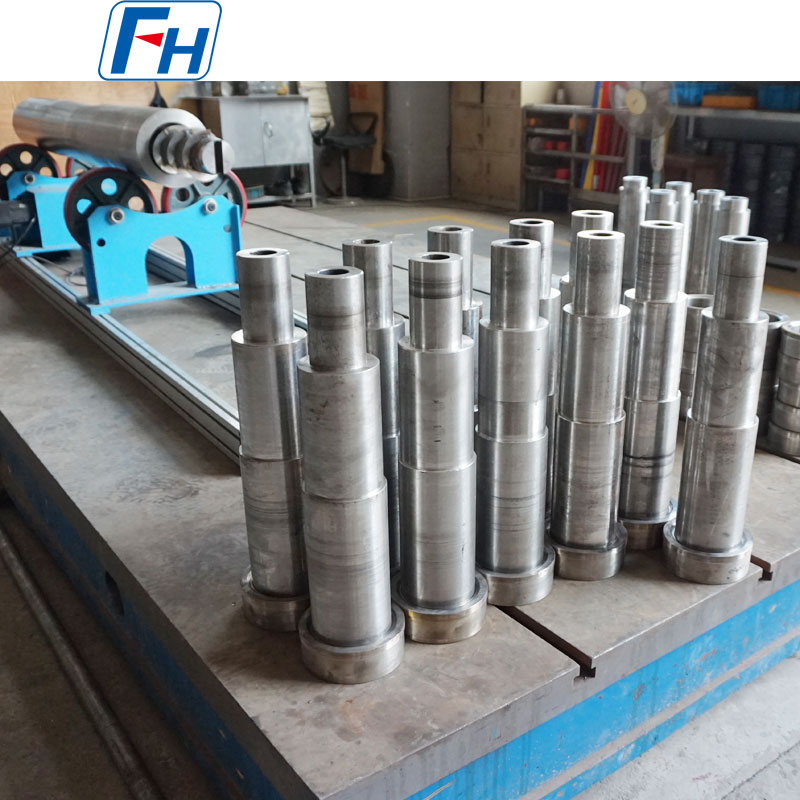 1.4848 Heat Resistant Cast Steel Furnace Rollers Suppliers, Wholesale Factory - Junteng Fanghu Alloy Technology is a China OEM 1.4848 Heat Resistant Cast Steel Furnace Rollers suppliers and wholesale factory, Brand: F...View Product →
The casting process itself matters. Centrifugal casting, used for furnace rolls, produces a dense, directionally solidified structure with no centerline shrinkage. This is essential for components that must maintain roundness and dimensional stability under continuous rotation at temperature. For a deeper look at how centrifugal casting improves material soundness, see our main functions of furnace fan blades article, which explains a similar logic applied to high-speed rotating components.
Other furnace internals that benefit from these cast alloys include U-type radiant tubes for heat treatment furnaces, which must resist both external oxidation and internal carburization while transmitting heat efficiently.
When you specify a material for a furnace basket, tray, roller, or radiant tube, melting point should be treated as a screening criterion—not a selection criterion. Follow this decision framework instead.
As a general rule, the maximum service temperature should not exceed 70% to 80% of the melting temperature (in Kelvin). For a 1.4848 roller with a melting range of 1400–1450°C, this translates to roughly 900–1100°C, which aligns with the recommended working temperature. If your furnace runs at 1150°C, you are beyond what 1.4848 can reliably sustain, and you should consider 1.4865 or a nickel-base alloy.
| Furnace Type | Typical Temperature Range (°C) | Recommended Alloy | Notes |
|---|---|---|---|
| Nitriding furnace | 500–650 | 1.4823 (HD) | Low temperature; nitriding resistance is key |
| Vacuum furnace | 900–1100 | 1.4848 or 1.4852 | Low atmosphere; oxidation not a concern, creep is |
| Pit furnace | 850–1050 | 1.4837 or 1.4848 | Good all-round performance; cost-effective |
| Continuous furnace | 950–1100 | 1.4848 or 1.4852 | Long dwell times; creep strength critical |
| Roller hearth furnace | 1000–1150 | 1.4848, 1.4865 | Rollers require high creep-rupture strength |
| Carburizing atmosphere | 900–1050 | 1.4865 or 2.4879 | High nickel resists carbon pickup |
For roller hearth furnaces running above 1050°C, we manufacture custom furnace rollers for international markets using centrifugally cast 1.4848 and 1.4865, sized and machined to your drawing specifications.
Carburizing atmospheres attack iron-base alloys by diffusing carbon into the surface, causing carbides to precipitate and embrittle the material. Higher nickel content (as in 1.4865 or 2.4879) provides better resistance. Water-cooled roll ends or trunnions reduce the effective temperature at the bearing journal, allowing a lighter alloy to be used than would be required for an uncooled design.
Finally, do not rely on published working temperature tables as hard limits. They assume minimal load, oxidizing atmosphere, and a specific design life. Your actual duty cycle—load mass, heating rate, and number of thermal cycles per day—will shift the safe operating envelope. The best approach is to consult with an engineer who can review your furnace parameters and recommend a grade matched to your specific conditions.
Three points matter when you look up the stainless steel melting point for a furnace component project:
If you are designing a new basket, replacing a failed roller, or upgrading a radiant tube system, sharing your furnace parameters with a material specialist will save you from expensive trial-and-error. Contact our engineering team with your temperature profile, atmosphere, and component drawings for a material recommendation grounded in actual furnace experience.
 CategoryRecent Post

Focus on Designing and Manufacturing Alloy Steel Parts since 2006
 Tel: 0510-83310100
  E-mail: info@alloy-casting.com
  Office Add: Room 1105,Building 6, Jiaye Wealth Center,Wuxi, Jiangsu, P.R.China P.C.:214000.
  Privacy

 English
 Español
 italiano
 Deutsch
 0086-13338774804
