
 Sep 04, 2026
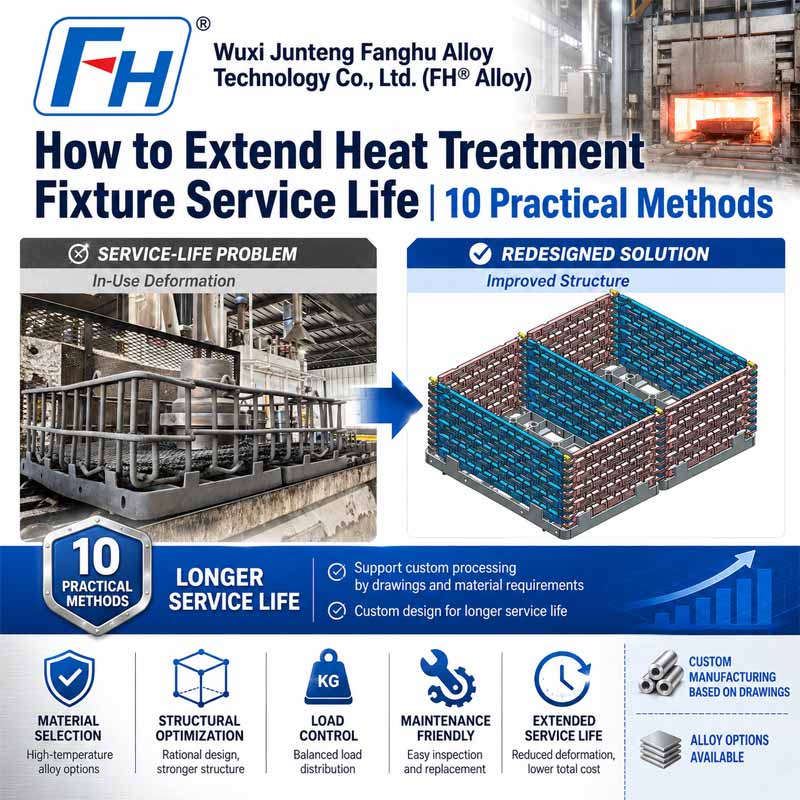
 Heat treatment fixtures operate in one of the most demanding environments for metallic structures.
During every production cycle, furnace baskets, trays, racks, grids, and support fixtures may experience:
Over time, these conditions can cause:
For industrial heat treatment operations, frequent fixture replacement increases not only purchasing costs but also production downtime and handling requirements.
Extending heat treatment fixture service life therefore requires more than simply selecting a higher alloy grade.
The most effective approach is to consider the complete system:
Material + Fixture Design + Load + Furnace Conditions + Operation + Inspection
This guide explains 10 practical methods that can help improve the reliability and operating life of heat treatment fixtures.
FH® Alloy manufactures customized heat treatment fixtures according to customer drawings, furnace conditions, loading requirements, and actual service environments.
Why Do Heat Treatment Fixtures Have a Limited Service Life?
No heat treatment fixture can operate indefinitely.
At elevated temperatures, metallic materials gradually experience physical and mechanical changes.
Several mechanisms can contribute to fixture deterioration.
High-Temperature Creep
When a fixture carries a load for extended periods at elevated temperature, the material may gradually deform.
This can lead to:
Thermal Fatigue
Repeated heating and cooling causes the fixture to expand and contract.
After many cycles, accumulated thermal stress can contribute to:
Oxidation and Atmosphere Attack
Depending on furnace conditions, fixture surfaces may experience:
Mechanical Damage
Fixtures are also exposed to mechanical loads outside the furnace.
Improper:
can shorten service life before thermal damage becomes the main problem.
For this reason, fixture life should be evaluated as a complete operating-cycle issue.
1. Select the Material According to Actual Furnace Conditions
Material selection is one of the first factors affecting fixture life.
However, choosing a material only according to its nominal maximum temperature is not enough.
The manufacturer should understand:
Common heat-resistant materials for furnace fixtures may include:
The best material is not necessarily the most expensive alloy.
It is the material that provides suitable performance under the customer's actual operating conditions.
2. Optimize the Fixture Structure Instead of Simply Adding More Material
When a fixture deforms, one common response is to make the next fixture thicker and heavier.
This may improve stiffness in some applications, but excessive material can also create disadvantages.
A heavier fixture:
A better approach is to improve structural efficiency.
Possible methods include:
The goal should be:
Maximum practical structural stability with reasonable fixture weight.
3. Control the Actual Loading Weight
A well-designed fixture can still fail early if it is continuously overloaded.
Production teams sometimes increase batch loading to improve furnace productivity.
However, this may significantly increase stress on the fixture at high temperature.
Important parameters should therefore be clearly defined:
For example, a fixture designed for evenly distributed loading should not be repeatedly used with most of the workpiece weight concentrated in the center.
High-temperature creep can accelerate considerably in heavily loaded areas.
4. Improve Load Distribution
Total load is important, but where the load is applied can be equally important.
Consider two trays carrying the same total weight.
Tray A
The parts are evenly distributed.
Tray B
Most parts are concentrated around the center.
Even though the total weight is identical, Tray B may experience much greater local stress and sagging.
A good loading arrangement should match the fixture's structural support system.
Possible improvements include:
Proper load distribution can often improve fixture life without changing the material.
5. Allow for Thermal Expansion
Heat treatment fixtures expand when heated and contract during cooling.
If the structure does not allow this movement, internal stresses can develop.
Over many cycles, this may lead to:
Design features may include:
The objective is not to make the fixture loose.
The goal is to avoid unnecessary constraints while maintaining correct workpiece positioning.
Thermal expansion management becomes particularly important for:
6. Pay Attention to Welded Areas
For fabricated heat treatment fixtures, welded joints can be critical locations.
Repeated thermal cycling combined with mechanical loading may eventually cause:
Improving welded fixture life requires attention to both manufacturing and design.
Important factors include:
Where practical, high-stress areas should not depend entirely on poorly positioned weld joints.
A high-quality weld cannot compensate for an incorrect load path, so welding and structural design must be considered together.
7. Balance Open Area, Strength, and Fixture Weight
Many heat treatment baskets and trays use open-grid structures.
Open structures can provide important benefits:
But excessive open area may weaken the structure.
For example, increasing grid openings may reduce weight but also increase:
The correct design balances three factors:
Heat transfer + Structural strength + Fixture mass
This balance should be based on the actual workpiece rather than a generic grid pattern.
8. Use the Correct Handling and Lifting Method
Fixture life can be shortened outside the furnace as well.
A heavy loaded fixture may be damaged by incorrect:
For example, lifting a long fixture from unsuitable points may cause permanent bending.
A fixture should therefore include handling features appropriate for the production process.
These may include:
Operators should also use the designed lifting locations rather than choosing convenient but structurally weak points.
9. Inspect Fixtures Before Severe Damage Develops
Regular inspection can identify gradual deterioration before complete fixture failure.
Operators should monitor:
A simple inspection record can be useful for comparing fixture condition after a defined number of cycles.
Early Warning Signs
Common warning signs include:
If these problems are identified early, it may be possible to modify loading practices or replace the fixture before an unexpected production interruption occurs.
10. Analyze Failed Fixtures Before Ordering Replacements
This is one of the most useful but frequently overlooked methods.
When an existing fixture fails prematurely, do not immediately order an identical replacement.
First determine:
Why did the previous fixture fail?
Review:
For example:
Failure Pattern: Center Sagging
Possible causes:
Failure Pattern: Corner Cracking
Possible causes:
Failure Pattern: Stack Misalignment
Possible causes:
Understanding the failure mode makes it possible to improve the next fixture rather than simply reproduce the original weakness.
Material Upgrade vs Design Improvement: Which Is More Effective?
Customers often ask whether they should upgrade the material or redesign the fixture.
The answer depends on the actual problem.
| Existing Problem | Possible Improvement Direction |
| General high-temperature sagging | Material + structural review |
| Center of tray deforms | Load distribution + support design |
| Weld cracking | Joint design + welding process |
| Stacking points deform | Contact area + load path |
| Severe oxidation | Material + furnace atmosphere |
| Fixture is too heavy | Structural optimization |
| Repeated thermal distortion | Expansion allowance + material |
| Short life despite good material | Review design and operation |
The best result is usually achieved by considering multiple factors together.
Is a More Expensive Fixture Always More Economical?
Not necessarily.
The correct comparison is not only:
Purchase price per fixture
For industrial users, a more useful metric is:
Fixture cost per production cycle
For example, Fixture A may have a lower purchase price but require frequent replacement.
Fixture B may cost more initially but provide longer service under the same operating conditions.
Important cost factors include:
This is why lifecycle cost is often more meaningful than comparing initial prices alone.
Heat Treatment Fixture Service Life Checklist
When reviewing fixture life, check the following areas.
Material
Loading
Manufacturing
Operation
Fixture Life Considerations for Different Furnace Types
Fixture service life is also influenced by furnace type.
Vacuum Furnace Fixtures
Important factors include:
Pit Furnace Fixtures
Key considerations include:
Roller Hearth Furnace Fixtures
Important factors include:
Carburizing Furnace Fixtures
Fixture selection should consider both:
A material performing well in another furnace environment may not necessarily provide the same service life under carburizing conditions.
When Should a Heat Treatment Fixture Be Repaired?
Minor fixture problems do not always require immediate replacement.
Depending on the design and condition, some structures may be repairable.
Potential repair situations include:
However, repair should be evaluated carefully when there is:
Repeatedly repairing a fixture that has reached the end of its high-temperature structural life may not be economical or reliable.
What Information Should You Record When a Fixture Fails?
Failure records are extremely valuable for improving future fixture designs.
Recommended information includes:
| Information | What to Record |
| Material | Existing grade |
| Fixture size | Length × Width × Height |
| Fixture weight | If available |
| Operating temperature | Normal and maximum |
| Furnace type | Vacuum, pit, roller hearth, etc. |
| Atmosphere | Air, carburizing, vacuum, protective gas |
| Workpiece | Product type and geometry |
| Loading weight | Total kg per fixture |
| Operating cycle | Heating / holding / cooling |
| Service life | Number of cycles or months |
| Failure location | Photos and measurements |
Photos should ideally show:
This information makes technical evaluation much more effective.
How FH® Alloy Supports Longer Fixture Service Life
FH® Alloy manufactures customized heat treatment fixtures for industrial furnace applications.
Products include:
For new projects, fixtures can be manufactured according to:
For replacement projects, customers can also provide:
This information can be used to evaluate whether the existing material, structure, or loading method should be reviewed before producing the replacement fixture.
FAQ
Q1: How long should a heat treatment fixture last?
There is no fixed service life for every fixture. Lifespan depends on temperature, furnace atmosphere, material, load, thermal cycles, structure, and handling conditions.
Q2: What is the best way to extend furnace basket life?
Start by controlling loading, selecting suitable materials, optimizing support spacing, allowing thermal expansion, and regularly inspecting the basket for progressive deformation.
Q3: Will using a higher-grade alloy always extend fixture life?
Not necessarily. A higher-performance material may help, but poor structural design, overloading, or restricted thermal expansion can still cause premature failure.
Q4: Why does my fixture deform after repeated furnace cycles?
Common causes include high-temperature creep, thermal fatigue, concentrated loads, long unsupported spans, and unsuitable material selection.
Q5: Should an old fixture drawing be copied exactly when ordering a replacement?
Not always. If the existing fixture has deformation or cracking problems, the failure mode should be reviewed before producing an identical replacement.
Q5: How can I compare two fixture designs economically?
Compare not only initial price but also expected cycles, maintenance, replacement frequency, production downtime, and usable furnace payload.
Conclusion
Extending the service life of heat treatment fixtures requires a systematic approach.
The most effective methods include:
The key principle is simple:
Long fixture life comes from matching material, structure, load, furnace conditions, and operating practice—not from material grade alone.
FH® Alloy provides customized heat treatment fixtures for industrial furnaces based on customer drawings and actual production requirements.
For new or replacement projects, customers can provide the fixture drawing, dimensions, furnace type, operating temperature, atmosphere, workpiece information, loading weight, existing service life, and failure photos for technical evaluation.
 CategoryRecent Post

Focus on Designing and Manufacturing Alloy Steel Parts since 2006
 Tel: 0510-83310100
  E-mail: info@alloy-casting.com
  Office Add: Room 1105,Building 6, Jiaye Wealth Center,Wuxi, Jiangsu, P.R.China P.C.:214000.
  Privacy

 English
 Español
 italiano
 Deutsch
 0086-13338774804
