
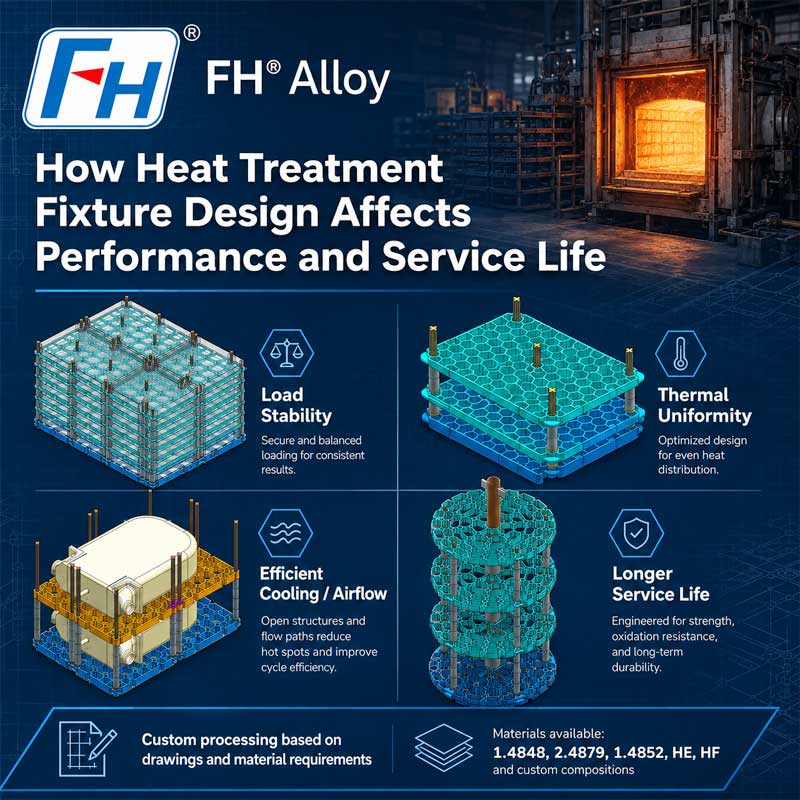
 Sep 01, 2026
 Choosing the correct material is important when manufacturing heat treatment fixtures, but material grade alone does not determine how long a fixture will last.
Two fixtures made from the same alloy can perform very differently if their:
are different.
At elevated temperatures, furnace fixtures must carry mechanical loads while repeatedly expanding, contracting, heating, and cooling.
For this reason, good heat treatment fixture design should balance structural strength, high-temperature stability, furnace efficiency, handling requirements, and service life.
FH® Alloy manufactures customized heat treatment baskets, trays, racks, and furnace fixtures according to customer drawings and actual furnace operating conditions.
Why Fixture Design Matters at High Temperature
At room temperature, a fixture may appear rigid and mechanically strong.
Inside an industrial furnace, however, the situation changes.
High temperatures can reduce material strength and increase the risk of:
A design that performs well during the first few furnace cycles may gradually lose its shape after repeated use.
This is why engineers should evaluate fixture performance under actual operating temperature rather than only under room-temperature loading conditions.
1. Load Distribution Is the Foundation of Fixture Design
One of the most important design considerations is how the workpiece load is transferred through the fixture.
Poor load distribution may create concentrated stress in only a few areas.
Typical consequences include:
A better design distributes the total load across multiple structural members.
For example, instead of allowing a heavy component to rest on a single narrow beam, the fixture may use several reinforced supports to spread the load more evenly.
Designers should consider:
Correct load distribution can significantly reduce long-term high-temperature deformation.
2. Support Point Position Can Affect Workpiece Deformation
Fixture design does not only affect the fixture itself.
It can also influence the dimensional stability of the workpiece.
If support points are incorrectly positioned, a component may deform during heating because its own weight is not properly supported.
For precision components, the support arrangement should consider:
Adding more support points is not always better.
Too many rigid contact points may restrict thermal expansion and create additional stress.
The objective is to provide stable but controlled support.
3. Thermal Expansion Must Be Built Into the Design
All metallic fixtures expand when heated and contract when cooled.
If this movement is ignored, repeated thermal cycling can create internal stress.
Common problems include:
Good high-temperature fixture design may include:
The exact solution depends on fixture geometry and furnace process.
Thermal expansion allowance becomes especially important for large fixtures and long structural members.
4. Section Geometry Affects High-Temperature Strength
Increasing thickness can improve stiffness, but making every component heavier is not necessarily the best solution.
Heavy fixtures also create disadvantages:
Instead of simply increasing thickness, engineers can improve strength through structural geometry.
Examples include:
Good engineering aims to achieve the required strength with the minimum practical fixture mass.
5. Open Area Influences Heating Efficiency
Heat treatment fixtures must support components without unnecessarily blocking heat transfer.
Dense structures may reduce direct exposure of the workpiece to:
For this reason, many baskets, trays, and grids use open structures.
Advantages may include:
However, increasing the open area too much can weaken the fixture.
The design therefore requires a balance between:
heat transfer efficiency and mechanical strength
6. Basket Design Requires More Than a Strong Frame
Heat treatment baskets are commonly used for batch processing.
Their design should consider both the fixture and the components loaded inside it.
Important factors include:
For heavy loading, the bottom of the basket is often one of the most critical areas.
Insufficient reinforcement may cause the basket base to sag even if the external frame remains intact.
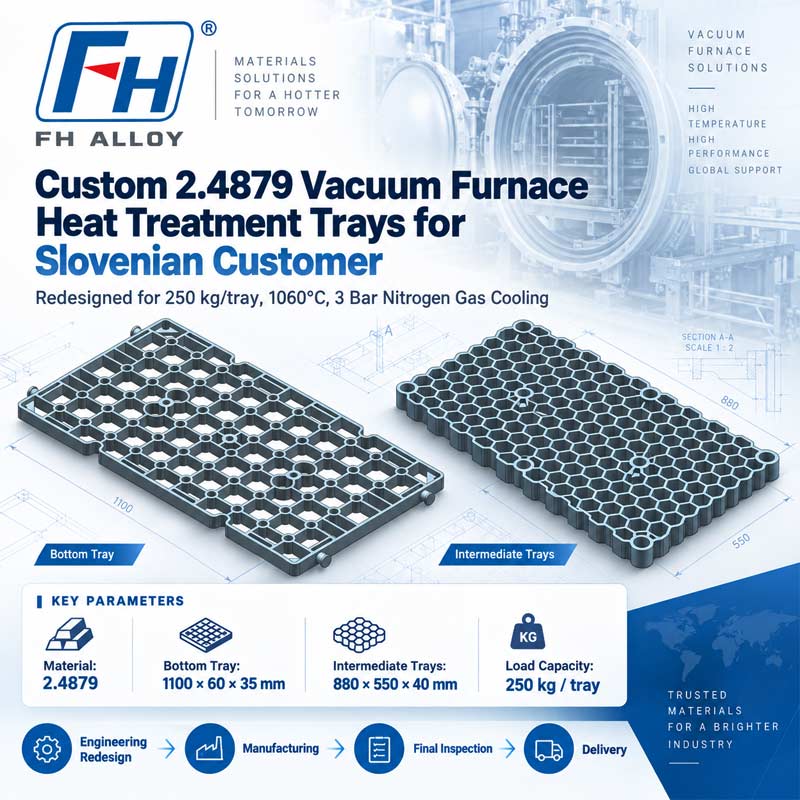
7. Tray Flatness and Reinforcement Are Closely Related
Heat treatment trays are often selected for applications requiring controlled component positioning.
Tray deformation can create:
Tray design may therefore use:
The reinforcement pattern should correspond to the actual loading area rather than being added randomly.
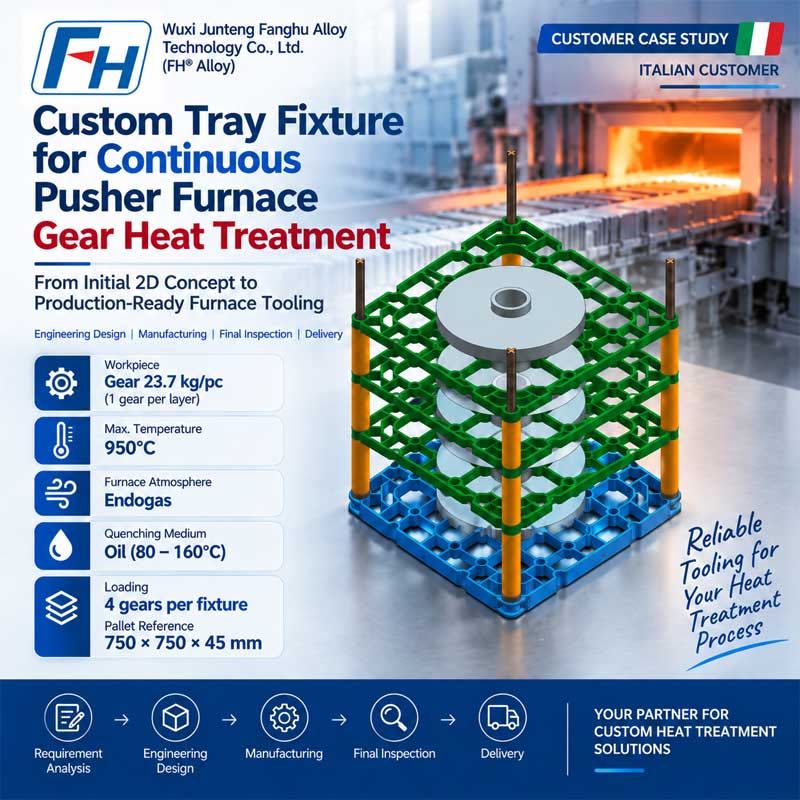
8. Rack Design Must Consider Vertical Stability
Heat treatment racks frequently carry components at several levels.
Compared with a simple tray, racks introduce additional design challenges.
These include:
For tall racks, engineers should pay particular attention to:
An unstable rack can create both furnace performance and handling risks.
9. Cast and Fabricated Fixtures Require Different Design Thinking
Heat treatment fixtures may be manufactured through casting, fabrication, or a combination of both.
Cast Fixture Design
Casting can be suitable for:
A cast design should consider section transitions carefully to avoid unnecessary mass and stress concentration.
Fabricated Fixture Design
Fabricated fixtures typically use:
Design attention should be given to:
Neither method is automatically superior. The appropriate process depends on structure, quantity, material, and service conditions.
10. Welding Location Can Affect Fixture Life
In fabricated heat treatment fixtures, weld joints are often critical areas.
Repeated thermal cycling can place stress around welded connections.
Potential issues include:
Fixture design should therefore avoid placing unnecessary welds directly in the highest-stress regions whenever practical.
Good joint design, correct filler material, proper welding procedures, and dimensional control all contribute to fixture reliability.
11. Stackable Fixtures Need Stable Locating Features
Stackable baskets and trays can significantly improve furnace utilization.
However, poor stacking design may result in:
Stacking points should provide predictable load transfer from one fixture layer to the next.
Designers should consider:
This becomes increasingly important when several fixture layers are stacked together.
12. Handling Method Must Be Considered During Design
A fixture is not used only inside the furnace.
It must also survive:
Fixture design may therefore need to include:
These features must be strong enough for the total loaded weight.
Poor handling design can shorten fixture life even if furnace conditions are well controlled.
Fixture Design Requirements for Different Furnace Types
Different furnace systems require different fixture structures.
Vacuum Furnaces
Vacuum furnace fixtures often emphasize:
Pit Furnaces
Pit furnace fixtures commonly require:
Roller Hearth Furnaces
Fixtures operating on rollers should consider:
Carburizing Furnaces
Design must consider both:
The same structural design cannot simply be copied across all furnace types.
Common Design Problems That Reduce Fixture Service Life
A heat treatment fixture may fail prematurely because of several design-related issues.
Typical examples include:
Excessive span between supports
Long unsupported sections may sag at temperature.
Uneven loading
Concentrated weight can cause localized deformation.
Overly rigid construction
Insufficient expansion allowance may increase thermal stress.
Excessive fixture weight
Heavy structures increase thermal mass without necessarily improving performance.
Weak stacking areas
Poor contact geometry can cause local deformation.
Incorrect weld placement
High-stress welded areas may develop cracks during repeated thermal cycling.
How Good Design Can Extend Fixture Service Life
Longer service life normally comes from a combination of improvements rather than one single change.
A better fixture design may include:
When these design factors are combined with the correct heat-resistant material, fixture performance can be significantly improved.
Information Needed Before Designing a Custom Heat Treatment Fixture
Before developing a fixture, the manufacturer should understand the real operating conditions.
Useful information includes:
| Parameter | Information Required |
| Furnace | Type and chamber dimensions |
| Temperature | Normal and maximum operating temperature |
| Atmosphere | Air, vacuum, carburizing or protective gas |
| Workpiece | Dimensions and geometry |
| Loading | Total weight per fixture |
| Process | Crane, forklift or automatic system |
| Handling | Maximum allowable dimensions |
| Fixture | Existing or required grade |
| Material | Existing or required grade |
| Service history | Existing fixture life and failure mode |
Providing complete information helps avoid simply reproducing the weaknesses of an existing fixture.
Custom Heat Treatment Fixture Design by FH® Alloy
FH Alloy manufactures customized heat treatment fixtures for industrial furnace applications.
Available products include:
Customers can provide:
For replacement projects, photos of existing deformation or failure areas can also help evaluate possible design improvements.
FAQ
Q1: Why do heat treatment fixtures deform even when the material is correct?
Material is only one factor. Excessive loading, long unsupported spans, poor load distribution, insufficient creep resistance, and thermal expansion constraints can also cause deformation.
Q2: Does a heavier fixture always last longer?
No. Increasing weight may improve stiffness in some areas, but excessive mass increases thermal load and does not automatically solve stress or creep problems.
Q3: How can heat treatment basket deformation be reduced?
Possible improvements include optimizing support spacing, reinforcement, load distribution, material selection, and maximum loading limits.
Q4: Should fixture design change for different furnace types?
Yes. Vacuum, pit, roller hearth, carburizing, and batch furnaces have different thermal, atmosphere, loading, and handling requirements.
Q5: Can an existing fixture design be optimized?
Yes. Existing drawings, service conditions, failure photos, loading data, and material information can be reviewed to identify potential structural improvements.
Conclusion
The service life of a heat treatment fixture depends on much more than alloy grade.
A reliable design must consider:
The best results come from combining appropriate material selection with application-specific structural design.
FH® Alloy provides customized heat treatment fixture design and manufacturing for industrial furnaces based on customer drawings and actual operating requirements.
For a new fixture or replacement project, provide the furnace type, operating temperature, workpiece dimensions, total load, fixture size, atmosphere, and existing drawing for technical evaluation.
 CategoryRecent Post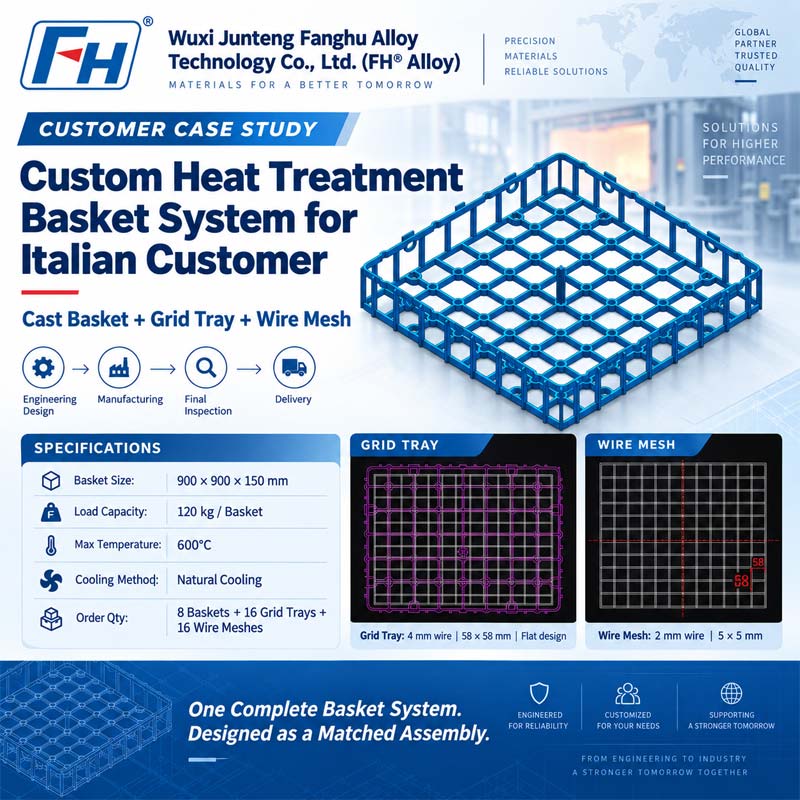

Focus on Designing and Manufacturing Alloy Steel Parts since 2006
 Tel: 0510-83310100
  E-mail: info@alloy-casting.com
  Office Add: Room 1105,Building 6, Jiaye Wealth Center,Wuxi, Jiangsu, P.R.China P.C.:214000.
  Privacy

 English
 Español
 italiano
 Deutsch
 0086-13338774804
