
 Aug 25, 2026
 Introduction
In industrial heat treatment operations, fixture performance depends heavily on material selection.
A furnace fixture must repeatedly withstand:
Choosing an unsuitable material may cause:
However, selecting a heat treatment fixture material is not simply about choosing the alloy with the highest temperature rating.
The correct material depends on the complete operating environment, including:
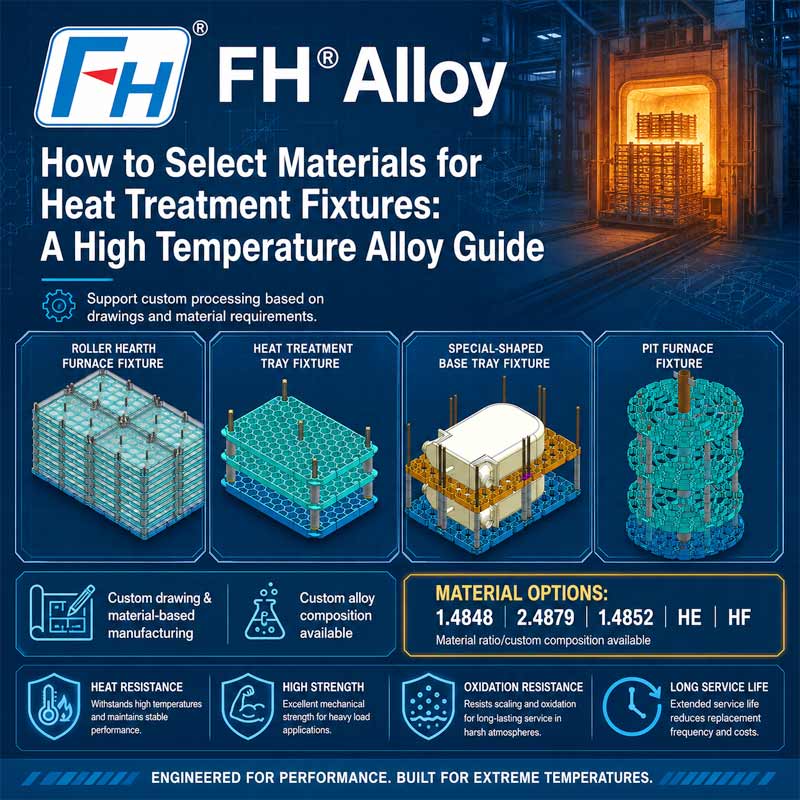
This article explains how engineers evaluate materials for high-temperature heat treatment fixtures and how different alloy families are used in industrial furnace applications.
FH® Alloy provides customized heat treatment fixtures manufactured according to customer process requirements, furnace conditions, and application needs.
Why Heat Treatment Fixture Materials Are Critical
Heat treatment fixtures work under conditions that are very different from normal mechanical components.
A fixture may experience hundreds or thousands of heating cycles during its service life.
During operation, the material must maintain:
High Temperature Strength
At elevated temperatures, many metals gradually lose mechanical strength.
A suitable fixture material should continue supporting:
Creep Resistance
Creep is one of the most important factors for high-temperature fixtures.
It refers to slow permanent deformation caused by:
Poor creep resistance can lead to:
Oxidation Resistance
In air furnace environments, fixture surfaces are exposed to oxygen.
Good oxidation resistance helps reduce:
Thermal Fatigue Resistance
Repeated heating and cooling creates thermal stress.
Materials with better thermal fatigue resistance can withstand more production cycles.
Main Material Categories for Heat Treatment Fixtures
Heat treatment fixtures are commonly manufactured from several material groups:
Each category has different advantages.
Heat-Resistant Stainless Steel Fixtures
Heat-resistant stainless steels are widely used because they provide a balance between:
They are commonly used for:
310S Heat Treatment Fixtures
310S is a commonly selected heat-resistant stainless steel.
It is suitable for many general industrial furnace applications.
Typical advantages include:
Typical Applications
310S fixtures are often used in:
1.4848 Heat Treatment Fixtures
1.4848 is widely used for industrial furnace components requiring reliable high-temperature performance.
It is commonly selected when applications require:
Including:
1.4849 Heat Treatment Fixtures
1.4849 is used for applications where higher temperature performance is required.
Compared with standard heat-resistant stainless steels, it may provide improved resistance against long-term thermal exposure.
Common applications include:
1.4852 Heat Treatment Fixtures
1.4852 is often selected for demanding furnace environments.
It is suitable for applications requiring:
Typical applications include:
Cast Heat-Resistant Alloy Fixtures
Some heat treatment fixtures are manufactured using casting technology.
Cast alloy fixtures are particularly suitable when the structure requires:
Advantages of Cast Fixture Materials
Complex Structural Design
Casting allows manufacturers to produce shapes that may be difficult to achieve through fabrication.
Reduced Welded Areas
Integrated cast structures can reduce potential weak points caused by multiple weld joints.
High Temperature Durability
Cast heat-resistant alloys are commonly used in demanding furnace applications.
Nickel-Based Alloy Fixtures
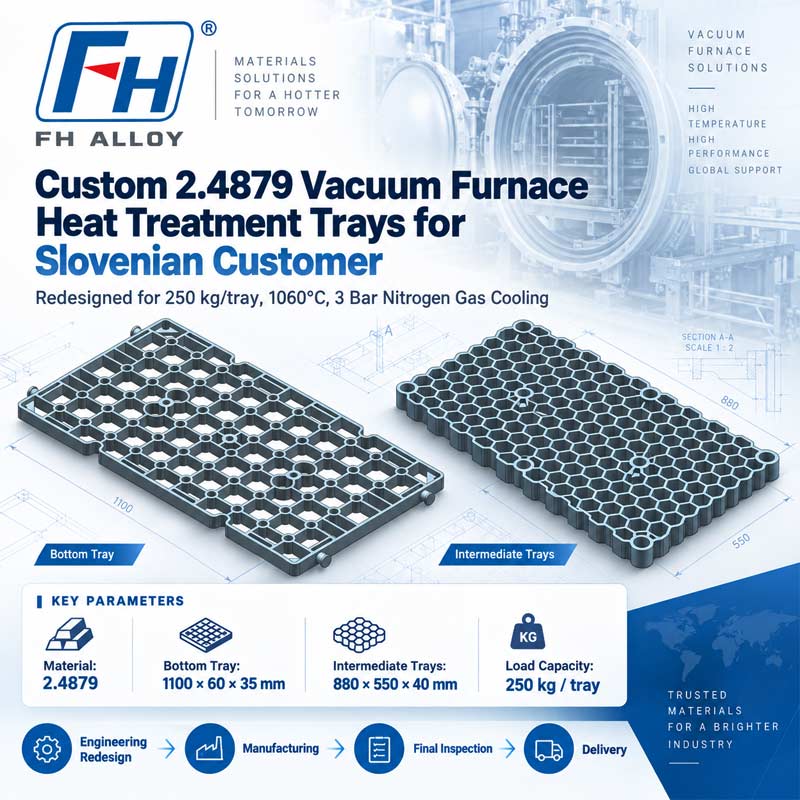
For extremely demanding applications, nickel-based alloys may be considered.
They are typically used where customers require:
Applications may include:
How Furnace Conditions Affect Material Selection
The same fixture material may perform differently depending on the furnace environment.
1. Operating Temperature
Temperature is the first factor engineers usually evaluate.
Higher temperatures require materials with:
2. Furnace Atmosphere
The atmosphere directly affects material performance.
Common environments include:
Air Atmosphere
Main concern:
Vacuum Environment
Important factors:
Carburizing Atmosphere
Important factors:
3. Loading Conditions
Fixture materials must match the actual load.
Consider:
A material suitable for lightweight parts may not be suitable for heavy industrial components.
4. Thermal Cycle Frequency
Production frequency affects fixture life.
A fixture used:
and a fixture used:
may require completely different material selection.
Material Selection Comparison
| Material | Main Characteristics | Typical Applications |
| 310S | Good oxidation resistance and cost balance | General furnace fixtures |
| 1.4848 | High-temperature stability | Baskets, trays, racks |
| 1.4849 | Improved thermal performance | Heavy-duty fixtures |
| 1.4852 | Better creep resistance | Long-cycle high-temperature use |
| Nickel alloys | Extreme performance | Severe furnace environments |
Common Mistakes When Selecting Fixture Materials
Choosing Only Based on Maximum Temperature
Maximum temperature data alone does not determine real performance.
A fixture may still fail because of:
Selecting the Most Expensive Alloy
Higher alloy content does not always mean the best solution.
The ideal material should provide:
Ignoring Fixture Design
Material and design cannot be separated.
A high-performance alloy with poor structural design may still experience:
Material Selection Should Work Together With Fixture Design
A successful heat treatment fixture requires cooperation between:
Material Selection
Choosing the correct alloy according to operating conditions.
Structural Design
Optimizing:
Manufacturing Process
Selecting suitable:
Only when these factors work together can fixture performance be maximized.
FH® Alloy High Temperature Fixture Material Solutions
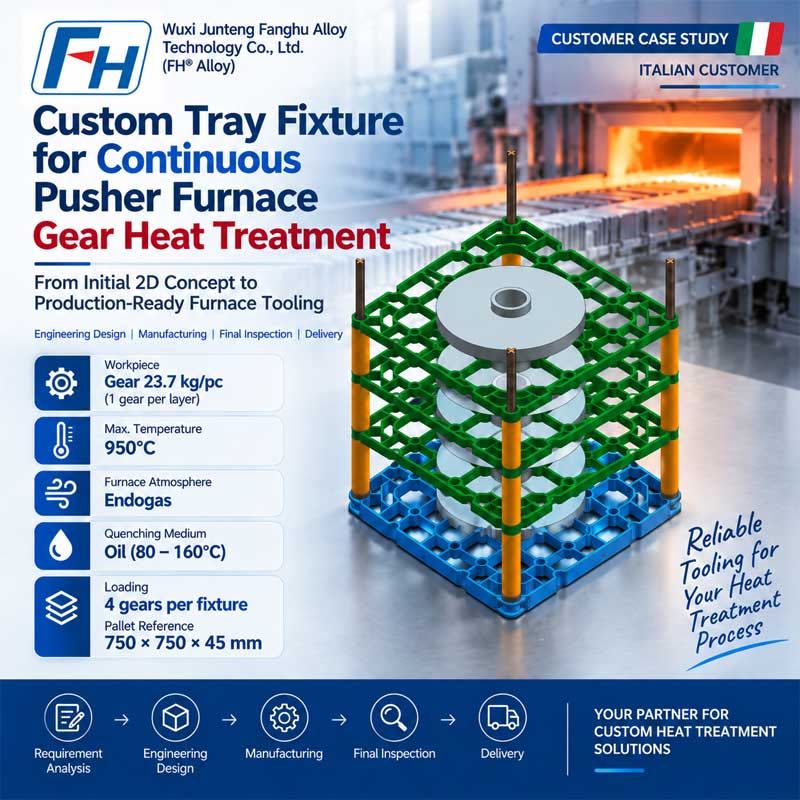
FH® Alloy supplies customized heat treatment fixtures for industrial furnace applications.
Available solutions include:
Materials include:
Material selection can be optimized according to:
FAQ
Q1: What is the best material for heat treatment fixtures?
There is no universal best material. The correct choice depends on furnace conditions, temperature, load, and service requirements.
Q2: Is stainless steel suitable for furnace fixtures?
Certain heat-resistant stainless steels, such as 310S and 1.4848, are widely used for industrial furnace fixtures.
Q3: Why do heat treatment fixtures deform?
Common causes include insufficient creep resistance, excessive loading, unsuitable materials, and improper structural design.
Q4: Are cast alloys better than stainless steel fixtures?
Not always. The best choice depends on the fixture design, operating conditions, and required service life.
Conclusion
Material selection is one of the most important steps when developing reliable heat treatment fixtures.
The correct alloy should be selected based on:
Instead of choosing materials only by specification or cost, engineers should evaluate the complete operating environment.
FH® Alloy provides customized high-temperature heat treatment fixtures using suitable heat-resistant steels and alloys for industrial furnace applications.
 CategoryRecent Post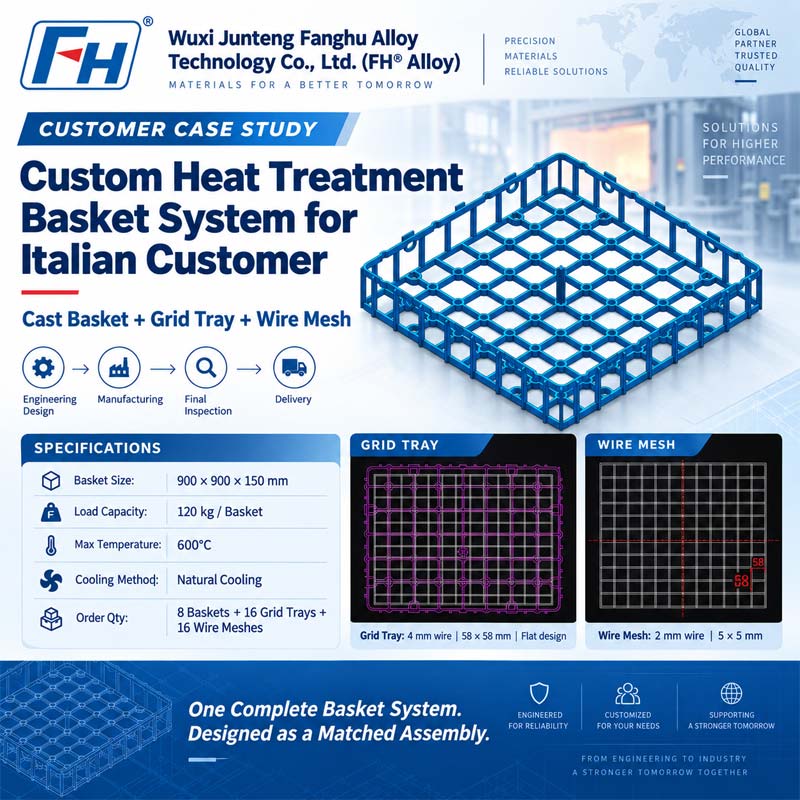

Focus on Designing and Manufacturing Alloy Steel Parts since 2006
 Tel: 0510-83310100
  E-mail: info@alloy-casting.com
  Office Add: Room 1105,Building 6, Jiaye Wealth Center,Wuxi, Jiangsu, P.R.China P.C.:214000.
  Privacy

 English
 Español
 italiano
 Deutsch
 0086-13338774804
