
 Sep 07, 2026
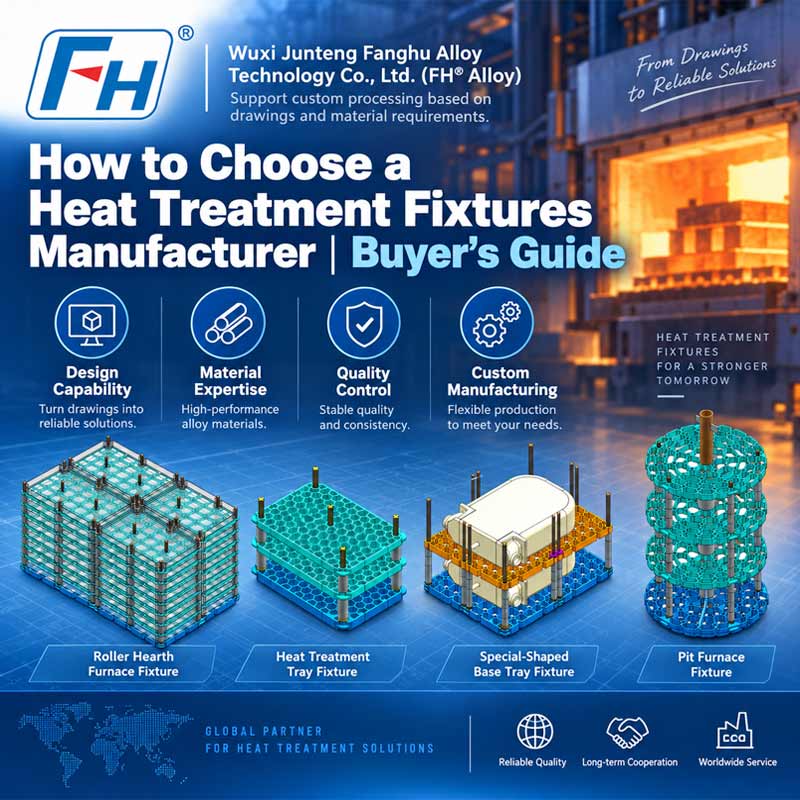
 How to Choose a Reliable Heat Treatment Fixtures Manufacturer: A Buyer’s Guide
Purchasing heat treatment fixtures is very different from buying ordinary fabricated steel products.
Furnace baskets, trays, racks, grids, and custom support structures must continue carrying loads while exposed to high temperatures, repeated thermal cycles, and demanding furnace atmospheres.
A fixture may look correct when delivered but still develop serious problems after entering production, including:
For this reason, selecting a heat treatment fixtures manufacturer should involve much more than comparing unit prices.
Industrial buyers should evaluate whether a supplier understands the relationship between:
Material + Furnace Conditions + Fixture Design + Manufacturing + Loading + Service Life
This guide explains the most important factors to review before choosing a manufacturer for custom heat treatment fixtures.
FH® Alloy manufactures customized heat treatment baskets, trays, racks, and other high-temperature furnace fixtures according to customer drawings and actual operating requirements.
Why Manufacturer Selection Matters for Heat Treatment Fixtures
Heat treatment fixtures are application-specific components.
Two customers may request baskets with similar external dimensions but require completely different solutions because their operating conditions are different.
For example:
Customer A
Customer B
Using the same fixture material and structure for both applications may not provide the same performance.
A qualified manufacturer should therefore understand the service conditions before discussing the final material and design.
1. Evaluate the Manufacturer’s High-Temperature Material Knowledge
Material expertise is one of the first areas to evaluate.
Heat treatment fixtures may use materials such as:
But simply offering these grades is not enough.
The manufacturer should understand why one material may be more appropriate than another.
Important considerations include:
A useful question for suppliers:
What information do you need before recommending the fixture material?
A technically capable supplier should ask about operating conditions rather than immediately recommending the highest-priced alloy.
2. Check Whether the Supplier Understands Your Furnace Conditions
The furnace environment directly affects fixture performance.
When requesting a quotation, a manufacturer should ideally ask about the furnace type.
Common systems include:
Each system creates different engineering requirements.
Vacuum Furnace Fixtures
Design may need to consider:
Pit Furnace Fixtures
Important factors may include:
Roller Hearth Furnace Fixtures
The manufacturer should consider:
A supplier that ignores the furnace type may overlook important fixture requirements.
3. Look for Custom Design Capability
Many industrial heat treatment fixtures are not standard products.
Customers frequently require fixtures based on:
A capable manufacturer should be able to understand and manufacture custom structures such as:
For replacement projects, design capability becomes even more important.
If the existing fixture is already deforming or cracking, simply copying the original drawing may reproduce the same problem.
4. Ask Whether Existing Fixture Problems Can Be Reviewed
One of the best ways to evaluate a potential manufacturer is to provide information about an existing fixture problem.
For example:
A useful technical discussion should consider possible causes such as:
Similarly:
Weld Cracking
Possible factors include:
Stack Misalignment
Possible factors include:
A manufacturer does not necessarily need to redesign every customer product, but the ability to discuss the actual failure mode is a useful indicator of technical competence.
5. Confirm Whether the Manufacturer Supports the Required Manufacturing Process
Heat treatment fixtures may be produced through different manufacturing routes.
The correct process depends on the design.
Cast Heat Treatment Fixtures
Casting may be appropriate for:
Fabricated Heat Treatment Fixtures
Fabricated designs may use:
Fabrication can be useful for highly customized structures and designs requiring easier dimensional adjustment.
Combined Structures
Some fixtures use both:
cast components + fabricated components
A manufacturer should understand the manufacturing process appropriate for the customer's drawing rather than forcing every fixture into the same production method.
6. Welding Capability Matters for Fabricated Furnace Fixtures
For welded furnace fixtures, joint quality can directly influence long-term reliability.
Potential weld-related problems include:
Important areas to evaluate include:
However, buyers should also remember:
Material, structural design, and welding should work together.
7. Ask How Material Is Verified
When purchasing high-temperature alloy fixtures, confirming that the supplied material matches the specification is important.
Depending on project requirements, material documentation may include:
When sending an RFQ, buyers should clearly specify whether material documentation is required.
For critical applications, this should be agreed upon before production rather than after delivery.
8. Evaluate Dimensional Inspection Capability
Fixture dimensions can directly affect:
Important inspection points may include:
For a large heat treatment tray, for example, overall dimensions alone may not be enough.
Flatness and support locations can also matter.
Buyers should identify critical dimensions on the drawing when necessary.
9. Check Experience With the Fixture Type You Need
A manufacturer offering “heat treatment fixtures” may still have more experience with certain products than others.
Ask whether they manufacture the specific type required.
Examples include:
Heat Treatment Baskets
Important considerations:
Furnace Trays
Important considerations:
Heat Treatment Racks
Important considerations:
Pit Furnace Fixtures
Important considerations:
Similar-looking fixtures can have very different engineering requirements.
10. Evaluate Whether the Manufacturer Can Work From Your Drawing
For custom industrial furnace fixtures, drawing-based production is common.
A useful RFQ drawing should ideally include:
If only a basic drawing is available, additional furnace and workpiece information may still be needed.
A supplier should be able to identify missing information before production.
11. Existing Samples and Photos Can Be Valuable
Not every replacement project has a complete engineering drawing.
Sometimes the customer may have:
These can still help technical communication.
If the existing fixture is damaged, photographs are particularly useful.
Recommended photos include:
The more clearly the operating problem is shown, the easier it is to discuss possible improvements.
12. Do Not Compare Suppliers by Price Alone
Price matters, but heat treatment fixtures should be compared using more than unit cost.
Suppose two suppliers offer:
Supplier A
Lower initial price but shorter fixture life.
Supplier B
Higher purchase price but longer service life.
The more economical option depends on total operating cost.
Useful factors include:
A useful comparison metric is:
rather than only:
13. Ask About Expected Service Conditions, Not Guaranteed Lifespan
Buyers often ask:
For heat treatment fixtures, a precise service-life guarantee can be difficult because fixture life depends heavily on actual use.
Important variables include:
A more useful technical discussion focuses on whether the fixture is designed for the stated operating conditions.
If the supplier promises an exact lifespan without understanding these conditions, buyers should treat that claim carefully.
14. Consider Packaging and Transportation for Large Fixtures
Heat treatment fixtures can be:
Transportation damage may affect dimensional accuracy before the fixture ever reaches the furnace.
For international orders, packaging should consider:
For long or complex fixtures, buyers may also need to confirm whether components are supplied:
This should be clarified before shipment.
15. What Information Should You Send With an RFQ?
A complete RFQ allows the manufacturer to evaluate the fixture more accurately.
The following information is recommended:
| Required Information | Details |
| Drawing | 2D / 3D if available |
| Fixture dimensions | Length × Width × Height |
| Material | Required grade, if specified |
| Quantity | Prototype or batch quantity |
| Furnace type | Vacuum, pit, roller hearth, etc. |
| Temperature | Normal and maximum |
| Atmosphere | Air, vacuum, carburizing, protective gas |
| Workpiece | Dimensions and geometry |
| Loading weight | Total kg per fixture |
| Loading method | Crane, forklift, automatic system |
| Process | Annealing, hardening, carburizing, etc. |
| Existing service life | If replacing an old fixture |
| Failure photos | If deformation/cracking exists |
The more complete this information is, the less likely the quotation will be based on assumptions.
Heat Treatment Fixtures Manufacturer Evaluation Checklist
Before selecting a supplier, consider the following checklist.
Technical Capability
Manufacturing
Material Control
Customization
Commercial Communication
Warning Signs When Evaluating a Fixture Supplier
Some warning signs deserve additional attention.
Quote Issued Without Asking About Furnace Conditions
For a simple drawing-to-print project this may sometimes be acceptable, but for material or design recommendations, furnace conditions are important.
Material Recommendations Based Only on Price
Material selection should reflect actual operating requirements.
No Attention to Loading Weight
A fixture cannot be properly evaluated without understanding the load it must carry.
Exact Service-Life Claims Without Operating Data
Fixture lifespan is affected by too many process variables for reliable estimation without application information.
Ignoring Existing Deformation or Cracking
If a replacement fixture has already failed prematurely, the failure should at least be reviewed before reproducing the same design.
Standard Fixture vs Custom Fixture: Which Should You Buy?
Standardized fixtures can be suitable when:
Custom heat treatment fixtures are more appropriate when:
For many industrial applications, customization is not primarily about appearance.
It is about matching the fixture to the actual process.
Why Buyers Work With FH® Alloy for Custom Heat Treatment Fixtures
FH® Alloy provides customized heat treatment fixtures and high-temperature furnace components for industrial applications.
Fixture types include:
Projects can be produced according to:
For replacement projects, customers can also provide photographs and service information from existing fixtures experiencing:
This allows the technical requirements to be reviewed before quotation and manufacturing.
What to Send FH® Alloy for a Heat Treatment Fixture Quotation
For a new project, provide:
For a replacement project, also provide:
This information helps reduce unnecessary assumptions during technical evaluation.
FAQ
Q1: How do I choose a heat treatment fixtures manufacturer?
Evaluate material expertise, furnace experience, custom design capability, manufacturing process, quality control, dimensional inspection, and ability to understand your actual loading and service conditions.
Q2: What information does a heat treatment fixture manufacturer need for quotation?
Ideally provide the fixture drawing, dimensions, material, quantity, furnace type, temperature, atmosphere, workpiece information, and total loading weight.
Q3: Can a manufacturer improve an existing heat treatment fixture design?
Potentially. Existing drawings, used fixture photos, failure locations, material, loading data, and furnace conditions can be reviewed to identify possible improvement directions.
Q4: Should I select a fixture supplier based on the lowest price?
Price is important, but buyers should also compare material, structure, expected operating life, fixture weight, quality requirements, and replacement frequency.
Q5: Can heat treatment fixtures be manufactured from customer drawings?
Yes. Custom heat treatment fixtures are commonly produced according to customer 2D or 3D drawings and technical specifications.
Q6: What materials are commonly used for heat treatment fixtures?
Depending on service conditions, common options may include 310S, 1.4848, 1.4849, 1.4852, other heat-resistant alloys, and nickel-based alloys for more severe applications.
Conclusion
Choosing a reliable heat treatment fixtures manufacturer requires more than comparing prices and delivery times.
For high-temperature furnace fixtures, buyers should evaluate whether the supplier can correctly understand:
A good procurement process begins with complete technical information.
The more clearly the manufacturer understands the actual furnace environment, the more accurately the fixture can be quoted and manufactured for the intended application.
FH® Alloy manufactures customized heat treatment baskets, trays, racks, vacuum furnace fixtures, pit furnace fixtures, and other industrial furnace loading structures according to customer drawings and service requirements.
For quotation, send your drawing, dimensions, material, furnace type, operating temperature, atmosphere, workpiece information, total loading weight, and required quantity.
 CategoryRecent Post

Focus on Designing and Manufacturing Alloy Steel Parts since 2006
 Tel: 0510-83310100
  E-mail: info@alloy-casting.com
  Office Add: Room 1105,Building 6, Jiaye Wealth Center,Wuxi, Jiangsu, P.R.China P.C.:214000.
  Privacy

 English
 Español
 italiano
 Deutsch
 0086-13338774804
