
 Aug 19, 2026
 Heat Treatment Fixtures Explained | Types, Materials & Selection Guide
Heat treatment quality depends not only on the furnace and temperature program. How the workpieces are supported inside the furnace can also influence process stability, loading efficiency, dimensional control, and production consistency.
This is where heat treatment fixtures become important.
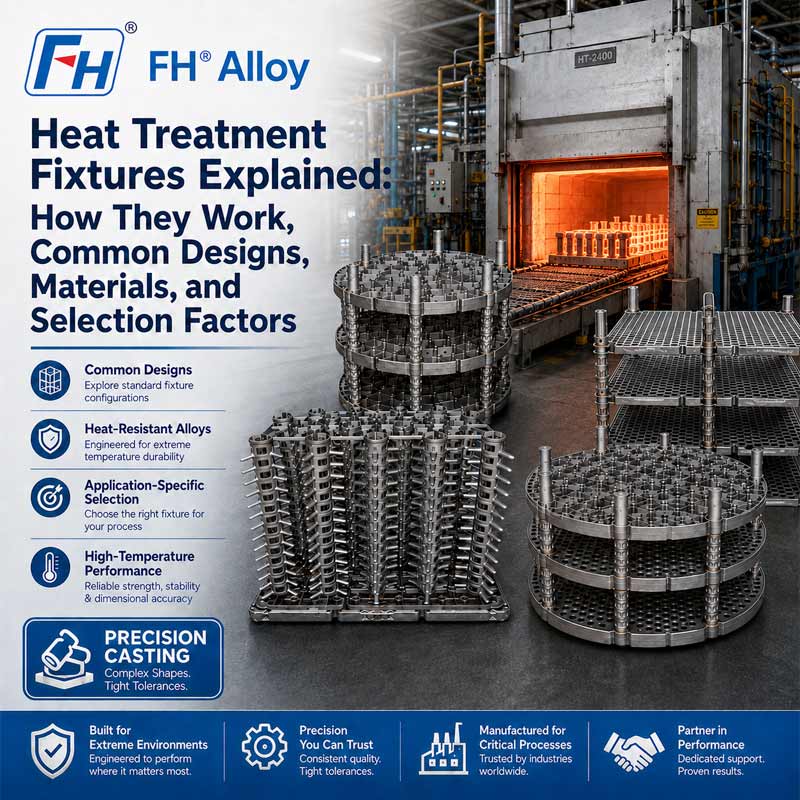
Heat treatment fixtures are engineered load-supporting structures used to carry, locate, separate, or position metal components during thermal processing. Depending on the application, a fixture may be a basket, tray, rack, grid, support frame, or completely customized loading system.
Unlike ordinary material-handling equipment, furnace fixtures must continue carrying a load while exposed to elevated temperatures and repeated thermal cycles.
For industrial users, the challenge is therefore not simply finding a fixture that fits the furnace.
The fixture must also match:
FH® Alloy supplies customized heat treatment fixtures for industrial furnace applications based on customer drawings and actual operating requirements.
How Do Heat Treatment Fixtures Work?
The basic function of a heat treatment fixture is to create a stable loading arrangement for parts being processed inside a furnace.
However, a well-designed fixture performs several functions at the same time.
It can help:
For some precision parts, the fixture also becomes part of the deformation-control strategy.
This means fixture design should be considered together with the workpiece and heat treatment process rather than as a separate accessory.
Where Are Heat Treatment Fixtures Used?
Heat treatment fixtures are used in a broad range of industrial thermal processes.
Typical processes include:
They can be found in equipment such as:
Because operating conditions vary significantly between furnace types, fixture structures are normally selected or customized for a specific application.
Common Heat Treatment Fixture Designs
There is no universal fixture design for industrial heat treatment.
Different workpieces and furnace systems require different loading arrangements.
Heat Treatment Baskets
Heat treatment baskets are commonly used when multiple parts need to be processed in the same furnace cycle.
Depending on the application, basket designs may include:
The design must balance loading capacity with sufficient open area for heat and atmosphere circulation.
Typical applications include batch processing of:
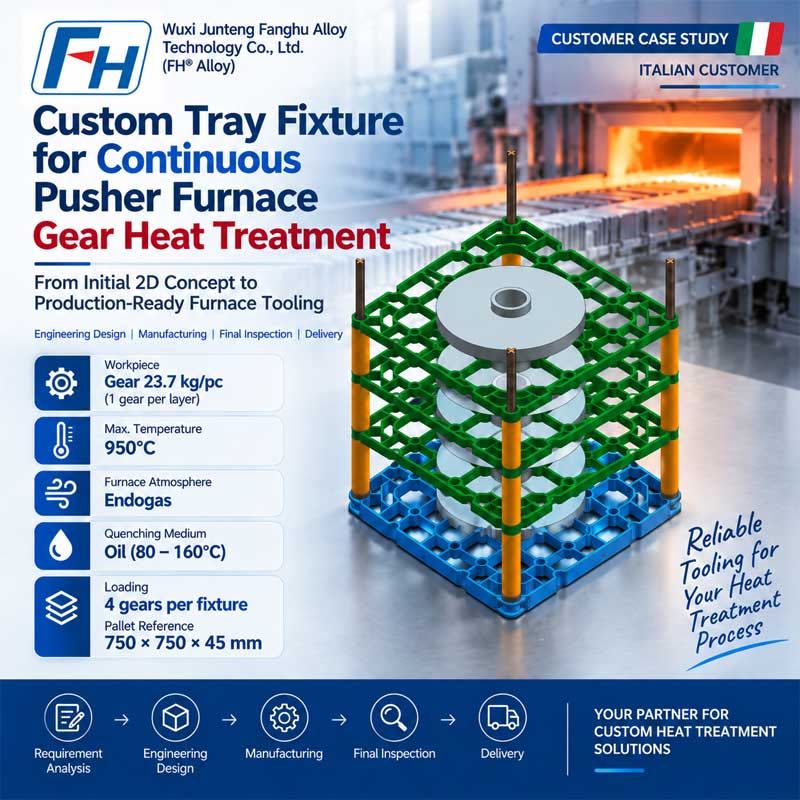
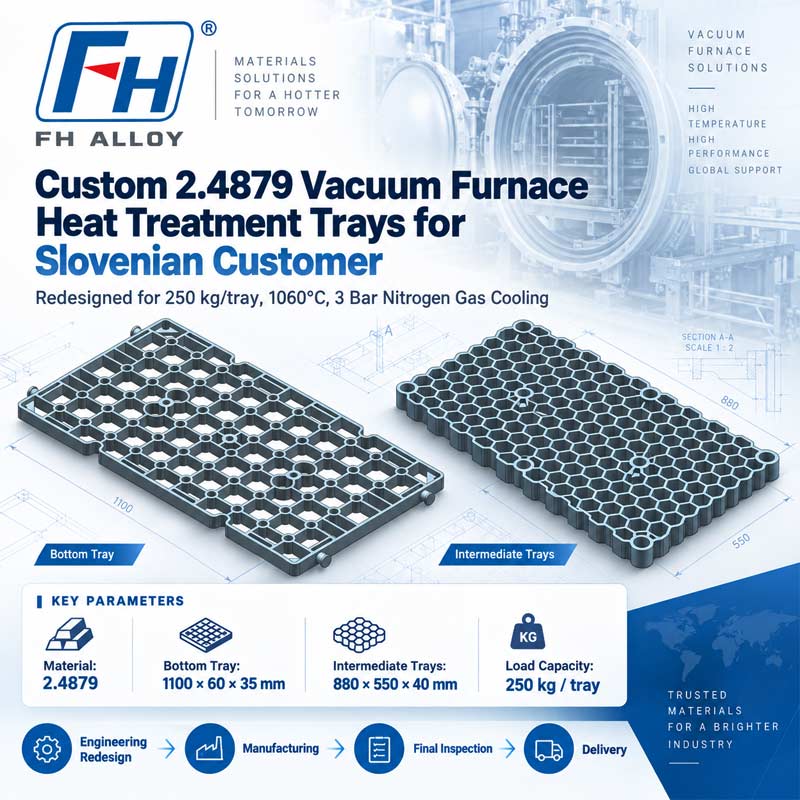
Furnace Trays
Heat treatment trays provide a relatively flat support surface.
They are often selected when workpieces need controlled placement rather than loose batch loading.
Typical tray designs may include:
Trays can also serve as the base of a larger modular fixture system.
Heat Treatment Racks
Rack-style fixtures are designed to hold components at multiple positions or levels.
They are particularly useful where the user needs to improve furnace utilization while preventing workpieces from contacting each other.
Rack fixtures can be customized according to:
Grid Fixtures
Grid structures are widely used as:
An open grid can reduce unnecessary fixture mass while leaving space for heat transfer and atmosphere circulation.
The geometry must still provide sufficient strength at operating temperature.
Custom Loading Fixtures and Jigs
Some heat treatment applications cannot use standard baskets or trays.
Complex components may require special supports designed around the geometry of the workpiece.
A custom fixture may include:
This is particularly important when the orientation of the workpiece affects distortion or process consistency.
Why High-Temperature Conditions Change Fixture Design
A fixture that looks mechanically strong at room temperature may perform very differently inside a furnace.
At elevated temperatures, metallic materials can experience reduced strength and gradual deformation.
Important high-temperature effects include:
Creep
Under sustained load and high temperature, a fixture can slowly deform even without sudden mechanical failure.
This can result in:
Thermal Expansion
Fixtures expand during heating and contract during cooling.
If the structure does not accommodate this movement, repeated cycles may create local stresses.
Thermal Fatigue
Repeated heating and cooling can eventually contribute to:
For this reason, fixture design should be based on actual working temperature rather than room-temperature mechanical properties alone.
What Materials Are Commonly Used for Heat Treatment Fixtures?
Material selection has a major influence on fixture performance.
Common solutions include heat-resistant stainless steels, cast heat-resistant alloys, and nickel-containing high-temperature alloys.
The appropriate grade depends on the operating environment.
Heat-Resistant Stainless Steels
Heat-resistant stainless steels can be used for baskets, trays, frames, and other furnace structures.
Commonly considered grades include materials such as:
They can provide a useful balance of:
Actual suitability should always be evaluated against the customer's operating conditions.
High-Temperature Cast Alloys
Cast heat-resistant alloys are frequently used where the fixture requires:
Casting also allows certain fixture structures to be produced as integrated components rather than assembled from numerous fabricated parts.
Higher-Performance Heat-Resistant Alloys
For more severe furnace conditions, alloys such as 1.4852 and other higher-performance grades may be evaluated.
These applications often involve:
Nickel-Based Alloys
Nickel-based alloys may be considered where conventional heat-resistant steels cannot provide sufficient performance.
However, higher alloy content also increases material cost.
The selection should therefore consider the total lifecycle requirement rather than choosing a material solely because it has a higher nominal temperature capability.
Cast or Fabricated Heat Treatment Fixtures?
Both manufacturing methods are used in industrial heat treatment applications.
The better choice depends on fixture geometry, production quantity, operating environment, and customer requirements.
Cast Fixtures
Casting is useful for producing:
Potential benefits include design flexibility and the ability to integrate structural features into a single casting.
Fabricated Fixtures
Fabricated fixtures may use:
Fabrication is particularly useful for:
Hybrid Designs
Some industrial fixtures combine cast and fabricated components.
For example, cast load-bearing sections may be combined with:
This approach allows the design to use different manufacturing processes where each is most appropriate.
What Determines a Good Fixture Design?
There is no single design rule that applies to every heat treatment fixture.
Several factors must be evaluated together.
Load Distribution
The fixture should distribute workpiece weight across the supporting structure.
Poor load distribution may create localized stress and accelerate deformation.
Support Position
The location of each support point can affect workpiece deformation.
For precision components, simply adding more supports is not always the answer.
Support positions should match the geometry and thermal behavior of the part.
Fixture Self-Weight
The fixture itself consumes furnace capacity and energy.
Excessive fixture mass may:
The objective is therefore not simply to make the fixture as heavy as possible.
A better design balances:
structural strength + fixture weight + heat transfer + service life
Heat and Atmosphere Flow
Open areas can help heat and process gases reach the workpiece more effectively.
Fixture geometry should avoid unnecessary shielding of critical component surfaces.
Lifting and Handling
The fixture must also work outside the furnace.
Depending on the production line, engineers may need to consider:
These requirements can significantly influence the final structure.
Heat Treatment Fixtures for Different Furnace Systems
Fixture requirements change depending on the type of furnace.
Vacuum Furnace Fixtures
Vacuum applications generally place greater emphasis on:
Vacuum fixture design should therefore be treated as a specialized subcategory of heat treatment fixture engineering.
Pit Furnace Fixtures
Pit furnaces often require vertically oriented loading systems.
Important considerations may include:
Roller Hearth Furnace Fixtures
Fixtures used on roller hearth furnaces must interact correctly with the furnace transport system.
Important design parameters include:
Carburizing Furnace Fixtures
Carburizing furnaces create particularly demanding conditions for some fixture materials.
Selection must take both:
into account.
What Causes Premature Fixture Failure?
When a heat treatment fixture fails too quickly, material grade is only one possible cause.
Common failure factors include:
A useful failure analysis should therefore investigate the complete operating environment.
Simply copying the dimensions of an old fixture may reproduce the same problem.
How Can Fixture Service Life Be Improved?
There is no single solution for extending fixture life.
In practice, better results usually come from several improvements working together.
Select Materials According to Service Conditions
Avoid selecting grades only from a generic temperature table.
Consider:
Optimize Structural Geometry
Good structural design can reduce:
Avoid Overloading
A fixture should have a defined operating load.
Repeated operation above the intended loading condition can dramatically shorten service life.
Inspect Fixtures Regularly
Useful inspection points include:
Early identification of deformation or cracking can reduce the risk of unexpected failure during production.
How to Select Heat Treatment Fixtures for a New Project
When developing a new fixture, start with the furnace and workpiece rather than with the fixture drawing.
The manufacturer should ideally understand the following information:
Furnace Information
Workpiece Information
Fixture Information
With this information, it is easier to determine whether the project should use a basket, tray, rack, grid, or dedicated custom structure
What Should Buyers Provide When Requesting a Quotation?
For a more accurate technical evaluation and quotation, buyers should provide as much information as possible.
Recommended information includes:
If the project involves replacing an existing fixture, additional information is useful:
This information allows the supplier to evaluate whether design or material improvements may be possible.
Custom Heat Treatment Fixture Manufacturing by FH® Alloy
FH® Alloy manufactures heat-resistant furnace fixtures for customized industrial applications.
Available fixture solutions include:
Production can be based on:
For projects experiencing short service life or deformation, the operating conditions can also be reviewed before manufacturing a replacement fixture.
FAQ
Q1: What are heat treatment fixtures?
Heat treatment fixtures are structures used to support, locate, separate, or carry workpieces during industrial thermal processing.
Q2: What types of heat treatment fixtures are commonly used?
Common designs include baskets, trays, racks, grids, jigs, support frames, and customized loading systems.
Q3: What material should be used for a furnace fixture?
Material selection depends on temperature, atmosphere, workpiece load, thermal cycle, fixture geometry, and expected service life.
Q4: Are cast fixtures better than welded fixtures?
Not necessarily. Casting and fabrication each have advantages. The appropriate manufacturing method depends on the structure and operating requirements.
Q5: Why do furnace fixtures deform after repeated use?
High-temperature creep, thermal cycling, excessive loading, insufficient structural support, and unsuitable materials can all contribute to deformation.
Q6: Can existing heat treatment fixtures be redesigned?
Yes. Existing drawings, used fixture photos, failure locations, service conditions, and loading information can be used to evaluate potential structural or material improvements.
Conclusion
Heat treatment fixtures are more than simple furnace loading accessories.
They are engineered components that must continue supporting workpieces while exposed to high temperature, mechanical load, furnace atmosphere, and repeated thermal cycles.
A reliable fixture solution requires the correct combination of:
For new projects, providing complete furnace and workpiece information allows the fixture manufacturer to develop a solution that better matches the actual application.
FH Alloy provides customized heat treatment fixtures manufactured according to drawings and industrial furnace operating requirements.
For technical evaluation or quotation, provide your drawing, dimensions, operating temperature, furnace atmosphere, workpiece information, loading weight, and required quantity.
 CategoryRecent Post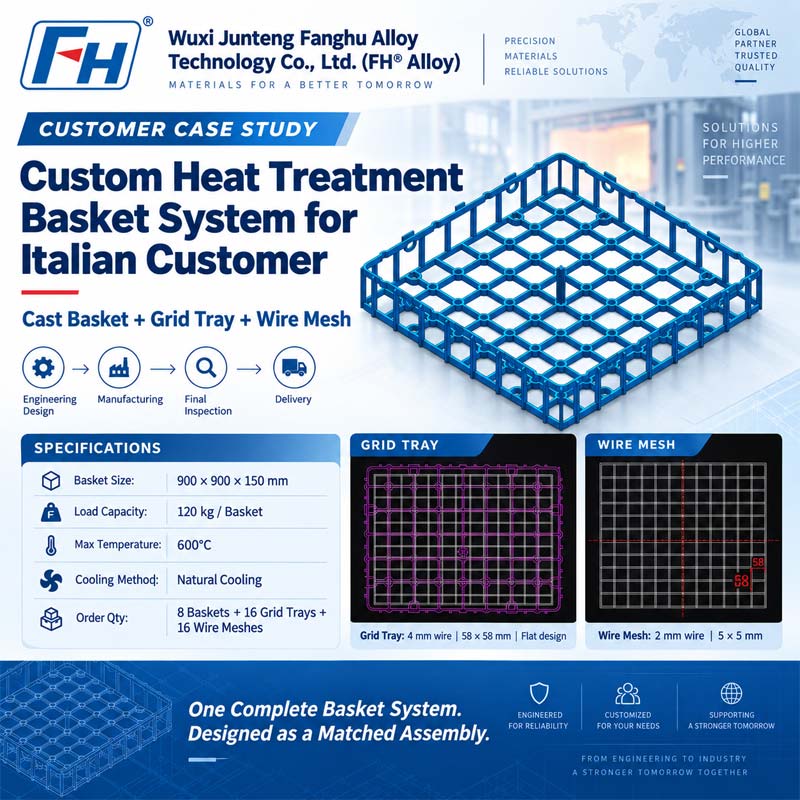

Focus on Designing and Manufacturing Alloy Steel Parts since 2006
 Tel: 0510-83310100
  E-mail: info@alloy-casting.com
  Office Add: Room 1105,Building 6, Jiaye Wealth Center,Wuxi, Jiangsu, P.R.China P.C.:214000.
  Privacy

 English
 Español
 italiano
 Deutsch
 0086-13338774804
