

 English
 Español
 italiano
 Deutsch
 0086-13338774804

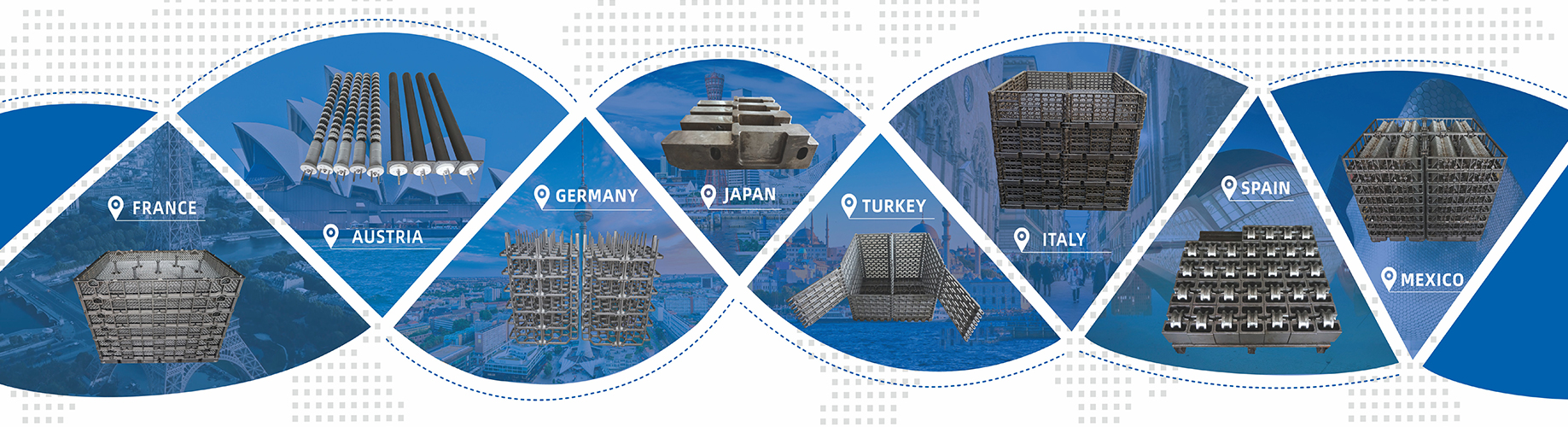
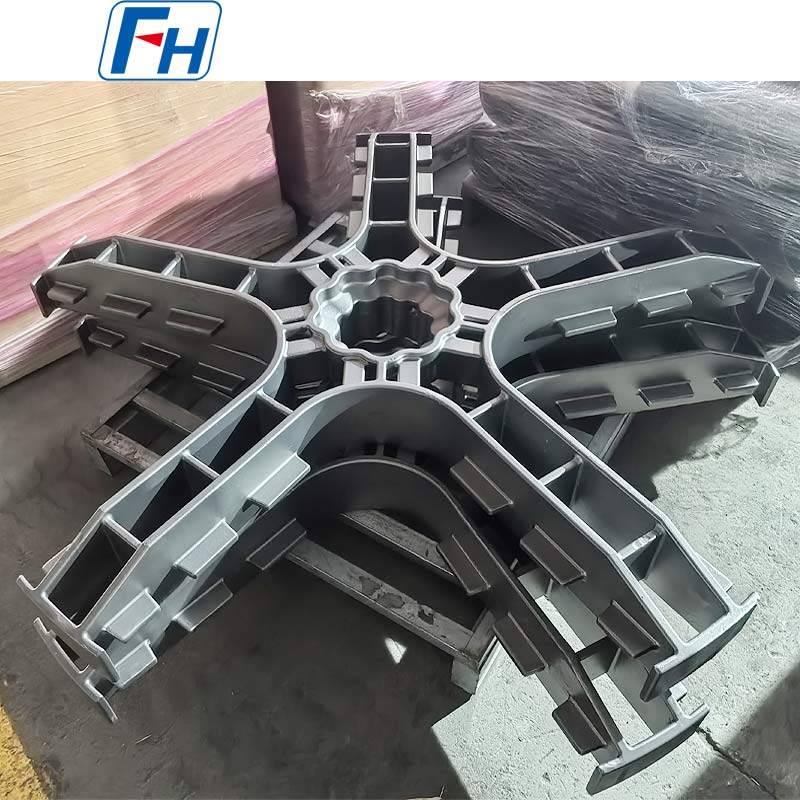
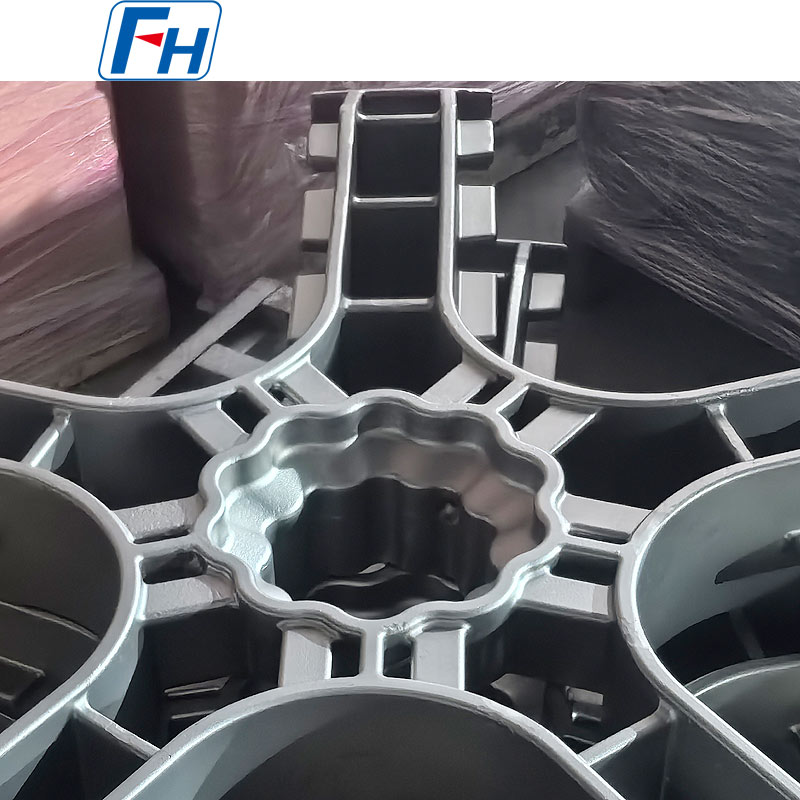
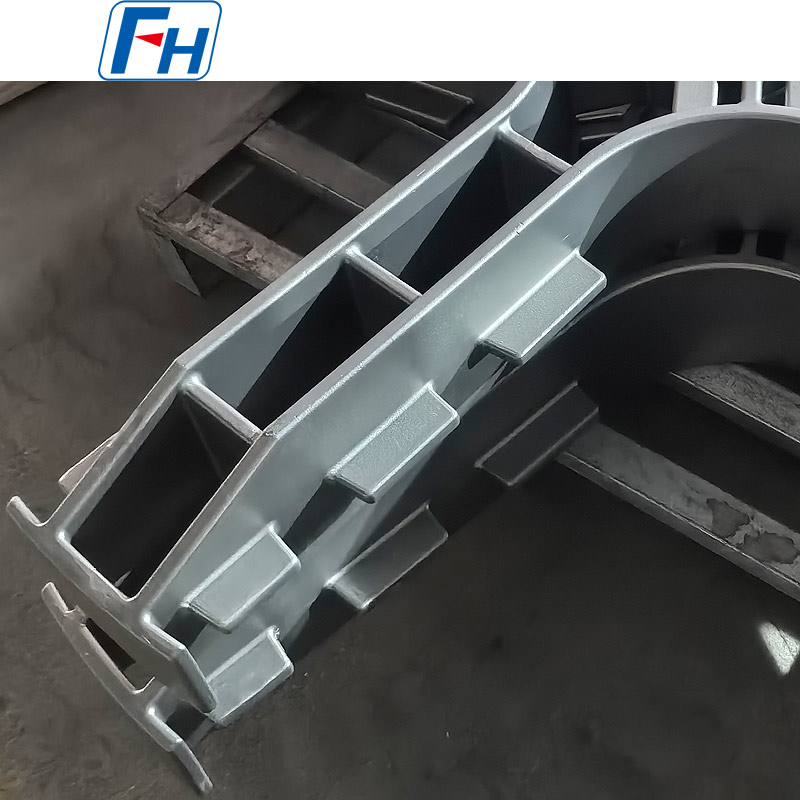

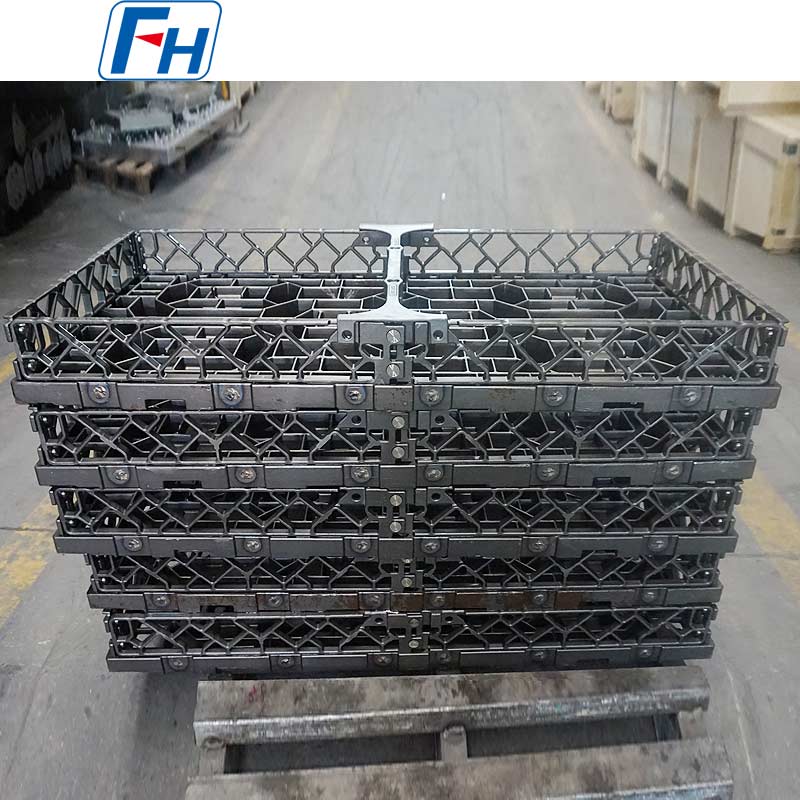
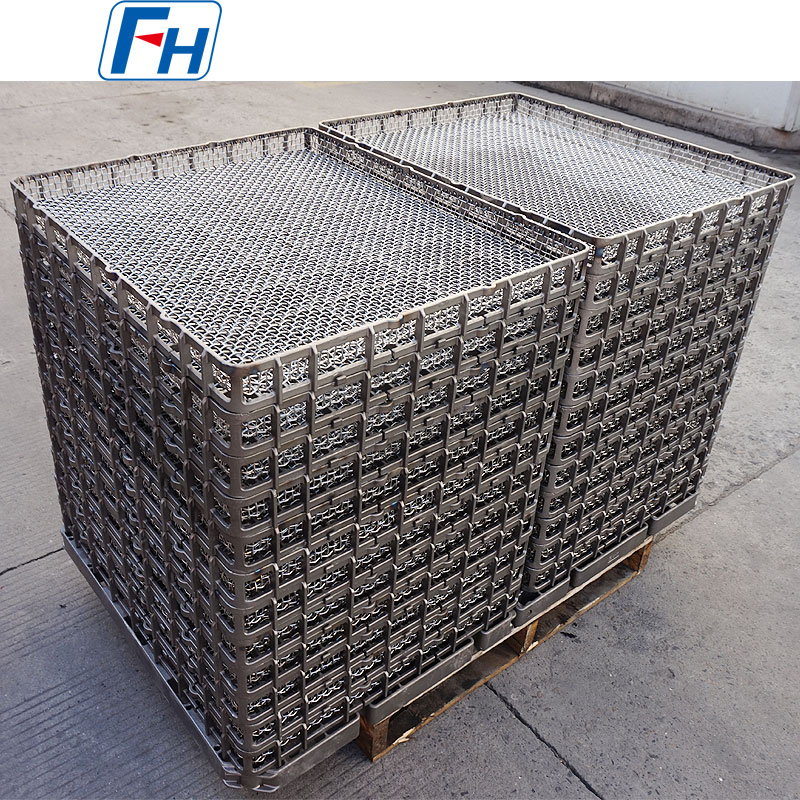
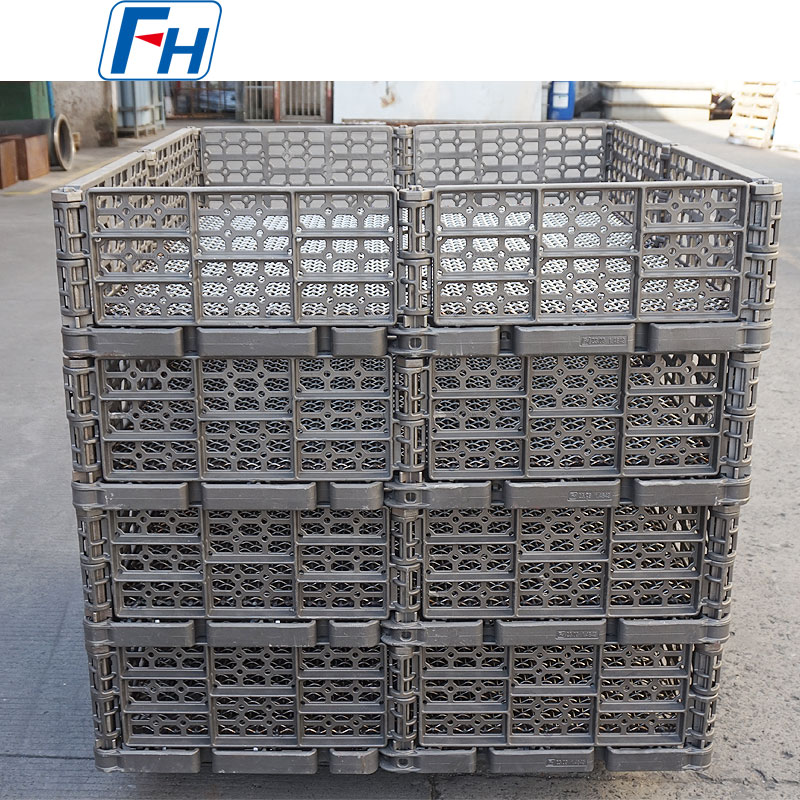
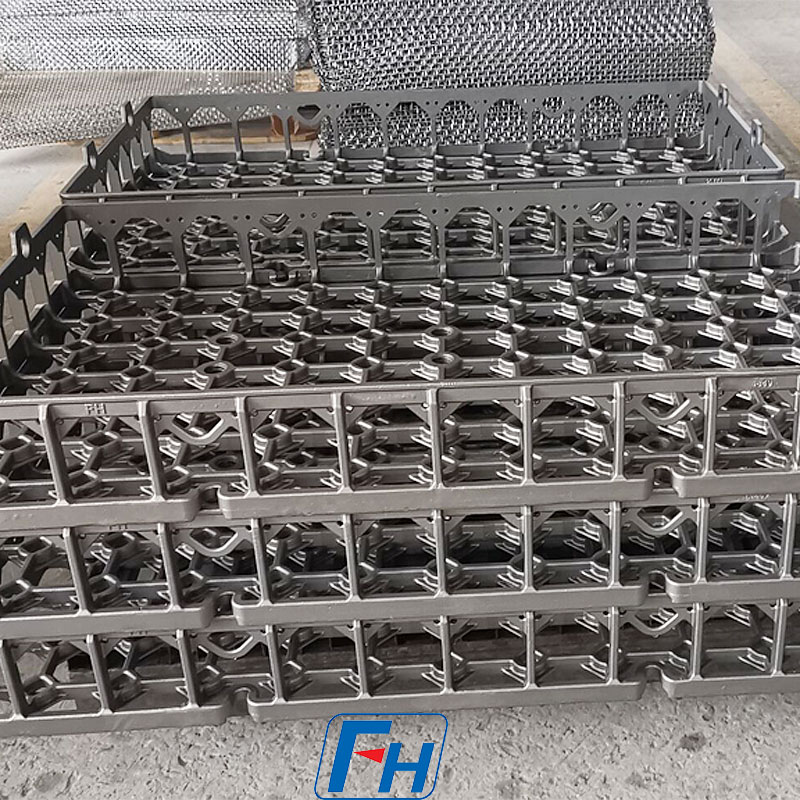


FH® Well-type Furnace Base Tray
Key Benefits
- Heavy-Load Bearing Capacity
Reinforced rib structure and strategically placed support feet distribute weight evenly – supports tall stacks of parts or multiple baskets without center sagging. - High Creep Strength Material
1.4849, 310S, or 1.4828 heat-resistant alloys maintain dimensional stability at 850–1050°C – no progressive deformation over hundreds of cycles. - Gas Circulation Optimized
Raised feet create a gap between tray and furnace bottom – allows hot gas or atmosphere to flow under the lowest layer for uniform heating. - Anti-Carburization / Anti-Nitriding
High-silicon alloys (1.4849 / 1.4828) resist carbon and nitrogen penetration – extends service life in aggressive atmospheres. - Custom Shape & Size
Circular or rectangular – precisely matched to your furnace internal diameter or dimensions. Segmented options for large diameters.
Technical Specifications
| Parameter | Value |
| Typical materials | 1.4849, 310S, 1.4828 (specified by customer) |
| Max. continuous temp. | 1050°C (1.4849) / 950°C (310S) / 1000°C (1.4828) |
| Shape | Circular (standard) or rectangular |
| Support feet height | 50 – 200 mm (custom) |
| Grid pattern | Open grid / perforated plate / cast solid |
| Max. load | 500 – 3000 kg (design dependent) |
| Fabrication | Precision welding or investment casting |
| Standard diameters | 600 mm, 800 mm, 1000 mm, 1200 mm (custom available) |
| Expected service life | 300 – 600 cycles (depending on material & atmosphere) |
| Material test certificate (MTC) included with every FH® heat treatment base tray | |
Why Choose FH® Well-type Furnace Base Trays?
1. The Foundation of Your Entire Load
The base tray supports everything above it. If it sags, cracks, or fails, the entire batch is compromised – parts may tip, baskets may bind, and heating becomes uneven. FH® base trays are engineered specifically for this critical role.
2. Material Selection Guide
| Material | Max Temp | Best For |
| 310S | 950°C | General carburizing / hardening, moderate loads |
| 1.4828 | 1000°C | Higher temperature annealing, good anti-carburization |
| 1.4849 | 1050°C | Heavy loads, long cycles, aggressive carburizing atmospheres |
| Cast Ni-base | 1100°C+ | Extreme conditions (special order) |
3. Design Features That Matter
| Feature | Benefit |
| Reinforced rib underside | Prevents center sagging under heavy loads |
| Raised support feet | Allows gas flow under bottom layer – uniform heating |
| Smooth top surface | Stable base for stacking baskets |
| Rounded corners (rectangular) | Reduces stress concentration |
| Segmented construction (large diameters) | Easy installation through top opening |
| Pre-oxidized surface | Forms protective oxide layer – reduces scaling |
4. Anti-Carburization = Longer Life
- In carburizing furnaces, carbon penetrates and embrittles ordinary trays. FH® uses:
- High-silicon alloys (1.4828, 1.4849) – silicon forms a barrier against carbon diffusion
- Pre-oxidation treatment – creates stable Cr₂O₃ / SiO₂ layer
- Smooth surfaces – reduces carbon adhesion and soot buildup
Applications
- Well-type / pit carburizing furnaces
- Well-type annealing furnaces
- Well-type tempering furnaces (medium-high temperature)
- Well-type gas nitriding furnaces (with 310S or 1.4849)
- Parts: large gears, shafts, rings, dies, tooling, long tubes, heavy castings
Material Grade Table:
| Heat-resistant Steel | |||||||||||||
| / | GB | DIN | ASTM | JIS | Chemical Composition (%) | Maximum Operation Temperature | |||||||
| C | Si | Mn | Cr | Ni | Nb/Cb | Mo | Other | ||||||
| 1 | ZG40Cr27Ni4 | 1.4823 | HD | SCH11 | 0.30 - 0.50 | ≤2.00 | ≤1.00 | 24.00 - 28.00 | 4.00 - 6.00 | - | ≤0.50 | - | 1050℃ |
| 2 | ZG40Cr22Ni10 | 1.4826 | HF | SCH12 | 0.30 - 0.50 | 1.00 - 2.50 | ≤2.00 | 19.00 - 23.00 | 8.00 - 12.00 | - | ≤0.50 | - | 950℃ |
| 3 | ZG30Cr28Ni10 | - | HE | SCH17 | 0.20 - 0.50 | ≤2.00 | ≤2.00 | 26.00 - 30.00 | 8.00 - 11.00 | - | - | - | 1050℃ |
| 4 | ZG40Cr25Ni12 | 1.4837 | HH | SCH13 | 0.30 - 0.50 | 1.00 - 2.50 | ≤2.00 | 24.00 - 27.00 | 11.00 - 14.00 | - | ≤0.50 | - | 1050℃ |
| 5 | ZG30Cr28Ni16 | - | HI | SCH18 | 0.20 - 0.50 | ≤2.00 | ≤2.00 | 26.00 - 30.00 | 14.00 - 18.00 | - | - | - | 1100℃ |
| 6 | ZG40Cr25Ni20Si2 | 1.4848 | HK | SCH21 | 0.30 - 0.50 | ≤1.75 | ≤1.50 | 23.00 - 27.00 | 19.00 - 22.00 | - | ≤0.50 | - | 1100℃ |
| 7 | ZG30Cr20Ni25 | - | HN | SCH19 | 0.20 - 0.50 | ≤2.00 | ≤2.00 | 19.00 - 23.00 | 23.00 - 27.00 | - | - | - | 1100℃ |
| 8 | ZG40Cr19Ni39 | 1.4865 | HU | SCH20 | 0.35 - 0.75 | ≤2.50 | ≤2.00 | 17.00 - 21.00 | 37.00 - 41.00 | - | - | - | 1020℃ |
| 9 | ZG40Cr15Ni35 | 1.4806 | HT | SCH15 | 0.35 - 0.70 | ≤2.00 | ≤2.00 | 15.00 - 19.00 | 33.00 - 37.00 | - | ≤0.50 | - | 1000℃ |
| 10 | ZG40Cr25Ni35Nb | 1.4852 | HPCb | SCH24Nb | 0.30 - 0.50 | ≤2.00 | ≤2.00 | 24.00 - 28.00 | 33.00 - 37.00 | 0.80 - 1.80 | ≤0.50 | - | 1100℃ |
| 11 | ZG40Cr19Ni39Nb | 1.4849 | - | - | 0.30 - 0.50 | 1.00 - 2.50 | ≤2.00 | 18.00 - 21.00 | 36.00 - 39.00 | 1.20- 1.80 | ≤0.50 | - | 1100℃ |
| 12 | ZG40Cr24Ni24Nb | 1.4855 | - | - | 0.30 - 0.50 | 1.00 - 2.50 | ≤2.00 | 23.00 - 25.00 | 23.00 - 25.00 | 0.80 - 1.80 | ≤0.50 | - | 1050℃ |
| 13 | ZG40Cr25Ni35 | 1.4857 | HP | SCH24 | 0.35 - 0.50 | 1.00 - 2.50 | ≤2.00 | 24.00 - 28.00 | 33.00 - 37.00 | - | ≤0.50 | - | 1100℃ |
| 14 | ZG1Cr20Ni32Nb | 1.4859 | - | - | 0.06 - 0.15 | 0.50 - 1.50 | ≤2.00 | 19.00 - 21.00 | 31.00 - 33.00 | 0.50 - 1.50 | ≤0.50 | - | 1050℃ |
| 15 | ZG45Cr12Ni60 | - | HW | - | 0.35 - 0.75 | ≤2.00 | ≤2.00 | 10.00 - 14.00 | 58.00 - 62.00 | - | - | - | 1100℃ |
| 16 | ZG45Cr18Ni66 | - | HX | - | 0.35 - 0.75 | ≤2.00 | ≤2.00 | 15.00 - 19.00 | 64.00 - 68.00 | - | - | - | 1100℃ |
| 17 | ZG1Cr28Co50 | 2.4778 | - | - | 0.05 - 0.25 | 0.50 - 1.00 | ≤1.50 | 27.00 - 30.00 | ≤1.00 | ≤0.50 | ≤0.50 | Co:48.0 - 52.0 | 1200℃ |
| 18 | ZG30Cr28Co50Nb | 2.4779 | - | - | 0.25 - 0.35 | 0.50 - 1.50 | 0.50 - 1.50 | 27.00 - 29.00 | - | 1.50 - 2.50 | ≤0.50 | Co:48.0 - 52.0 | 1200℃ |
| 19 | ZG40Cr28Ni48W5 | 2.4879 | - | SCH42 | 0.35 - 0.55 | 1.00 - 2.00 | ≤1.50 | 27.00 - 30.00 | 47.00 - 50.00 | - | ≤0.50 | W:4.0 - 5.5 | 1200℃ |
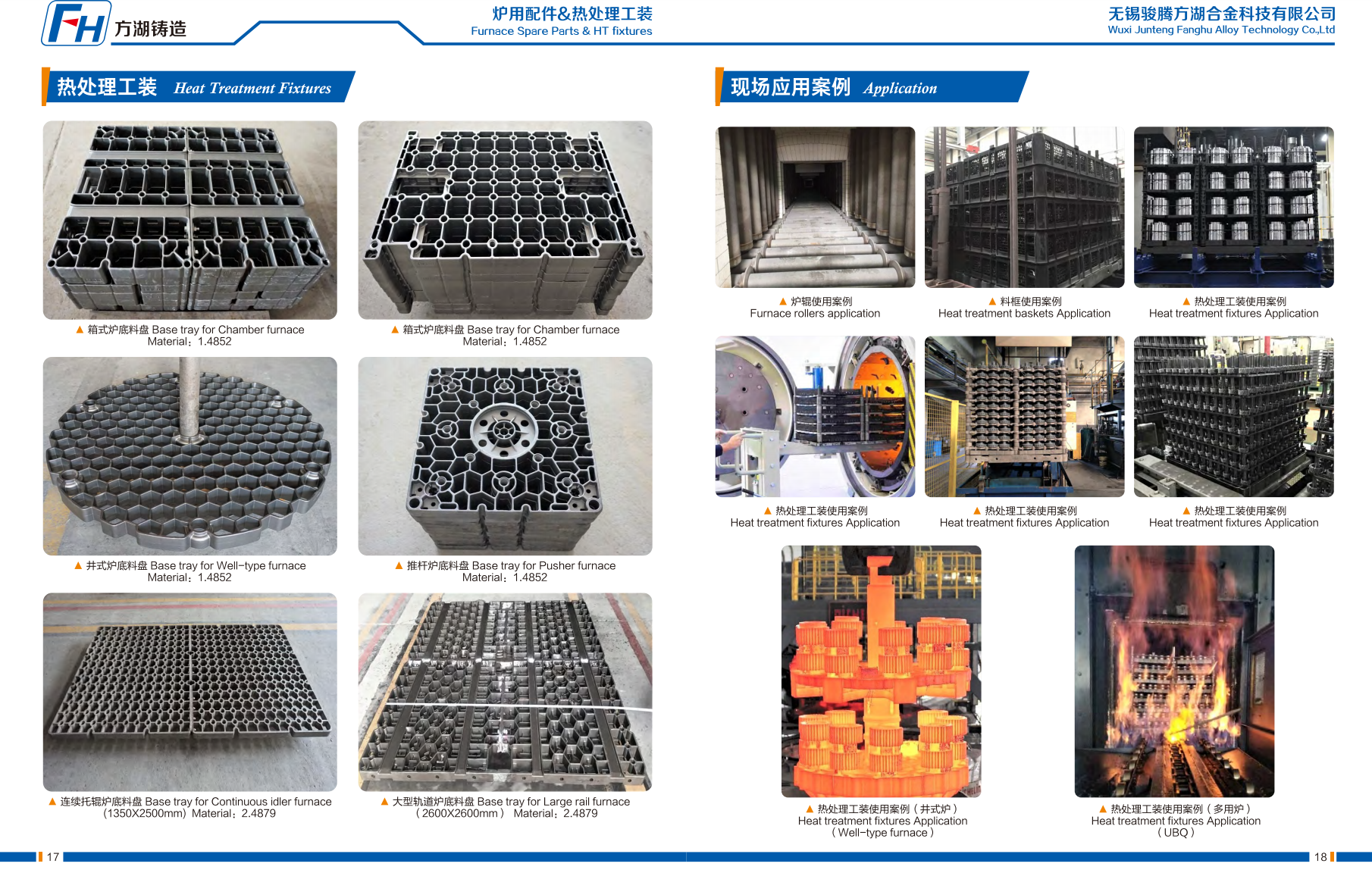
Genuine Photos of FH® Heat Treatment Base Trays
Ordering Process
- Provide furnace internal diameter (or length × width) and depth
- Share max load weight and operating temperature
- Specify atmosphere (air, carburizing, endogas, nitrogen, ammonia)
- FH® proposes material grade, grid pattern, foot height, and rib layout
- Production: 10–20 working days
- Delivery includes: MTC, flatness inspection report, installation guide
FAQ:
Q1: Why do I need a special base tray for my well-type furnace? Can't I just use a regular basket on the furnace floor?
A: Placing baskets directly on the furnace floor blocks gas circulation under the bottom layer, causing uneven heating. It also concentrates all weight on a small contact area. FH® base trays feature raised feet for gas flow and reinforced ribs to distribute heavy loads evenly – preventing both uneven heating and premature tray failure.
Q2: What material do you recommend for a well-type carburizing furnace at 930°C with 1200 kg total load?
A: 1.4849 is our recommendation. It offers the best creep strength and anti-carburization for heavy loads at 930°C. Expected service life: 400–600 cycles. 310S would be borderline at that load and temperature – expect sagging after 150–200 cycles. We can provide a lifecycle cost analysis to help you decide.
Q3: How do I clean and maintain the base tray?
A: Every 100–150 cycles, remove the tray during scheduled shutdown and lightly bead blast (glass beads, ≤0.3 MPa) to remove carbon soot and loose scale. Check flatness on a level surface. If sag exceeds 5 mm over 1000 mm, consider replacement or repair. Do not hammer or straighten with heat – this introduces stress points that lead to cracking.
Q4: My well-type furnace is 1400 mm diameter. Can you make a one-piece base tray?
A: For diameters over 1000 mm, we typically recommend segmented designs (3–4 interlocking pieces). Segments are easier to install through the top opening without entering the furnace. They also handle thermal expansion better than a single large piece. Yes, we can also make one-piece if your furnace allows side or bottom access – please confirm access method.
Q5: Can this base tray be used in a well-type gas nitriding furnace?
A: Yes. For gas nitriding (500–580°C), we recommend 310S or 1.4849. Both resist nitriding embrittlement better than lower grades. Note that all stainless steel trays will develop a surface nitride layer over time – regular cleaning every 50–80 cycles is recommended. For ion (plasma) nitriding, we recommend smooth surfaces and rounded edges to reduce arcing.
Q6: What is your warranty and do you provide material certificates?
A: 12 months against manufacturing defects (weld cracks, casting flaws, material defects). Normal creep, surface carburization/nitriding, and gradual sagging are considered normal wear – not covered. Every base tray comes with a material test certificate (MTC) for full traceability. Weld inspection reports are available on request.







 Tel: 0510-83310100
  E-mail: info@alloy-casting.com
  Add: Room 1105,Building 6, Jiaye Wealth Center,Wuxi, Jiangsu, P.R.China P.C.:214000.