
 Aug 24, 2026
 In industrial heat treatment production, fixtures are much more than simple carriers used to move components in and out of furnaces.
A properly designed heat treatment fixture helps control:
However, selecting the right fixture is not always straightforward.
A fixture that works well for small batch components may not be suitable for heavy castings. A design used in a conventional furnace may not meet the requirements of a vacuum heat treatment process.
The correct solution depends on the relationship between:
This guide explains the major types of heat treatment fixtures and how engineers select the appropriate design for different industrial applications.
FH® Alloy provides customized heat treatment fixtures based on customer drawings, furnace conditions, and production requirements.
Why Heat Treatment Fixture Selection Matters
During heat treatment, components experience repeated exposure to high temperatures and thermal cycles.
The fixture must maintain its structural function while supporting the workpiece.
An unsuitable fixture design may lead to:
For manufacturers running continuous heat treatment operations, fixture performance directly affects productivity.
A well-designed fixture should achieve a balance between:
Mechanical strength + Heat transfer + Weight optimization + Service life
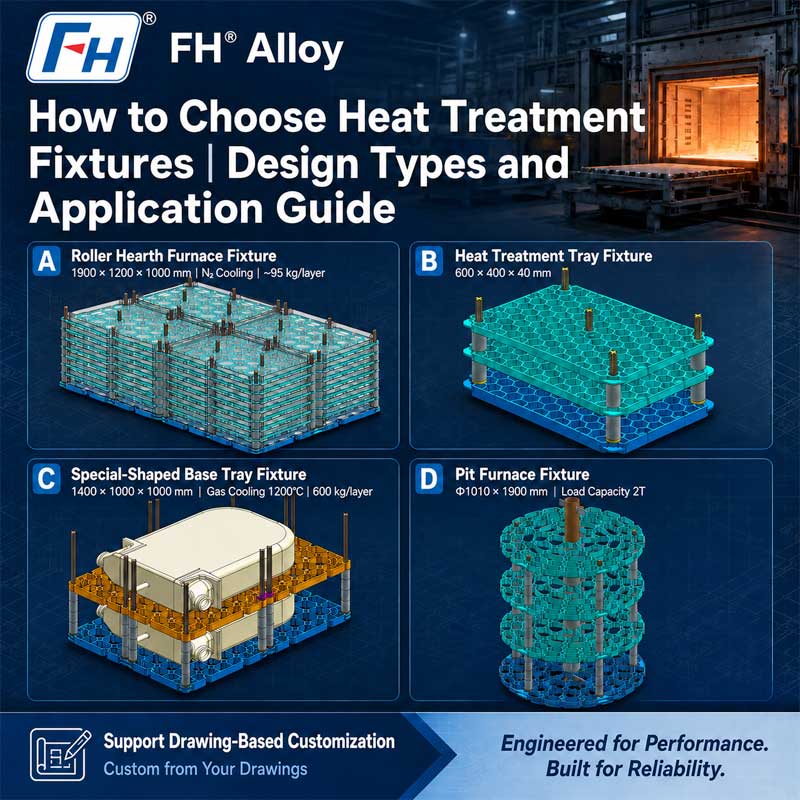
Different Heat Treatment Fixture Designs and Their Applications
There are several common fixture configurations used in industrial furnaces.
The best choice depends on the component shape, process requirements, and furnace environment.
Heat Treatment Baskets: Flexible Solutions for Batch Processing
Heat treatment baskets are commonly selected for batch production where multiple components are processed together.
They are widely used for:
Advantages of Heat Treatment Baskets
Efficient Batch Loading
Baskets allow operators to load many components in one furnace cycle.
This improves:
Good Heat Circulation
Open structures allow heat and furnace atmosphere to reach the components more effectively.
This helps improve temperature uniformity during processing.
Easy Handling
Many industrial baskets include:
These designs make them suitable for repeated production environments.
When Should You Choose a Heat Treatment Basket?
A basket is often suitable when:
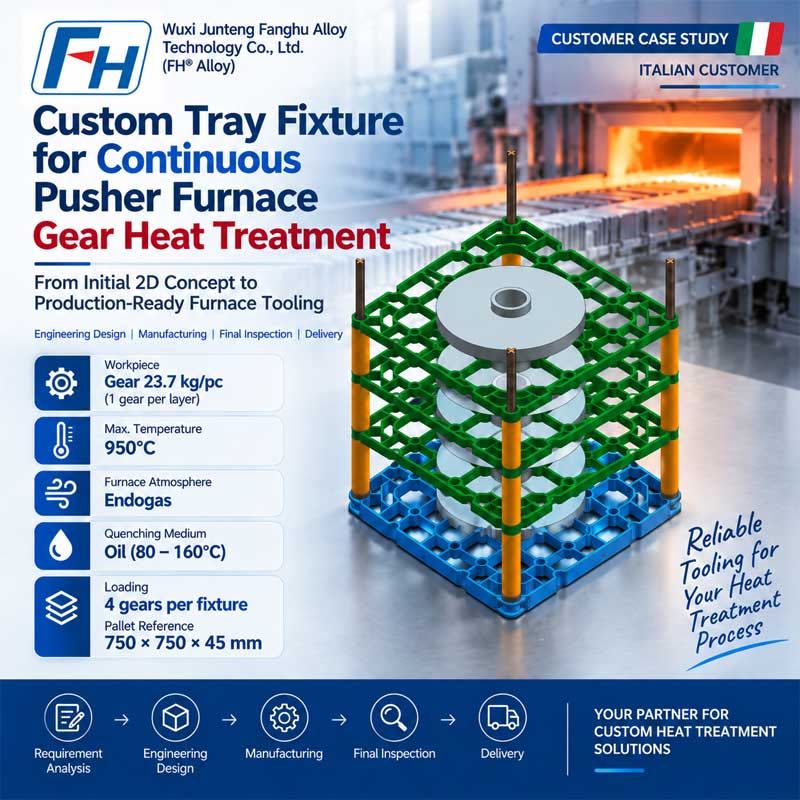
Heat Treatment Trays: Stable Positioning for Precision Components
Heat treatment trays provide a controlled support surface for components that require organized placement.
Compared with baskets, trays usually provide better positioning control.
They are often used for:
Key Design Features of Heat Treatment Trays
Depending on the application, trays may include:
Why Are Trays Used in Heat Treatment?
A tray can help:
For applications requiring dimensional accuracy, tray design can be critical.
Heat Treatment Racks: Supporting Large or Complex Components
Heat treatment racks are designed for applications where components need specific positioning or multi-level support.
They are commonly used for:
Important Rack Design Considerations
Load Distribution
High-temperature strength is not only determined by material.
The structure must distribute loads properly to prevent:
Component Positioning
The rack should provide stable support while allowing:
Furnace Compatibility
Rack dimensions must match:
Grid Fixtures: Optimizing Heat Transfer and Weight
Grid-type fixtures are designed with open structures to improve heat flow.
They are commonly used as:
Advantages of Grid Structures
A properly designed grid fixture can provide:
However, the open structure must still maintain sufficient strength during high-temperature operation.
Custom Heat Treatment Fixtures: Designed Around the Workpiece
Standard fixture designs cannot always meet industrial requirements.
For special components, manufacturers often require customized solutions.
Custom fixtures are developed according to:
Examples of Custom Fixture Applications
Custom designs are often used for:
Matching Fixture Design with Furnace Type
The furnace environment is one of the most important factors when selecting a fixture.
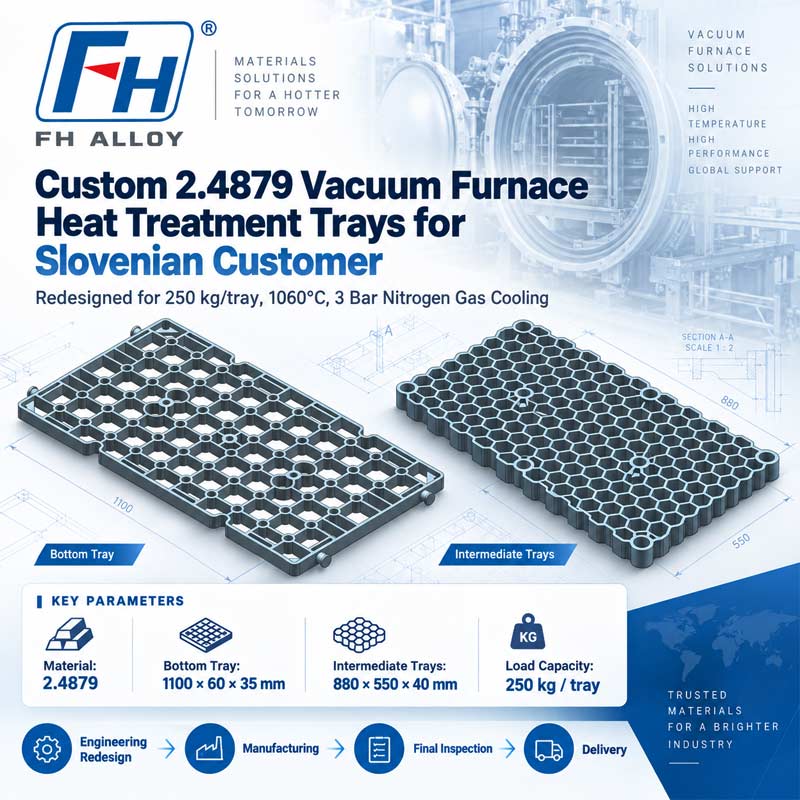
Vacuum Furnace Fixtures
Vacuum furnace applications require special attention to:
Vacuum fixtures usually require optimized structures because heat transfer conditions differ from conventional furnaces.
Pit Furnace Fixtures
Pit furnace fixtures are commonly designed for vertical loading.
Important considerations include:
Roller Hearth Furnace Fixtures
Continuous furnace systems require fixtures that can work together with the transport mechanism.
Design considerations include:
Carburizing Furnace Fixtures
Carburizing processes expose fixtures to demanding thermal and atmospheric conditions.
Material selection and structural design must consider:
Selecting the Right Fixture Material
Fixture design and material selection must be considered together.
Common heat-resistant materials include:
310S Stainless Steel
Often selected for:
1.4848 Heat Resistant Steel
Commonly used where requirements include:
1.4849 and 1.4852 Alloys
Used for more demanding conditions involving:
Nickel-Based Alloys
Selected for applications requiring higher temperature capability or more severe operating conditions.
Key Factors When Selecting Heat Treatment Fixtures
Before choosing a fixture design, engineers should evaluate the following factors.
1. Workpiece Geometry
Consider:
2. Furnace Conditions
Important parameters include:
3. Loading Requirements
Evaluate:
4. Expected Service Life
A fixture designed for occasional use may differ from one operating continuously.
Consider:
Common Mistakes When Choosing Heat Treatment Fixtures
Selecting Only Based on Initial Cost
A lower-cost fixture may result in:
Ignoring Furnace Conditions
A fixture suitable for air atmosphere may not perform well in:
Using Standard Designs for Special Applications
Complex components often require customized support solutions
Custom Heat Treatment Fixture Manufacturing by FH® Alloy
FH® Alloy specializes in manufacturing customized heat treatment fixtures for industrial furnace applications.
Solutions include:
Manufacturing can be based on:
By combining suitable materials, optimized structures, and manufacturing experience, FH Alloy helps customers improve furnace performance and fixture reliability.
FAQ
Q1: What type of heat treatment fixture is most commonly used?
Baskets, trays, and racks are among the most widely used designs. The best choice depends on the workpiece and furnace process.
Q2: How do I select a heat treatment fixture?
Selection should consider workpiece dimensions, furnace type, temperature, atmosphere, loading method, and expected service life.
Q3: Can heat treatment fixtures be customized?
Yes. Most industrial furnace fixtures are customized according to actual production requirements.
Q4: What materials are suitable for high-temperature fixtures?
Common materials include 310S, 1.4848, 1.4849, 1.4852, and other heat-resistant alloys.
Conclusion
Choosing the right heat treatment fixture requires more than selecting a basket, tray, or rack.
The fixture must be designed according to the complete operating environment:
A properly selected fixture can improve production efficiency, reduce deformation risks, and provide longer service life.
FH® Alloy provides customized heat treatment fixtures for industrial customers requiring reliable high-temperature furnace solutions.
Related Articles
 CategoryRecent Post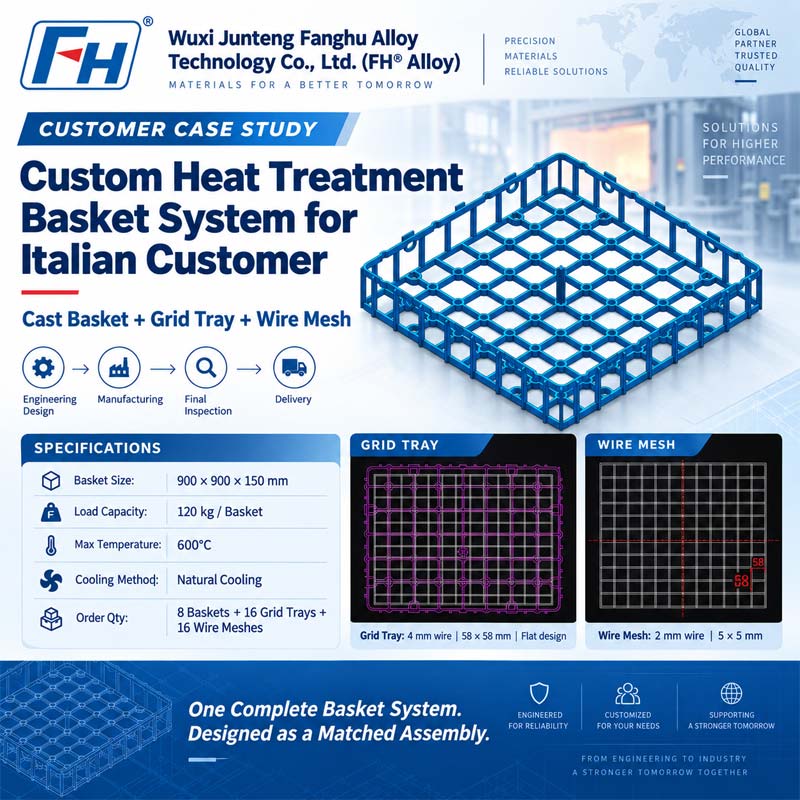

Focus on Designing and Manufacturing Alloy Steel Parts since 2006
 Tel: 0510-83310100
  E-mail: info@alloy-casting.com
  Office Add: Room 1105,Building 6, Jiaye Wealth Center,Wuxi, Jiangsu, P.R.China P.C.:214000.
  Privacy

 English
 Español
 italiano
 Deutsch
 0086-13338774804
