 Jul 13, 2026
 Content
If your furnace runs above 950°C, carries heavy or irregular loads, or operates on a continuous cycle with frequent thermal shock, a cast heat treatment basket is almost always the better choice. If your process runs at moderate temperature, needs fast air or gas flow around small parts, or you need to keep basket weight down to save energy, a wrought or wire mesh basket will usually serve you better and cost less upfront. The right answer depends less on preference and more on load weight, furnace type, and how many thermal cycles the basket has to survive.
Both basket types are used across chamber, pit, pusher, vacuum and roller hearth furnaces, but they are built differently and behave differently under repeated heating and cooling. The table below summarizes the practical differences that matter most when specifying a basket.
| Factor | Cast Basket | Wrought / Wire Mesh Basket |
|---|---|---|
| Manufacturing method | Investment casting or centrifugal casting of alloy steel | Welded or woven from formed steel bar, rod or wire |
| Typical load capacity | Medium to heavy, concentrated or irregular loads | Light to medium, evenly distributed small parts |
| Thermal cycle resistance | High, resists thermal fatigue and warping | Moderate, thinner sections fatigue faster under repeated cycling |
| Airflow / gas penetration | Lower, denser wall sections | High, open structure suits gas carburizing and quenching |
| Weight | Heavier, adds thermal mass to the load | Lighter, reduces furnace energy consumption per cycle |
| Repair and modification | Difficult once cast, limited field repair | Easier to re-weld, patch or reshape on site |
| Typical service life | Longer under high-temperature, high-load duty | Shorter under high load, longer under light duty |
| Best furnace type | Pit furnace, roller hearth furnace, salt bath furnace | Chamber furnace, mesh belt furnace, vacuum brazing furnace |
A cast basket is produced through investment casting or centrifugal casting, which allows the internal support ribs, corner joints and load-bearing sections to be formed as a single continuous structure rather than assembled from separate welded pieces. This matters because welded joints are usually the first point of failure in a furnace fixture. Under repeated heating past 1000°C and rapid cooling, a welded joint experiences concentrated thermal stress at the weld line, while a cast structure distributes that stress across a smoothly transitioned cross-section.
In practical terms, a cast basket built from heat-resistant alloys such as 1.4849 or 2.4879 can typically support several hundred kilograms of unevenly distributed parts without localized sagging, which is common when gear blanks, shafts, or forged components are loaded off-center. Centrifugal casting is particularly effective for producing dense, fine-grain wall sections that resist creep deformation at sustained high temperature, making it a preferred route for baskets used in continuous roller hearth or pusher furnaces where the fixture almost never fully cools down between cycles.
Wire mesh and wrought baskets are fabricated from formed steel bar or wire that is welded into a grid or basket-weave structure. Because the wall sections are thin and open, these baskets carry far less thermal mass than a cast equivalent of the same size. That difference is not trivial: in gas carburizing or vacuum brazing furnaces, every kilogram of fixture mass has to be heated and cooled along with the workpieces, and a lighter basket can reduce the cycle time and the associated energy cost by a measurable margin.
The open mesh structure also allows quenching oil, protective gas, or vacuum atmosphere to reach the workpiece surface more evenly, which is exactly why mesh screens are standard equipment in vacuum brazing and low-pressure carburizing furnaces. For small fasteners, bearing components, or thin-walled parts that do not generate heavy point loads, a welded mesh basket is usually lighter on the crane, easier to load by robot arm, and less expensive to replace when it eventually wears out.
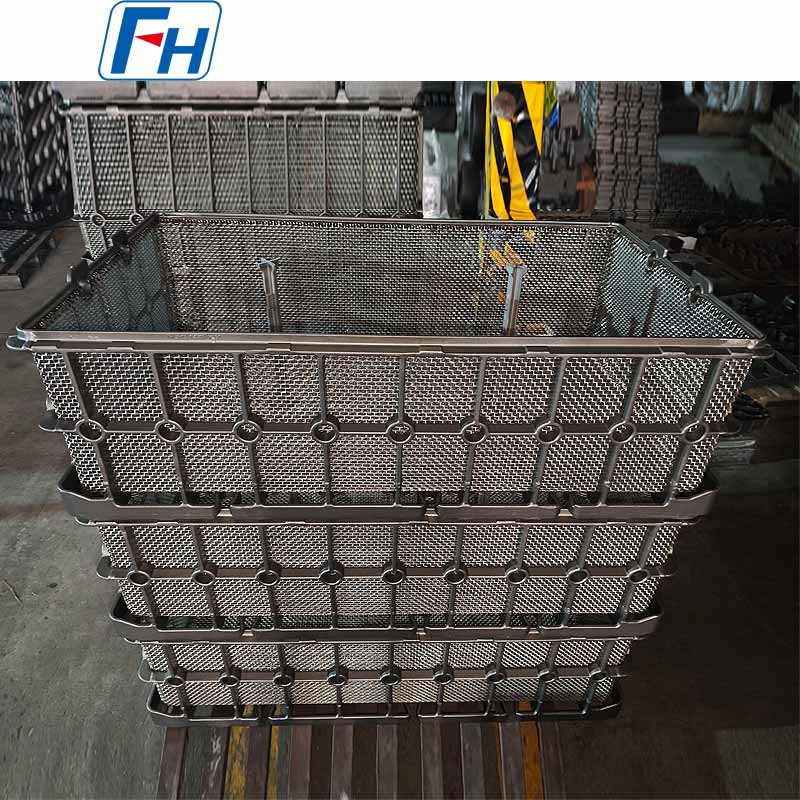
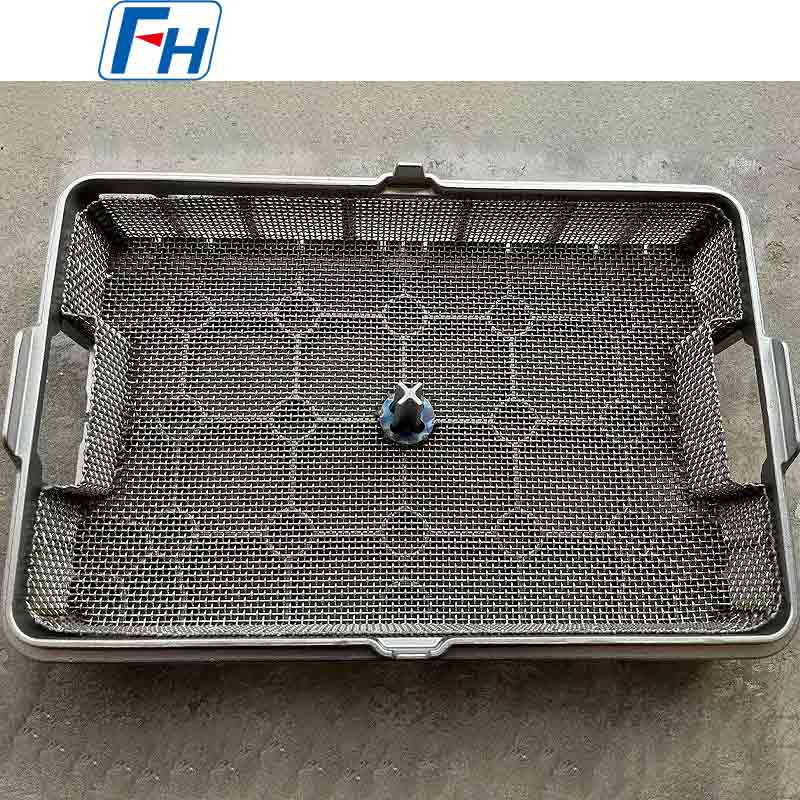
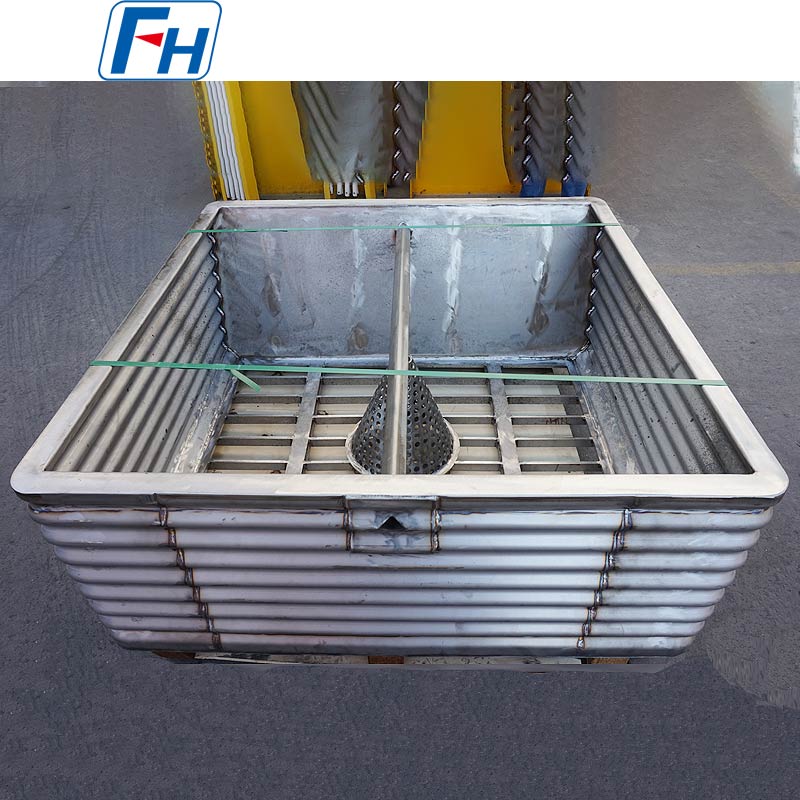
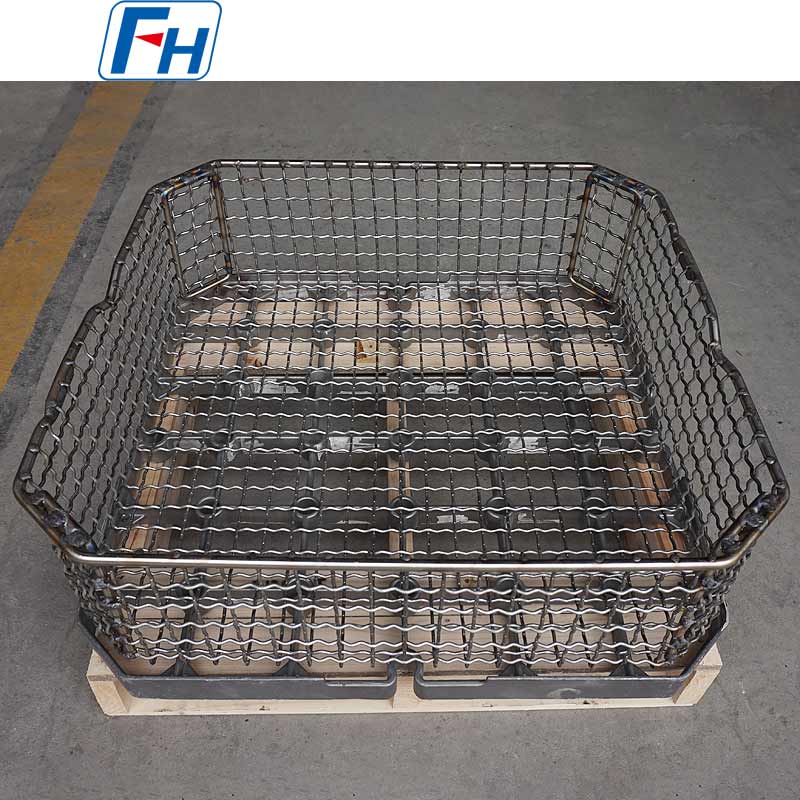
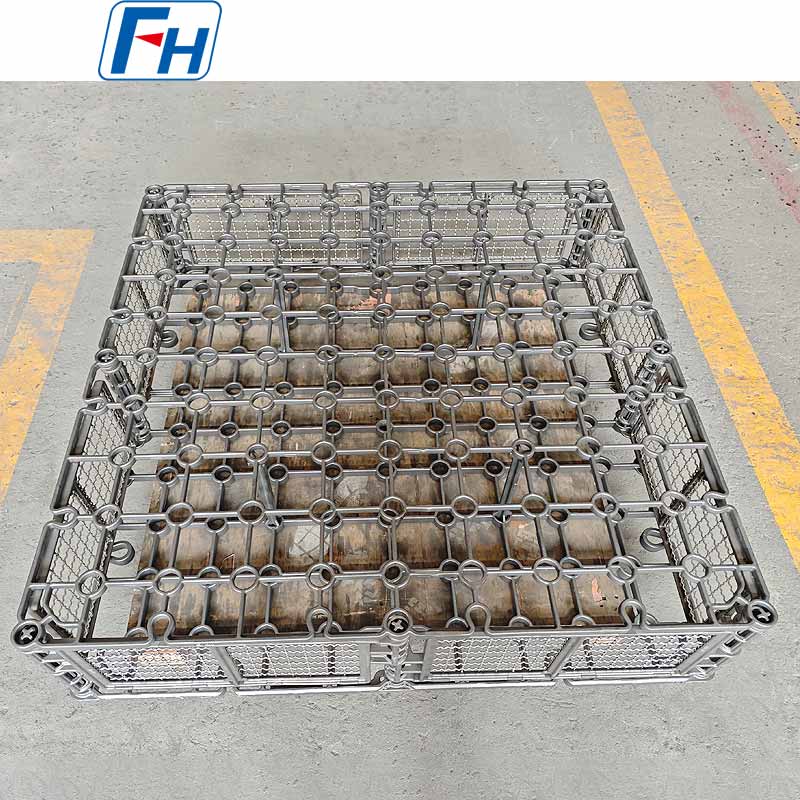
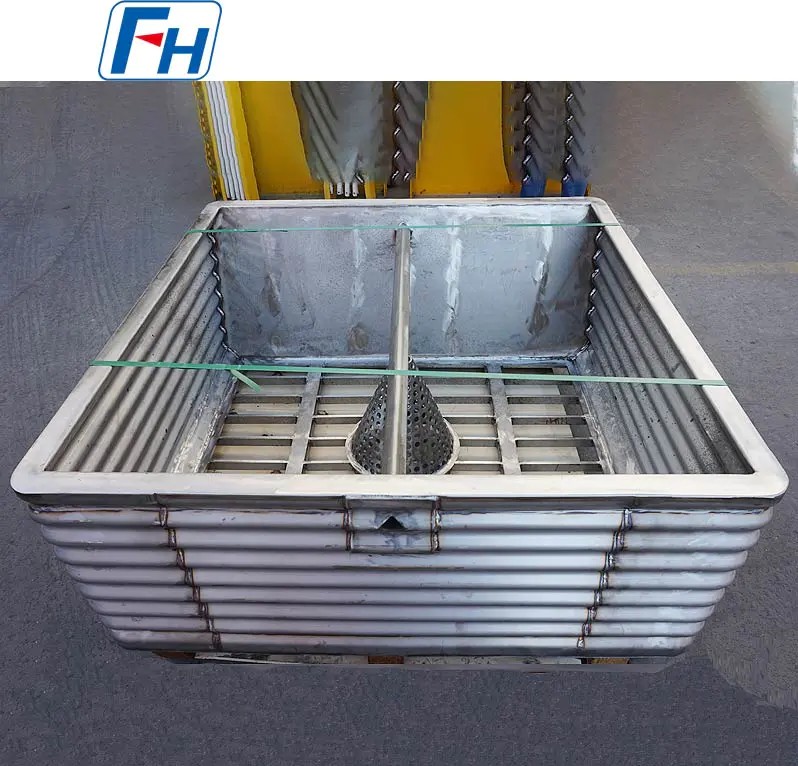
The comparison above becomes easier to apply once you see how these structures are actually built. The selection below shows both cast and welded mesh basket designs used across vacuum, roller hearth, and multi-purpose furnace applications.
From stackable vacuum furnace baskets to welded mesh screens and combined charging baskets, each design is engineered for a specific furnace type, load profile and temperature range.
A basket rarely works alone. It sits on a heat-treatment base tray, is positioned by a heat-treatment fixture, and often travels through the furnace on furnace rollers or a hearth roll designed for cast link belt furnaces. When evaluating cast versus mesh construction, it helps to look at the whole loading system rather than the basket in isolation.
For precision applications such as aerospace or bearing components, a precision casting basket built to tight support-point tolerances can reduce workpiece distortion by keeping spacing between internal supports below roughly 200 mm, which is a meaningful factor regardless of whether the outer shell is cast or welded.
Use the checklist below as a quick reference when specifying a new basket for an existing or new furnace line.
| Question | If yes, lean toward |
|---|---|
| Does the load exceed 150 kg per basket or include irregular, heavy parts | Cast basket |
| Does the furnace run continuously above 1000°C | Cast basket |
| Do parts need fast, even gas or oil penetration | Wire mesh basket |
| Is minimizing basket weight important for energy savings | Wire mesh basket |
| Is on-site field repair by welding a requirement | Wire mesh basket |
| Is long-term durability more important than upfront cost | Cast basket |
There is no single basket that is universally better, only a better fit for a given furnace, load, and temperature profile. Heavy, irregular loads in high-temperature, high-cycle furnaces call for a cast basket built from a wear resistant, thermal-fatigue resistant alloy. Light, evenly distributed loads that need fast atmosphere penetration and lower thermal mass are better served by a welded wire mesh basket. Many production lines actually use both: cast baskets for the heaviest, longest-running furnaces, and mesh baskets for lighter, faster-cycling processes, matching each fixture to the job it does best.
 Category
Focus on Designing and Manufacturing Alloy Steel Parts since 2006
 Tel: 0510-83310100
  E-mail: [email protected]
  Office Add: Room 1105,Building 6, Jiaye Wealth Center,Wuxi, Jiangsu, P.R.China P.C.:214000.
  Privacy

 English
 Español
 italiano
 Deutsch
 0086-13338774804