 Aug 03, 2026
 Content
Selecting and designing a heat treatment fixture comes down to four decisions made in order: match the fixture to the furnace type and peak temperature, choose a heat-resistant alloy grade that survives the thermal cycle without creeping or cracking, design the load path so the workpiece is supported without restricting thermal expansion, and pick a casting method (investment casting or centrifugal casting) suited to the fixture geometry. Skipping any one of these steps is the most common reason fixtures warp, crack, or shorten furnace uptime.
A heat-treatment fixture is a supporting, positioning, and securing device built specifically for high-temperature furnace work. Before comparing suppliers or drawings, four variables should be locked down first.
Vacuum furnaces, pit-type IPSEN furnaces, chain casting furnaces, and radiant heat tube furnaces each impose different heat paths and atmosphere chemistry. A fixture rated for 950°C carburizing service will not survive 1180°C vacuum brazing.
Total workpiece weight, stacking height, and part geometry determine whether a basket, base tray, or welded rack design is more efficient. Overloading is the single largest cause of premature sagging.
Cr-Ni heat-resistant steel castings (such as Cr25Ni20, 1.4848, 1.4849, or 1.4852) each carry different creep-resistance and oxidation limits that must match the furnace cycle.
Investment (lost-wax) casting suits complex fixture bodies; centrifugal casting suits round, symmetrical parts such as furnace rollers and radiant heat tubes.
Different furnace families require different auxiliary components alongside the fixture itself. The table below outlines typical matching.
| Furnace Type | Typical Fixture / Component | Notes |
| Vacuum / IPSEN pit-type furnace | Welded heat treatment fixtures, Precision Casting Basket | Requires tight dimensional tolerance and low outgassing surfaces |
| Continuous mesh belt / pusher furnace | Furnace Rollers for Continuous Furnace, AFC Pusher Head | Rollers must resist rail wear across thousands of cycles |
| Chain casting / link-belt furnace | Hearth Roll for Cast Link Belt Furnace, Chain plate for chain casting furnace | Chain plate geometry directly affects belt tracking accuracy |
| Radiant tube heating furnace | Radiant heat tube, Furnace Piers | Piers support tube weight and prevent sag under sustained heat |
| Circulating atmosphere furnace | Ipsen Fan Blade | Fan blade balance affects temperature uniformity across the load |
| Roller hearth / bogie furnace | AFC Furnace Roller Rails and Rollers, Heat Treatment Base Trays | Base trays distribute point loads evenly across the roller bed |
Once the furnace and load profile are known, the next design step is grade selection. The four grades below cover most industrial carburizing, nitriding, and vacuum cycles.
Continuous use up to approx. 1100°C
Balanced chromium-nickel content gives strong resistance to carburizing atmospheres, commonly used for general-purpose base trays and racks.
Continuous use up to approx. 1100°C
Higher creep strength at elevated load, favored for charging baskets and bogie hearth furnace applications with repeated cycling.
Continuous use up to approx. 1150°C
Improved oxidation resistance, suited to charging racks that see frequent furnace door openings and thermal shock.
Peak temperature up to approx. 1180°C
Top-tier grade for well-type IPSEN furnaces and precision-cast fixtures operating near the upper limit of steel heat resistance.
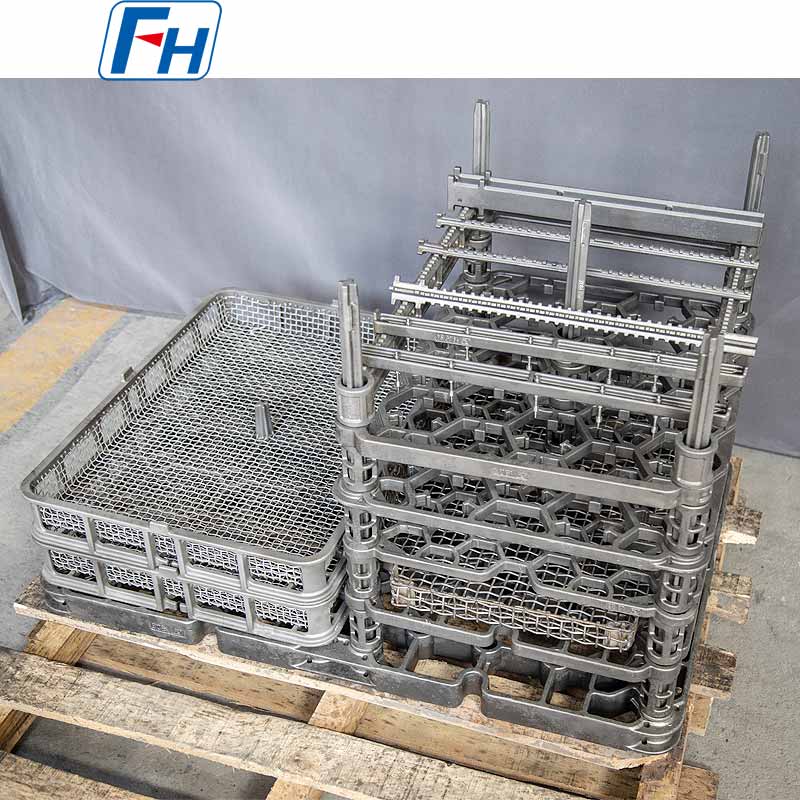
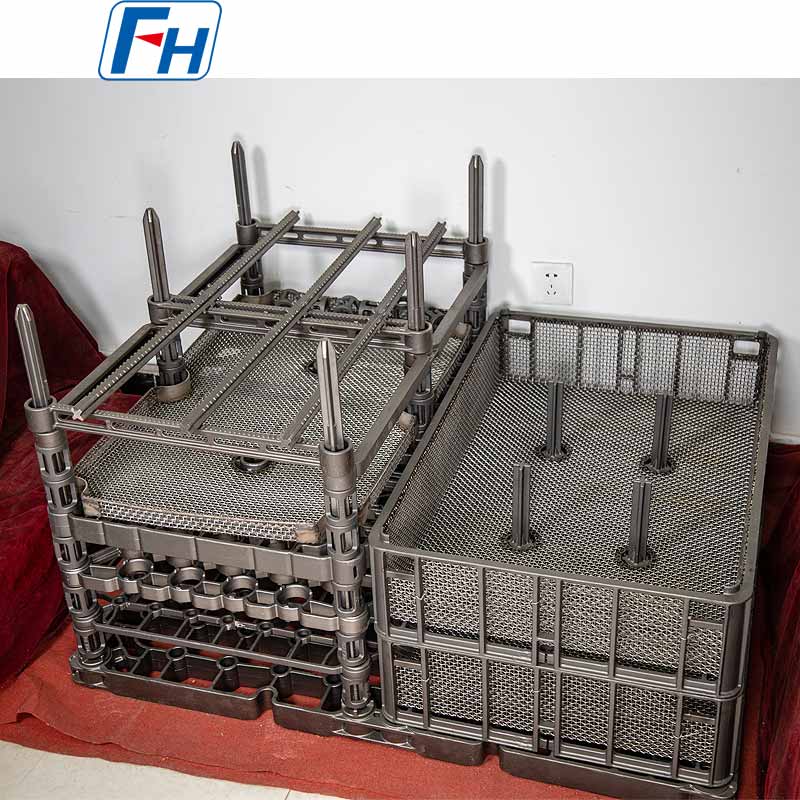
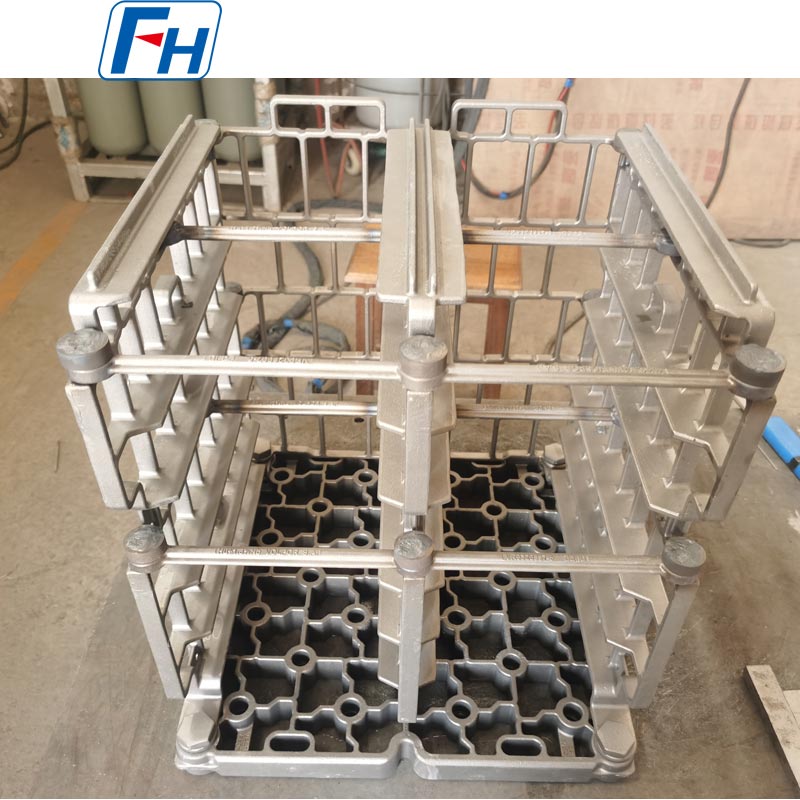
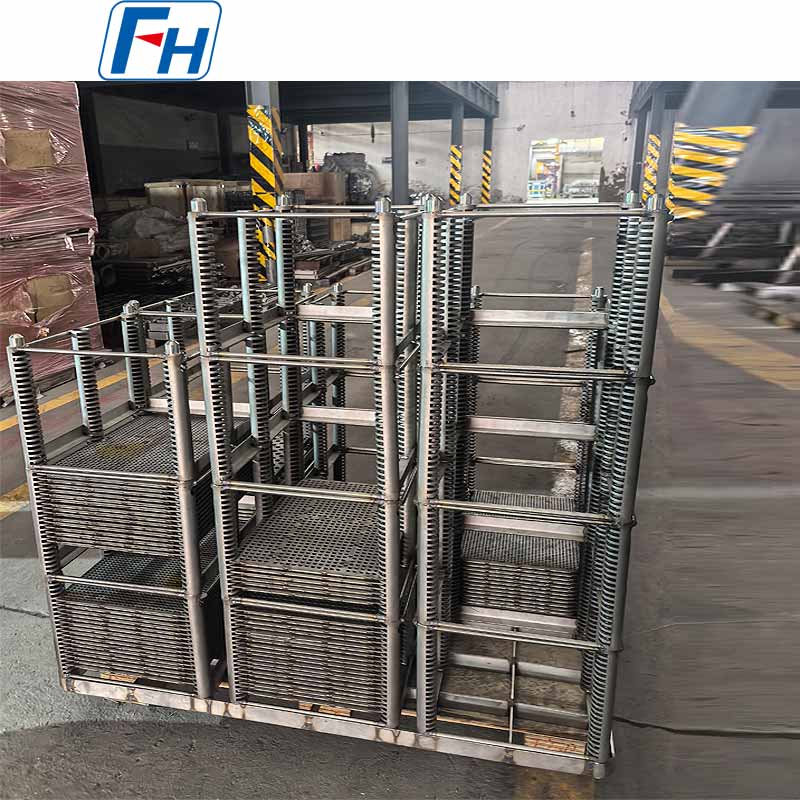
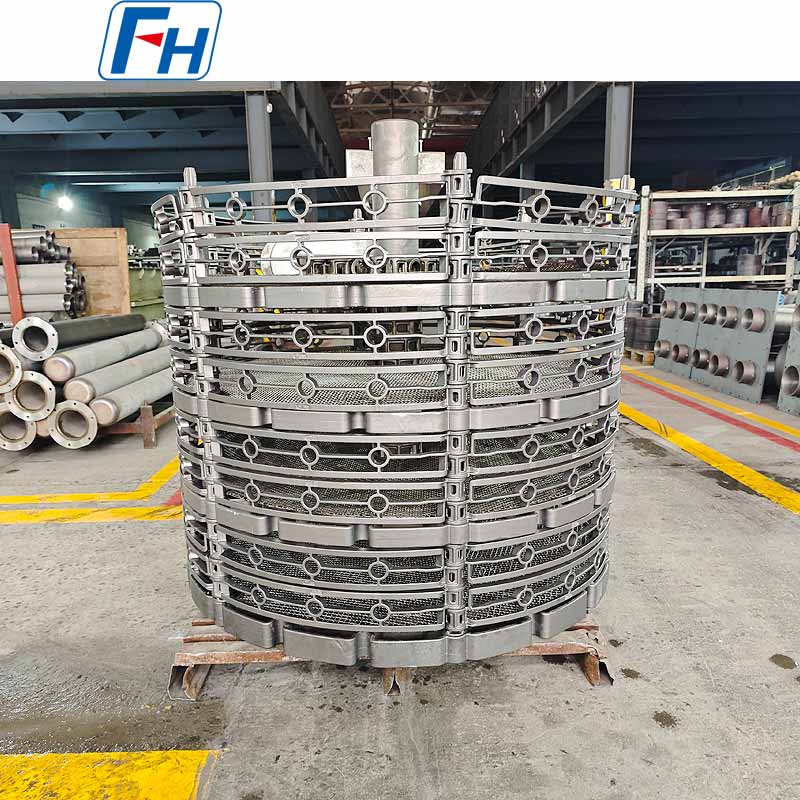
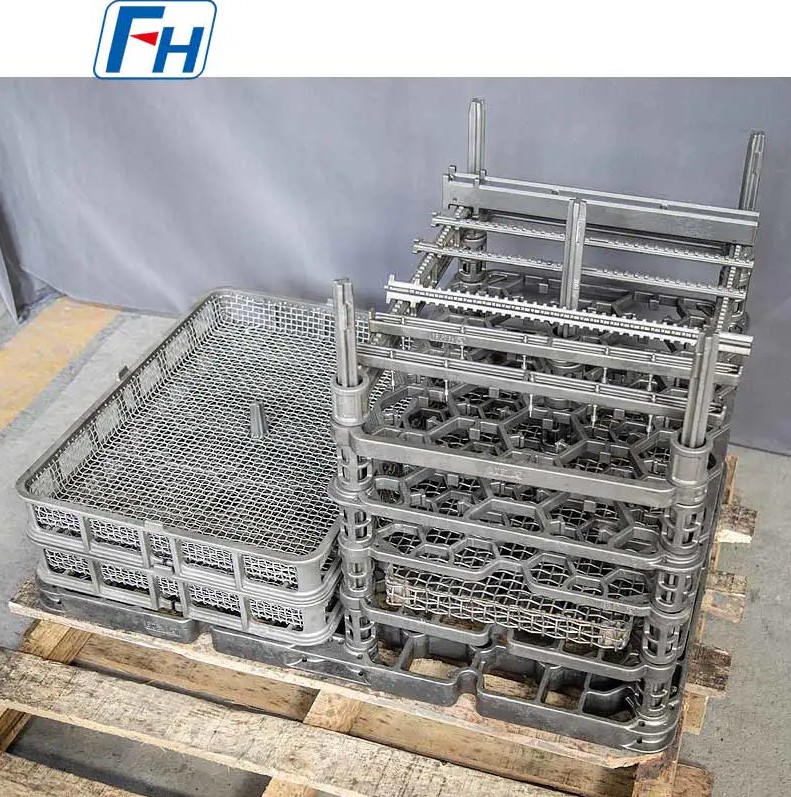
A representative selection of cast and welded fixture designs, spanning continuous-duty racks to precision baskets for vacuum service.
Cast and welded configurations engineered for vacuum, pit-type, and continuous furnace duty, built from heat-resistant alloy grades rated to 1180°C.
Material selection alone will not prevent early failure if the structural design ignores how the fixture actually behaves under repeated heating and cooling.
Concentrated point loads on a Precision Casting Basket or base tray accelerate local creep. Cross-ribbing and multiple support points spread the load across the section instead of a single beam.
Alloy steel expands roughly 1.5 to 2 percent in linear dimension between room temperature and 1100°C. Fixed joints without expansion gaps are a common cause of cracking at welds.
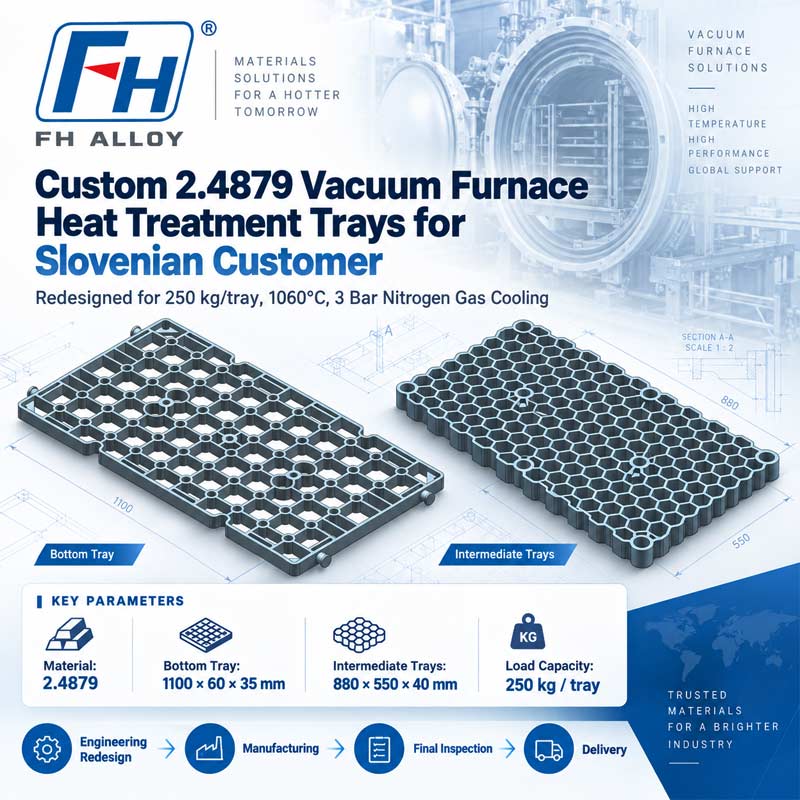
Lighter lattice-style Heat Treatment Base Trays heat and cool faster than solid plates, shortening cycle time and lowering the thermal stress each cycle applies to the casting.
Rail contact edges, roller grooves, and pusher faces benefit from wear resistant liners or hardened inserts, reducing the need to replace the entire fixture when only the contact surface wears out.
The manufacturing route affects both cost and how well the fixture will perform once installed.
| Factor | Investment (Lost-Wax) Casting | Centrifugal Casting |
| Best-suited geometry | Complex fixture bodies, baskets, trays with ribs and cutouts | Round, symmetrical parts such as furnace rollers and radiant heat tubes |
| Surface finish | Smooth, near-net shape, minimal machining | Dense outer skin from spin-cast solidification |
| Grain structure | Fine, uniform grains reduce distortion risk | Directional solidification improves radial strength |
| Typical fixture use | Charging baskets, base trays, welded racks | Furnace rollers, radiant tubes, hearth rolls |
Understanding common failure modes helps prioritize which design decisions matter most during procurement.
Distribution based on typical field return patterns reported across continuous carburizing and vacuum furnace operations; figures illustrate relative proportion rather than absolute rates.
Fixtures in continuous furnace service are typically inspected every 200 to 500 cycles for sagging, cracking, and rail wear, with more frequent checks for fixtures running above 1100°C.
Yes, when the base dimensions, load rating, and alloy grade are matched to the most demanding furnace in the group, a single fixture design can serve IPSEN, AICHELIN, SECO/WARWICK, and similar brands.
Casting is generally preferred for complex, high-cycle fixtures because it avoids weld seams that concentrate thermal stress; welded fixtures remain useful for low-volume or rapid prototyping needs.
 CategoryRecent Post

Focus on Designing and Manufacturing Alloy Steel Parts since 2006
 Tel: 0510-83310100
  E-mail: info@alloy-casting.com
  Office Add: Room 1105,Building 6, Jiaye Wealth Center,Wuxi, Jiangsu, P.R.China P.C.:214000.
  Privacy

 English
 Español
 italiano
 Deutsch
 0086-13338774804