
 May 25, 2026
 Content
In industrial heat treatment and energy equipment sectors, high-chromium nickel series (Cr25Ni20) heat resistant steel castings demonstrate superior creep resistance and oxidation stability compared to medium-chromium low-nickel series (Cr18Ni8) castings when operating in sustained environments above 1100°C. For critical components such as furnace rollers, radiant tubes, and heat treatment fixtures operating beyond 1000°C, selecting high-chromium nickel alloy materials can extend component service life by 30% to 50%, significantly reducing unplanned downtime frequency and maintenance costs.
Heat resistant steel castings can be categorized into two major branches based on alloy systems: medium-chromium austenitic steels and high-chromium nickel austenitic steels. Each has applicable scenarios within the 650°C to 1200°C temperature range, with core differences manifested in alloy composition ratios, microstructural stability, and high-temperature mechanical performance degradation curves.
Typical grades such as Cr18Ni8 series control chromium content within 16% to 20% and nickel content at approximately 8% to 12%. This system maintains structural strength in the 650°C to 950°C range through solid solution strengthening and limited carbide precipitation. Its advantages include controllable raw material costs and wider casting process windows, making it suitable for mass production of relatively simple furnace base plates, trays, and low-temperature section furnace rollers.
However, when service temperatures exceed 1000°C, the austenitic matrix stability of medium-chromium low-nickel series castings declines, with accelerated precipitation rates of σ phase and brittle carbides. This results in high-temperature endurance strength degradation of over 40% from initial values after 500 hours. Consequently, this material is better suited for intermittent operations, large temperature fluctuations, or predominantly medium-to-low temperature working conditions.
Represented by Cr25Ni20 alloy systems, chromium content is elevated to 24% to 28%, nickel content reaches 18% to 22%, with trace additions of niobium and tungsten for carbide morphology control. The high chromium content ensures formation of dense Cr₂O₃-Al₂O₃ composite oxide films on surfaces, with growth rates in 1100°C air environments only one-third those of medium-chromium series castings.
The high nickel proportion significantly enhances austenitic phase stability at elevated temperatures, suppressing σ phase precipitation and enabling casting creep rupture lifetimes exceeding 10,000 hours under 1050°C at 100MPa stress conditions. This material is the preferred choice for continuous annealing furnace radiant tubes, carburizing furnace fan impellers, and industrial kiln lining components operating at 1200°C.
To quantify the performance differences between these two materials in actual working conditions, systematic comparisons are conducted across four dimensions: oxidation resistance, high-temperature strength, corrosion resistance, and process adaptability.
| Performance Dimension | Medium-Chromium Low-Nickel (Cr18Ni8) | High-Chromium Nickel (Cr25Ni20) |
|---|---|---|
| Design Maximum Operating Temperature | 950°C | 1150°C (special formulations up to 1200°C) |
| 1000°C Oxidation Weight Gain Rate | Approx. 0.25 g/m²·h | Approx. 0.08 g/m²·h |
| 1050°C/100MPa Creep Rupture Lifetime | Approx. 3,500 hours | Approx. 12,000 hours |
| σ Phase Precipitation Sensitive Temperature Range | 650°C to 900°C | 750°C to 1050°C (significantly lower precipitation volume) |
| Casting Fluidity and Hot Cracking Tendency | Good fluidity, low hot cracking risk | Medium fluidity, requires controlled pouring temperature and cooling rate |
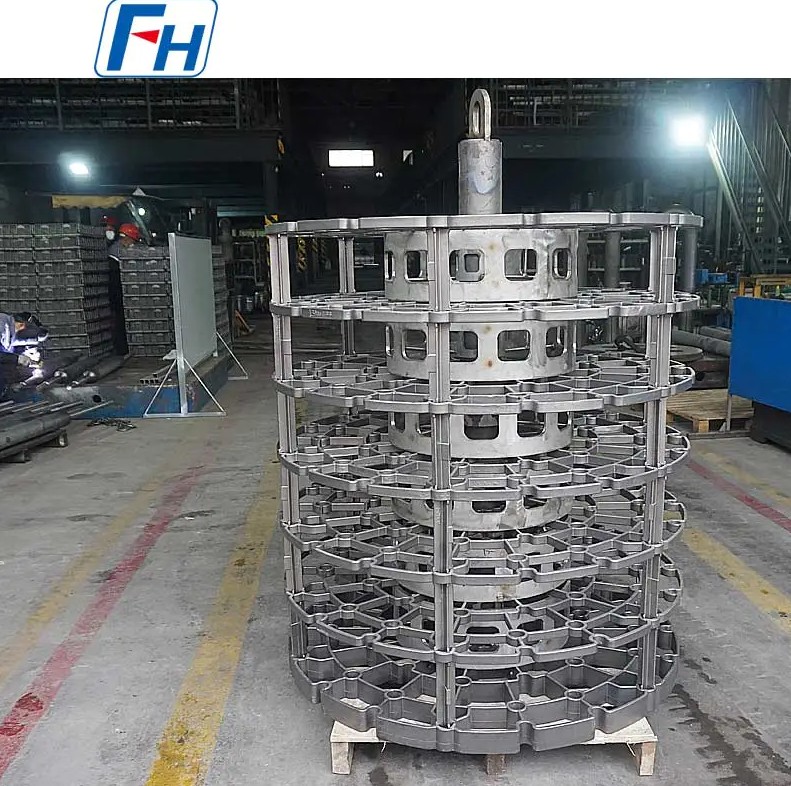
| Typical Application Scenarios | Low-temperature furnace rollers, baskets, base plates | Radiant tubes, fan impellers, high-temperature furnace rollers, burner nozzles |
| Table 1: Core Performance Comparison Between Medium-Chromium Low-Nickel and High-Chromium Nickel Heat Resistant Steel Castings | ||
The primary failure modes for heat resistant steel castings in high-temperature air environments involve oxide scale spallation and substrate thinning. ASTM G54 isochronal oxidation test data reveals that after 200 hours of continuous exposure in 1100°C air, high-chromium nickel series castings maintain oxide film thicknesses between 12 to 18 micrometers, while medium-chromium low-nickel series castings develop oxide films reaching 35 to 50 micrometers with evident layering and cracking.
The mechanism for dense oxide film formation lies in the preferential formation of continuous Cr₂O₃ layers enabled by high chromium content, while nickel elements reduce interfacial stress between the oxide film and substrate, minimizing film detachment during thermal cycling. For heat treatment fixtures experiencing frequent heating and cooling cycles, this characteristic can reduce oxidation weight loss rates by over 60%.
Creep represents the most lethal failure mode for heat resistant steel castings under sustained high-temperature loading conditions. GB/T 2039 standard endurance strength testing demonstrates:
This quantitative data divergence directly determines the material selection boundaries for critical load-bearing components such as radiant tubes and cantilever furnace rollers.
The high-temperature performance of heat resistant steel castings depends not solely on alloy composition, but is profoundly influenced by microstructural evolution during long-term service. The phase transformation behaviors of these two materials within identical temperature ranges exhibit fundamental distinctions.
Within the 650°C to 900°C temperature range, M₂₃C₆-type carbides in medium-chromium low-nickel series castings precipitate continuously along austenite grain boundaries, coarsening progressively with extended service duration. Grain boundary carbide volume fractions can reach 3% to 5% after 1,000 hours, severely weakening grain boundary cohesion.
More critically, chromium and iron enrichment at grain boundary regions readily forms brittle σ phase (FeCr intermetallic compound). With hardness values between HV 900 to 1100, σ phase distributed in network configurations along grain boundaries can reduce room-temperature impact toughness by over 70%, simultaneously degrading high-temperature plasticity. For furnace components subjected to thermal and mechanical shock, σ phase embrittlement represents the primary bottleneck limiting service lifetime.
High nickel content expands the austenite phase field to lower temperatures, significantly suppressing σ phase formation kinetics. In Cr25Ni20 castings, even after 10,000 hours of 1050°C service, σ phase volume fractions remain controllable below 0.5%.
The primary strengthening phases in this system are NbC or M(C,N)-type carbonitrides, characterized by fine particle sizes (50 to 200 nanometers), uniform distribution, and dispersion strengthening mechanisms that enhance high-temperature strength with substantially lower coarsening rates than M₂C₆. Combined with appropriate solution treatment (1150°C to 1200°C holding for 2 to 4 hours followed by water quenching), castings achieve optimized carbide distribution states from the onset of service, delaying performance degradation.
Based on the performance differences outlined above, the applicable boundaries for these two heat resistant steel casting types in industrial equipment have become relatively clear. Selection decisions should comprehensively evaluate working temperature, load characteristics, thermal cycling frequency, and expected lifetime requirements.
| Application Scenario | Typical Operating Temperature | Recommended Material | Core Consideration Factors |
|---|---|---|---|
| Low-Temperature Annealing Furnace Rollers | 650°C to 850°C | Medium-Chromium Low-Nickel Series | Cost-effectiveness, favorable casting processability |
| Carburizing Furnace Trays and Fixtures | 900°C to 950°C | Medium-Chromium Low-Nickel or Modified Series | Balance between oxidation and anti-carburization performance in carbon-potential environments |
| Continuous Annealing Furnace Radiant Tubes | 1050°C to 1150°C | High-Chromium Nickel Series | Long-term creep resistance, oxide film stability |
| High-Temperature Fan Impellers | 1000°C to 1100°C | High-Chromium Nickel Series | High-temperature fatigue strength, thermal shock resistance |
| Industrial Kiln Lining Hangers | 1100°C to 1200°C | High-Chromium Nickel Series (special formulation) | Ultimate temperature tolerance, creep resistance under structural self-weight |
| Petrochemical Cracking Furnace Tube Supports | 950°C to 1050°C | High-Chromium Nickel Series | Synergistic requirements for corrosion and creep resistance in sulfur-containing atmospheres |
| Table 2: Heat Resistant Steel Casting Selection Recommendations for Different Industrial Scenarios | |||
Consider trays and pillars in automotive gear carburizing production lines: In 930°C carburizing atmospheres, medium-chromium low-nickel series fixtures achieve service lifetimes of approximately 8 to 12 months, with primary failure modes involving warping deformation and cracking due to grain boundary oxidation. When switching to high-chromium nickel series materials, service lifetimes under identical conditions extend to 18 to 24 months, with deformation reductions exceeding 40%.
Although high-chromium nickel series castings involve higher initial procurement costs, comprehensive calculations incorporating replacement frequency, downtime losses, and labor maintenance expenses reveal that their total lifecycle costs are actually reduced by 25% to 35%. This economic advantage becomes particularly pronounced for continuously operating automated heat treatment production lines.
Regardless of material selection, the performance realization of heat resistant steel castings depends on rigorous quality control systems. The following inspection items represent critical links ensuring castings meet design operating condition requirements.
Spectroscopic analysis ensures deviations of major elements such as chromium, nickel, and carbon are controlled within ±0.5%, with trace element additions such as niobium and tungsten precisely maintained at ±0.1%. Metallographic examination focuses on:
Beyond conventional room-temperature tensile testing, the following high-temperature verification items must be supplemented:
For critical load-bearing components, it is recommended to increase sampling proportions by 10% to 20% for non-destructive testing (radiographic or ultrasonic), ensuring internal defect dimensions do not exceed 5% of wall thickness.
As industrial furnaces evolve toward higher temperatures, longer continuous operation cycles, and more complex atmospheric environments, heat resistant steel casting technology demonstrates the following development trends:
For end users, material selection decisions should transcend single-cost comparison frameworks and establish evaluation models centered on total lifecycle cost (LCC). When operating temperatures exceed 1000°C or annual operating hours surpass 6,000 hours, the comprehensive cost-performance advantages of high-chromium nickel series heat resistant steel castings become fully apparent, representing the rational choice for ensuring long-cycle stable equipment operation.
 CategoryRecent Post

Focus on Designing and Manufacturing Alloy Steel Parts since 2006
 Tel: 0510-83310100
  E-mail: info@alloy-casting.com
  Office Add: Room 1105,Building 6, Jiaye Wealth Center,Wuxi, Jiangsu, P.R.China P.C.:214000.
  Privacy

 English
 Español
 italiano
 Deutsch
 0086-13338774804
