
 May 18, 2026
 Content
The core of selecting a heat treatment basket lies in the precise matching of material temperature resistance, structural rigidity, and furnace type. Experimental data shows that baskets made of high-thermal-conductivity alloy materials with smooth surfaces achieved through precision casting can maintain uniform heat flow distribution under temperature differences of hundreds of degrees Celsius, reducing overall energy consumption by approximately 8%–12%. Meanwhile, controlling the spacing between internal support blocks within 200 mm through 3D laser inspection significantly reduces the risk of workpiece warping. For automated production lines, standardized interface designs enable baskets to interface with robotic arms within tens of seconds, greatly improving line changeover efficiency.
The material of a heat treatment basket directly determines its structural integrity and thermal conductivity in high-temperature environments. Different alloy compositions correspond to different temperature resistance ranges and corrosion resistance capabilities; incorrect material selection often leads to basket deformation or cracking during rapid heating/cooling cycles.
High-quality heat treatment baskets typically employ proprietary alloys with high-temperature resistance and corrosion resistance. These materials maintain structural integrity during rapid heating and cooling cycles, preventing heat loss caused by basket deformation. High-thermal-conductivity alloys combined with precision casting processes to form smooth surfaces are the material foundation for ensuring uniform heat transfer and eliminating hot and cold spots.
| Process Type | Typical Temperature Range | Core Material Requirements | Failure Risks |
|---|---|---|---|
| Carburizing / Carbonitriding | 850–950°C | High carbon tolerance, anti-carburization embrittlement | Intergranular corrosion, creep deformation |
| Vacuum Quenching | 1,000–1,200°C | Low vapor pressure, high-temperature strength retention | Element volatilization, structural collapse |
| Salt Bath Heat Treatment | 500–1,300°C | Molten salt corrosion resistance, thermal fatigue resistance | Pitting, stress corrosion cracking |
| Continuous Annealing | 700–1,050°C | Thermal cycle fatigue resistance, dimensional stability | Thermal fatigue cracks, warping |
Basket structural design requires balancing loading density, thermal conductivity uniformity, and workpiece support stability. Improper support layouts or insufficient rigidity are the primary causes of workpiece deformation and increased energy consumption.
Through 3D laser inspection technology, ensuring the spacing between internal support blocks is controlled within 200 mm enables uniform force distribution on the workpiece, significantly reducing warping risk. For irregularly shaped workpieces, adjustable tray systems allow flexible adjustment of height and tilt angle according to workpiece shape, avoiding plastic deformation caused by localized pressure.
Combining reinforcement ribs with intelligent release joints improves the overall rigidity of the basket while allowing controlled micro-displacement of the material during thermal cycling. This design prevents thermal stress from exceeding limits due to fully rigid constraints during heating/cooling processes, thereby avoiding structural cracking.
Different furnace types have distinctly different requirements for basket structure:
As the conductive bridge between workpieces and furnace thermal energy, basket design has a far greater impact on thermal efficiency than generally recognized. Through dual optimization of materials and structure, significant energy savings can be achieved.
Using high-thermal-conductivity alloy materials with smooth surfaces obtained through investment casting maintains uniform heat flow distribution under temperature differences of hundreds of degrees Celsius. This uniformity directly reduces the occurrence of hot and cold spots in the furnace, resulting in more consistent workpiece heating and shorter soaking times required to reach target temperatures.
Basket structures optimized for different furnace types allow more workpieces to be accommodated in a single heating process. Increased loading density means higher heat treatment output per unit time, amortizing the fixed energy cost of each furnace cycle. This effect is particularly pronounced on continuous production lines.
Experimental data shows that after adopting high-efficiency heat treatment baskets, overall energy consumption can be reduced by approximately 8%–12%. This energy-saving effect is especially prominent on large-scale continuous production lines, where the cumulative effect of heat loss during continuous operation is more significant. Energy savings primarily come from three aspects:
On modern continuous heat treatment production lines, the rapid and reliable integration of baskets with automated systems is a critical link for achieving efficient production. Basket design must proactively consider mechanical interfaces, data tracking, and rapid changeover requirements.
Baskets with standardized interface designs can interface with conveying systems and loading mechanisms within tens of seconds. This modular design significantly shortens line changeover time, enabling improved equipment utilization in multi-variety, small-batch production modes.
By reserving positioning holes on the basket surface and cooperating with vision-guided robotic arms, precise gripping and placement of workpieces can be achieved. This consistency ensures repeatable positioning accuracy for each workpiece, laying the foundation for precise control of subsequent heat treatment process parameters.
By embedding RFID or temperature sensors inside the basket, real-time tracking of workpiece batch information and temperature history can be achieved. This data is directly uploaded to factory-level management systems, providing data support for production monitoring, quality traceability, and process optimization.
Whether for box furnaces, vacuum furnaces, or salt bath furnaces, baskets can be quickly adapted through adjustable brackets. This compatibility design avoids the inventory pressure of configuring separate baskets for each furnace type, improving the versatility of equipment assets.
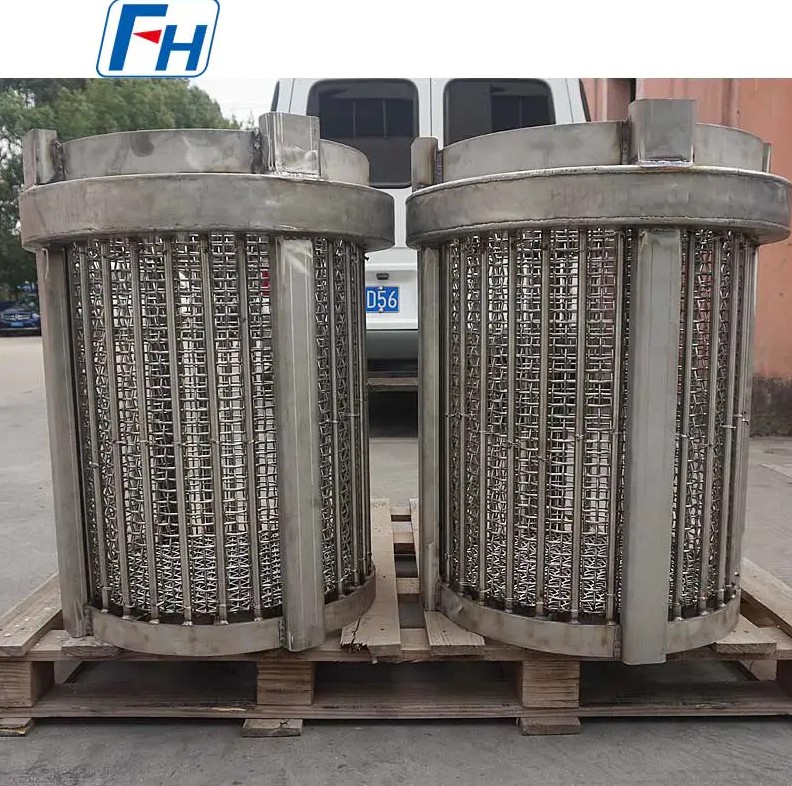
Workpiece deformation in high-temperature environments is primarily caused by uneven support or concentrated thermal stress. Basket design must mitigate these risks through precise support layout and thermal process control.
Controlling support block spacing within 200 mm is a verified safety threshold. At this spacing, even for long or thin-walled workpieces, uniform support force distribution can be achieved, preventing warping caused by self-weight or uneven thermal expansion.
Cooperating with intelligent heat treatment management systems, closed-loop control of temperature and heating/cooling rates ensures thermal stress remains within safe ranges. Real-time feedback mechanisms allow timely adjustment of process parameters when abnormal temperature gradients are detected, preventing stress accumulation from exceeding limits.
Tray height and tilt angle adjustable functions for different workpiece shapes enable baskets to adapt to diverse loading needs ranging from shaft parts to complex box-type cavities. This adaptability reduces point contact and localized indentations caused by forcing workpieces into standard support layouts.
Faced with diverse process requirements and equipment conditions, establishing a systematic selection decision framework helps avoid matching errors caused by empiricism.
Clarify maximum operating temperature, heating medium (atmosphere/vacuum/salt bath), temperature uniformity requirements, and production cycle time. These parameters directly eliminate material options that fail to meet basic temperature resistance or corrosion resistance requirements.
Document typical workpiece dimensions, weight, shape complexity, and deformation sensitivity. For high-precision workpieces, prioritize structures with support point spacing less than 200 mm and adjustable trays.
If the production line has deployed or plans to deploy robotic arms and MES systems, confirm whether the basket possesses standardized mechanical interfaces, positioning holes, and data acquisition embedding capabilities. Omission at this step will result in exponentially higher retrofit costs later.
Request suppliers to provide energy consumption comparison data under similar operating conditions. Using an energy saving range of 8%–12% as a baseline, combined with local energy prices and annual operating hours, calculate the payback period. Simultaneously evaluate maintenance costs over the expected basket service life.
 CategoryRecent Post

Focus on Designing and Manufacturing Alloy Steel Parts since 2006
 Tel: 0510-83310100
  E-mail: info@alloy-casting.com
  Office Add: Room 1105,Building 6, Jiaye Wealth Center,Wuxi, Jiangsu, P.R.China P.C.:214000.
  Privacy

 English
 Español
 italiano
 Deutsch
 0086-13338774804
