
 Nov 20, 2026
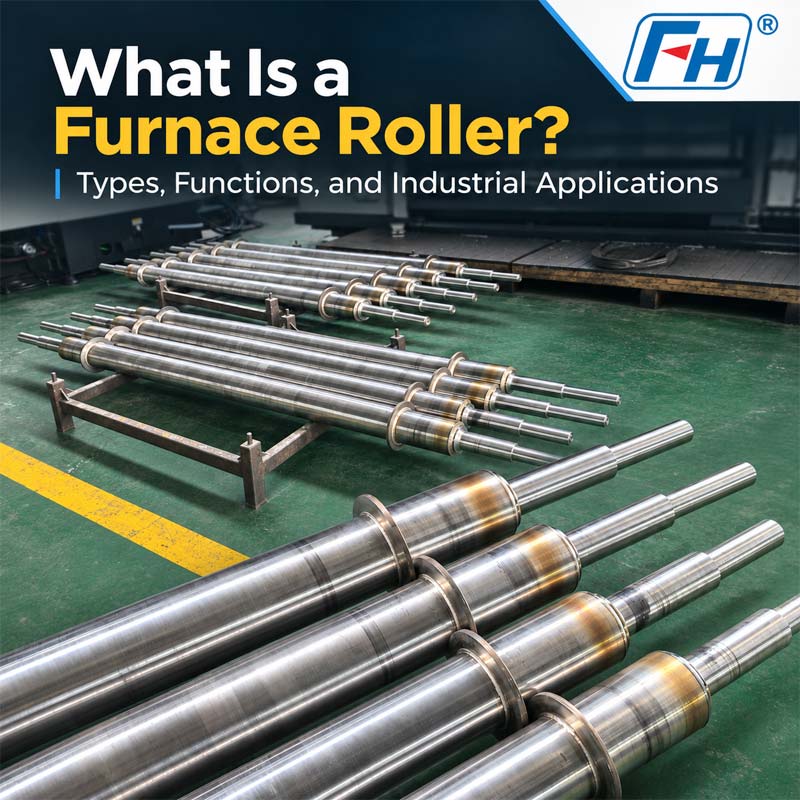
Furnace rollers are essential components in industrial heating systems, particularly in roller hearth furnaces and continuous heat treatment production lines. They support and transport workpieces through high-temperature processing zones while maintaining stable material movement and consistent production efficiency.
Because furnace rollers operate under high temperatures, mechanical loads, and demanding furnace atmospheres, their material selection, structural design, and manufacturing quality directly affect equipment reliability and service life.
In this guide, we explain what furnace rollers are, how they work, their common types, and the key factors to consider when selecting them.
1. What Is a Furnace Roller?
A furnace roller is a rotating mechanical component installed inside or around an industrial furnace system. Its primary function is to support and convey products through different heating, soaking, and cooling zones.
Unlike conventional industrial conveyor rollers, furnace rollers must withstand elevated temperatures and thermal cycling while maintaining dimensional stability and mechanical strength.
Depending on the furnace design, furnace rollers may operate directly inside the heating chamber or in designated high-temperature conveying sections.
Typical applications include:
2. Main Functions of Furnace Rollers
Furnace rollers perform several important functions.
Workpiece Support
They support products during high-temperature processing and help maintain stable positioning throughout the furnace.
Material Conveying
Rotating rollers transport workpieces through different furnace zones at a controlled production speed.
Continuous Production
They enable continuous material handling, reducing manual intervention and improving production efficiency.
Process Stability
Properly designed rollers help maintain consistent workpiece movement and reduce operational disturbances caused by roller deformation or misalignment.
3. Common Types of Furnace Rollers
Furnace rollers can be classified according to their structure, manufacturing method, and operating conditions.
Hollow Furnace Rollers
Hollow rollers feature an internal cavity that reduces component weight and material consumption while providing the required structural performance.
Solid Furnace Rollers
Solid rollers are manufactured with a solid cross-section and may be selected for particular structural or operating requirements.
Centrifugally Cast Furnace Rollers
Centrifugal casting is commonly used to manufacture hollow cylindrical high-alloy components. It is suitable for producing rollers requiring controlled wall thickness and internal quality.
Custom Alloy Furnace Rollers
Custom rollers are manufactured according to specific drawings, dimensions, materials, and operating conditions.
4. Materials Used in Furnace Rollers
Furnace rollers are commonly manufactured from heat-resistant cast alloys.
Material selection depends on:
Commonly specified alloy grades include 1.4848, 1.4849, 1.4852, and 2.4879.
These grades have different chemical compositions and performance characteristics. They should not be considered interchangeable without checking the applicable material specifications and operating conditions.
5. Key Factors Affecting Furnace Roller Performance
The performance of a furnace roller depends on more than its material grade.
Important considerations include:
A suitable combination of material, geometry, and manufacturing accuracy is essential for reliable operation.
6. Why Choose Custom Furnace Rollers?
Standard rollers may not meet the dimensional and operating requirements of every industrial furnace.
Custom manufacturing allows furnace rollers to be designed around actual equipment conditions.
A manufacturer can work from customer drawings, technical specifications, or existing samples to determine the appropriate dimensions, alloy selection, and manufacturing requirements.
7. FH® Furnace Roller Manufacturing
FH® specializes in heat-resistant alloy castings and industrial furnace components for overseas B2B customers.
Our furnace roller solutions can be developed according to customer drawings and technical requirements, with consideration given to alloy selection, dimensions, operating temperature, and application conditions.
For continuous furnace applications, selecting the correct combination of alloy and roller structure is essential to long-term equipment performance.
Explore our FH® Furnace Rollers to learn more about available manufacturing solutions.
Frequently Asked Questions
What material is commonly used for furnace rollers?
Heat-resistant cast alloys such as 1.4848, 1.4849, 1.4852, and 2.4879 may be selected depending on the operating temperature, furnace atmosphere, and mechanical loading.
Are furnace rollers custom-made?
Yes. Many industrial furnace rollers are manufactured according to customer drawings, dimensions, material requirements, and equipment specifications.
What determines the service life of a furnace roller?
Material properties, operating temperature, mechanical loading, furnace atmosphere, thermal cycling, and manufacturing quality all influence service life.
Can furnace rollers be manufactured according to existing samples?
Yes. Existing rollers can be used as dimensional and structural references, subject to engineering evaluation and confirmation of operating conditions.
Request a Quote
Looking for a reliable manufacturer of heat-resistant alloy furnace rollers?
Contact FH® with your drawings, material requirements, and operating conditions. Our team can help evaluate your furnace roller requirements and discuss a suitable manufacturing solution.
Send us your technical drawings to request a quotation.
 CategoryRecent Post

Focus on Designing and Manufacturing Alloy Steel Parts since 2006
 Tel: 0510-83310100
 E-mail: info@alloy-casting.com
 Office Add: Room 1105,Building 6, Jiaye Wealth Center,Wuxi, Jiangsu, P.R.China P.C.:214000.
 Privacy

 English
 Español
 italiano
 Deutsch
 0086-13338774804
