
 Mar 06, 2026
 Content
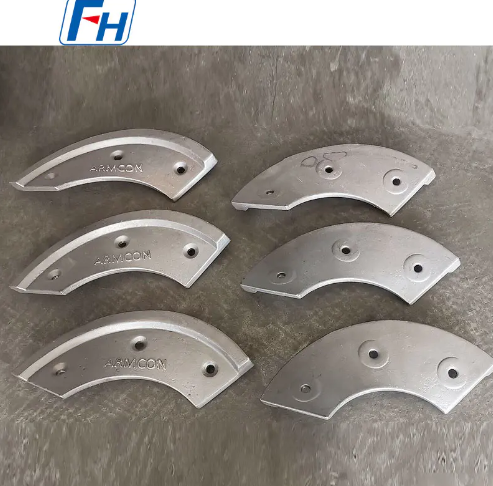
The most frequent defects in wear resistant castings during service are abrasive wear (accounting for approximately 50-60% of failures in industrial applications), followed by impact fracture and thermal fatigue cracking. In high-stress environments like mining or steel manufacturing, these issues can reduce component lifespan by up to 70% if the incorrect alloy is selected. However, a significant portion of premature failures—estimated at 30%—stem from micro-defects like shrinkage porosity or improper heat treatment rather than the material being worn out naturally.
Once in operation, wear resistant castings face extreme conditions. Understanding these failure modes is critical for maintenance planning and material selection.
This is the predominant defect mechanism. In equipment like fan blades or crusher hammers, hard particles cut into the metal surface. For example, in a cement plant, a fan blade handling raw meal can lose over 15mm of thickness in less than 6 months if the hardness (typically targeted at 400-600 HB) is not matched to the abrasive material.
Wear resistant materials are often hard but brittle. When a casting, such as a crusher liner, encounters tramp metal or oversized rock, it may crack rather than deform. Approximately 20% of scrapped wear parts are due to impact fractures that occur before any significant wear has taken place.
Components like furnace rollers and radiant tubes undergo constant heating and cooling cycles. This leads to thermal stress. Surface cracking, often appearing as a network of fine lines (crazing), is a tell-tale sign. If unchecked, these cracks propagate, leading to structural failure. Data from heat treatment furnaces shows that thermal fatigue accounts for 80% of failures in radiant tubes after 12-18 months of operation.
Often, what looks like a service failure is actually a defect introduced during casting or heat treatment. These internal flaws act as starting points for the issues mentioned above.
As the molten metal solidifies, it contracts. Without proper feeding (risers), voids form inside the casting. This is particularly critical in thick-section wear parts. A casting with micro-shrinkage may pass a visual inspection but will fail under load because the effective load-bearing area is reduced. Porosity levels above 3% can reduce fatigue strength by nearly 50%.
| Porosity Level | Relative Wear Life | Failure Mode |
|---|---|---|
| < 1% (Sound) | 100% (Baseline) | Gradual Abrasion |
| 3% - 5% | 60% - 70% | Spalling & Pitting |
| > 7% | < 30% | Catastrophic Fracture |
The desired hardness of wear resistant castings (e.g., 500 Brinell for a fan blade) is achieved through specific quenching and tempering processes. Common defects here include:
Prevention is better than replacement. Since 2006, Wuxi Junteng Fanghu Alloy Technology Co., Ltd. has focused on eliminating these defects through design and process control. As a wholesale supplier and OEM wear resistant castings company in China, we emphasize two key strategies to avoid the failures listed above.
Many defects originate from poor design. Sharp corners act as stress risers, promoting quench cracks. Large, uneven sections lead to shrinkage porosity. By collaborating with technical teams to add fillets, core prints, or adjust wall thicknesses, we can reduce casting stress by up to 40% before the part is even poured. This is a cost-effective solution that enhances the efficiency of heat treatment operations.
There is no "one-size-fits-all" alloy. The optimal chemistry depends on the specific application:
Our primary products include heat treatment fixtures, radiant tubes, furnace rollers, fan blades, furnace rails, and wheels. We offer technical assistance to customize or optimize these components, helping our customers discover solutions that effectively counter the specific defects they encounter in their operations.
 CategoryRecent Post

Focus on Designing and Manufacturing Alloy Steel Parts since 2006
 Tel: 0510-83310100
  E-mail: info@alloy-casting.com
  Office Add: Room 1105,Building 6, Jiaye Wealth Center,Wuxi, Jiangsu, P.R.China P.C.:214000.
  Privacy

 English
 Español
 italiano
 Deutsch
 0086-13338774804
