
 Apr 24, 2026
 Content
In extreme industrial fields, material selection directly determines the service life of core equipment. Direct Conclusion: Nickel-based alloy castings, with their superior γ' phase strengthening mechanism, perform best in oxidation resistance, creep resistance, and reduction corrosion resistance, making them the first choice for aero-engines and chemical heat exchangers. Conversely, cobalt-based alloy castings rely on dispersed carbide strengthening and possess irreplaceable advantages in high-temperature hardness, thermal fatigue resistance, and extreme wear scenarios (especially metal-to-metal friction).
Nickel-based alloys primarily use nickel (Ni) as the matrix, with the addition of aluminum (Al) and titanium (Ti) to form γ' phase (Ni3(Al, Ti)) precipitation strengthening. This strengthening phase has excellent thermal stability at high temperatures, effectively hindering dislocation movement and allowing the material to maintain high mechanical strength even above 1100°C. Additionally, its face-centered cubic (FCC) structure provides excellent plasticity and toughness.
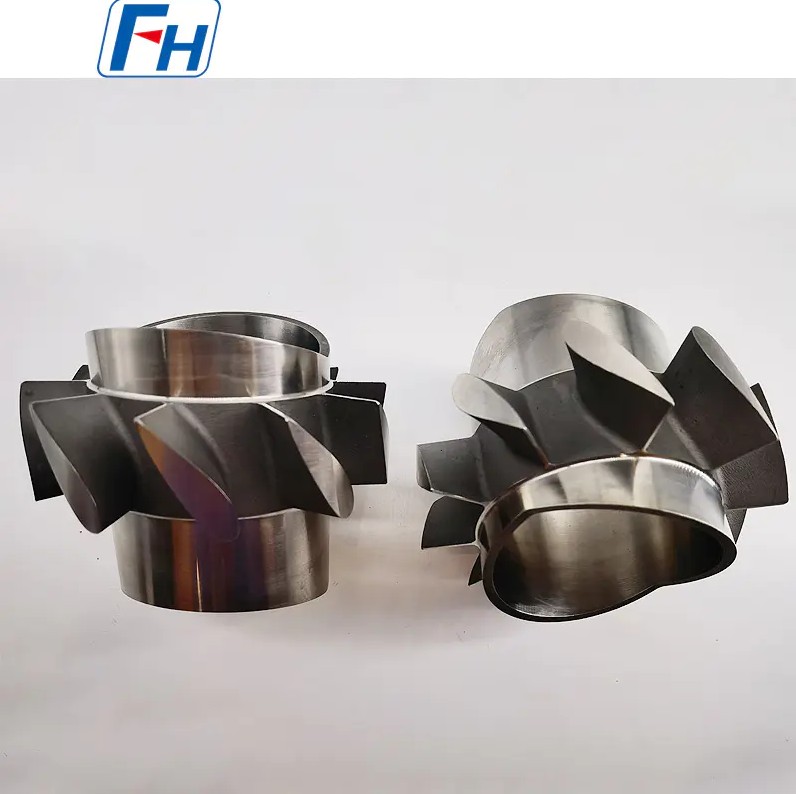
Unlike nickel-based alloys, cobalt-based alloys (such as the Stellite series) are carbide-strengthened materials. Their structure contains a large number of hard carbides (such as MC, M23C6, M7C3) formed by elements like chromium, tungsten, and molybdenum. These carbide particles act like "nails" embedded in the austenite matrix, giving the alloy extremely high red hardness, meaning it retains significant hardness even at temperatures approaching its melting point.
| Comparison Item | Nickel-Based Alloy Castings | Cobalt-Based Alloy Castings |
|---|---|---|
| Strengthening Phase Type | γ' phase (Intermetallic) | MC/M23C6 (Carbide) |
| Typical Service Temp | 700°C - 1150°C | 650°C - 1000°C |
| Wear Resistance | Moderate (Mainly cavitation) | Excellent (High wear resistance) |
| Thermal Expansion | Higher | Lower (Good thermal fatigue res.) |
When performing technical selection, it is recommended to follow this logic:
By precisely matching the characteristics of these two types of materials, industrial enterprises can achieve a leap from simple "heat resistance" to "long life and low maintenance." Nickel-based alloys handle structural pressure at high temperatures, while cobalt-based alloys conquer surface wear and thermal fatigue—together, they form the solid foundation for high-temperature protection in modern industry.
 CategoryRecent Post

Focus on Designing and Manufacturing Alloy Steel Parts since 2006
 Tel: 0510-83310100
  E-mail: info@alloy-casting.com
  Office Add: Room 1105,Building 6, Jiaye Wealth Center,Wuxi, Jiangsu, P.R.China P.C.:214000.
  Privacy

 English
 Español
 italiano
 Deutsch
 0086-13338774804
