
 Nov 26, 2026
Furnace rollers operate under demanding thermal conditions.
During production, they may experience repeated heating, cooling, and temperature fluctuations. These conditions can generate thermal stresses that affect component integrity.
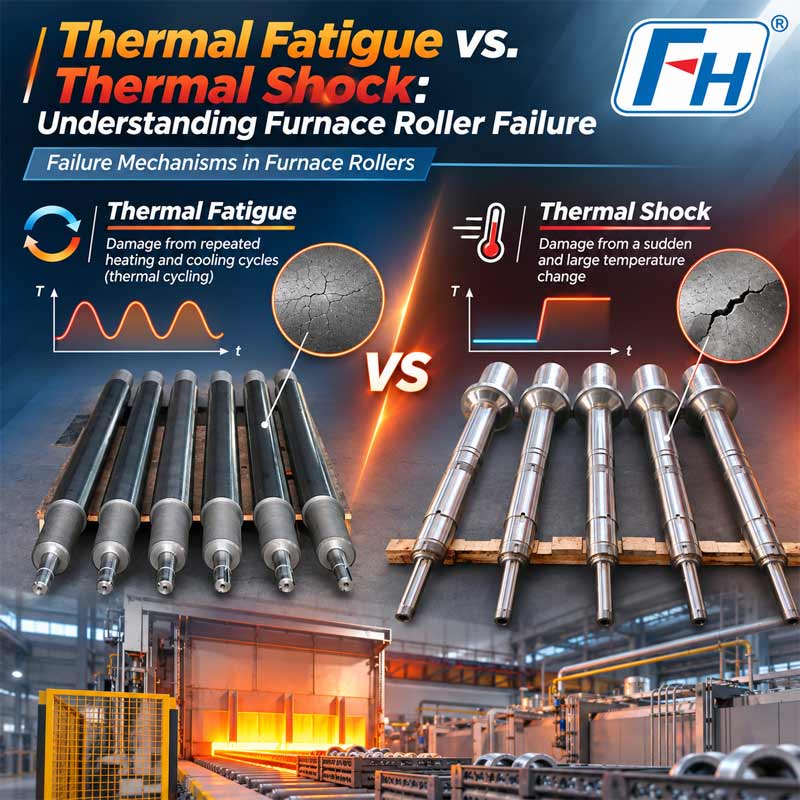
Two important failure mechanisms are thermal fatigue and thermal shock.
Although they are related to temperature changes, they are not the same phenomenon.
Understanding their differences helps engineers improve furnace roller design, material selection, and operating practices.
1. What Is Thermal Fatigue?
Thermal fatigue is damage caused by repeated temperature variations that generate cyclic thermal stresses.
When a furnace roller heats up, it expands. When it cools, it contracts.
If these dimensional changes are restricted or uneven, stresses develop within the component.
Repeated stress cycles can eventually initiate and propagate cracks.
Common contributing factors include:
Thermal fatigue is generally associated with repeated thermal cycles over time.
2. What Is Thermal Shock?
Thermal shock occurs when a component experiences a rapid temperature change that produces significant temperature gradients.
Different regions of the component expand or contract at different rates.
This can generate high transient thermal stresses.
Potential causes include:
Depending on the material and stress conditions, thermal shock may cause cracking or other forms of damage.
3. Thermal Fatigue vs. Thermal Shock
| Comparison | Thermal Fatigue | Thermal Shock |
| Main cause | Repeated thermal stress cycles | Rapid temperature change |
| Typical time pattern | Repeated exposure | Sudden thermal event |
| Main mechanism | Cyclic stress accumulation | Transient thermal stress |
| Possible damage | Crack initiation and propagation | Cracking or sudden structural damage |
| Prevention | Thermal cycle management | Avoiding excessive temperature gradients |
Both mechanisms may occur in the same furnace roller during its service life.
4. Common Signs of Thermal Damage
During inspection, engineers should look for:
Surface Cracks
Cracks may develop in areas exposed to repeated thermal stresses.
Oxide Scale Damage
Repeated heating and cooling may cause oxide scale cracking or spalling.
Dimensional Changes
Thermal deformation or accumulated creep may alter the roller's geometry.
Increased Runout
Changes in roller geometry may lead to unstable rotation.
Localized Damage
Areas exposed to uneven heating or cooling may experience concentrated damage.
A complete failure analysis should distinguish thermal damage from mechanical overload, casting defects, corrosion, and other possible causes.
5. Factors That Increase Thermal Damage Risk
Several operating and design factors can increase the risk.
Uneven Heating
Temperature differences along the roller may produce uneven expansion.
Rapid Cooling
Sudden cooling can create large temperature gradients.
Incorrect Installation
Insufficient allowance for thermal expansion may introduce additional stress.
Improper Roller Design
Inappropriate geometry and support arrangements can increase local stresses.
Unsuitable Material
The selected alloy may not provide sufficient performance under the actual thermal cycling conditions.
6. How to Reduce Thermal Fatigue and Thermal Shock
A comprehensive prevention strategy should include the following measures.
Select Suitable Heat-Resistant Alloys
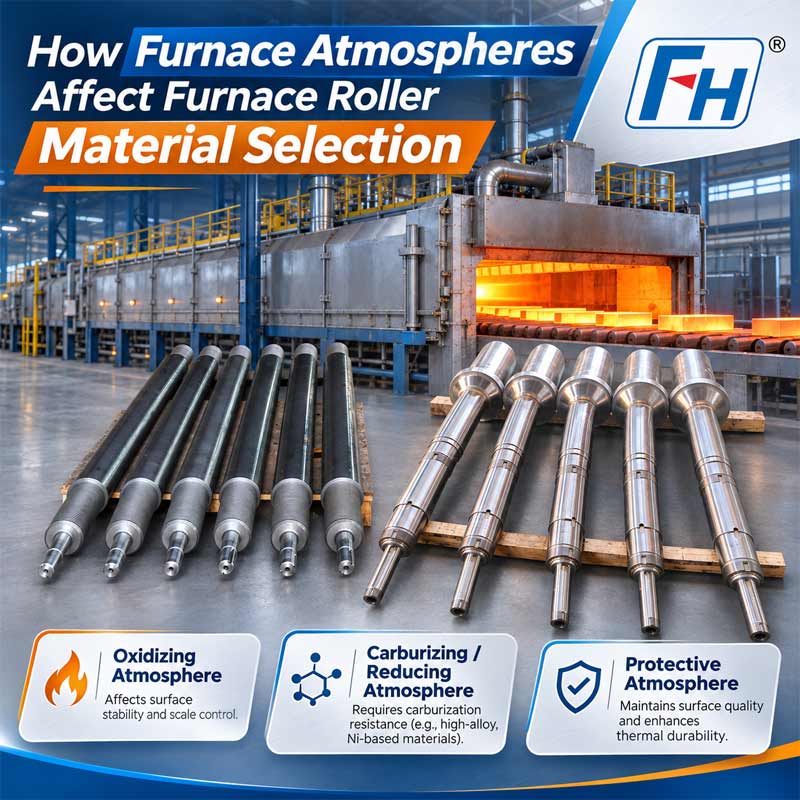
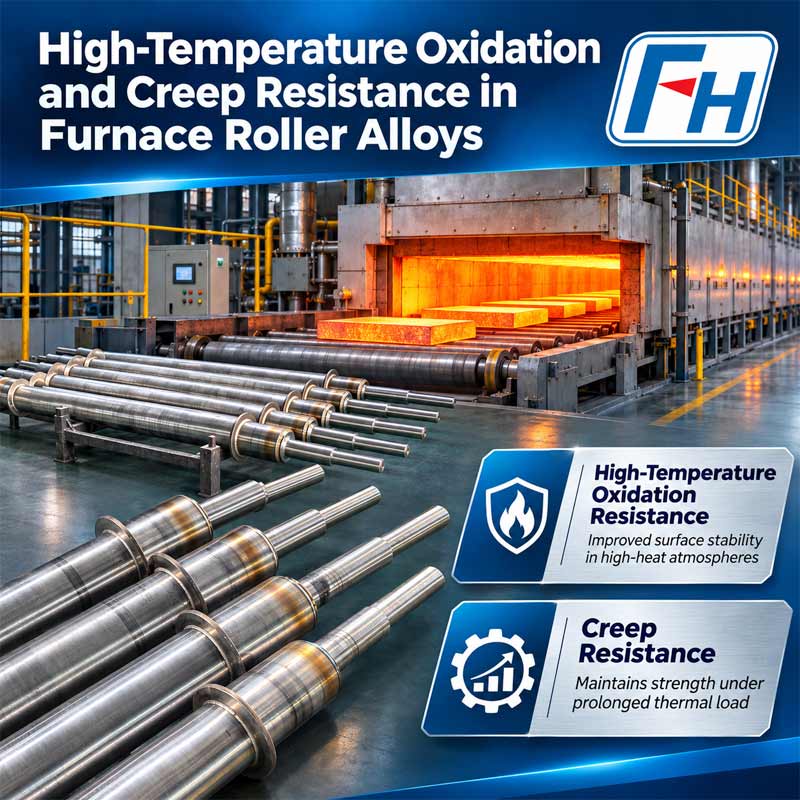
Material selection should consider thermal cycling, oxidation resistance, and high-temperature mechanical properties.
Optimize Roller Geometry
Dimensions, wall thickness, and support arrangements should be evaluated to reduce excessive stress concentrations.
Control Heating and Cooling Rates
Avoid unnecessary rapid temperature changes when the process allows controlled transitions.
Allow Thermal Expansion
The installation arrangement should accommodate the expected thermal expansion.
Maintain Stable Operating Conditions
Avoid unnecessary temperature fluctuations and uneven loading.
Inspect Rollers Regularly
Monitor cracks, deformation, runout, and surface condition.
7. How Does Material Selection Affect Thermal Performance?
Heat-resistant alloys differ in their chemical composition, microstructure, and thermal properties.
Important evaluation parameters include:
Common alloy grades considered for industrial furnace components include 1.4848, 1.4849, 1.4852, and 2.4879.
The best material depends on the complete operating environment and component design.
8. Why Is Manufacturing Quality Important?
Manufacturing quality is another important factor in furnace roller reliability.
Depending on the product design, quality control may include:
These inspections help verify compliance with agreed technical requirements.
9. FH® Furnace Roller Manufacturing
FH® specializes in heat-resistant alloy castings and industrial furnace components.
Our manufacturing approach considers alloy specifications, casting requirements, machining dimensions, and inspection criteria.
For replacement or custom furnace rollers, customers can provide existing drawings, samples, and operating information for technical evaluation.
Explore FH® Furnace Rollers.
Frequently Asked Questions
What is the difference between thermal fatigue and thermal shock?
Thermal fatigue results from repeated thermal stress cycles, while thermal shock is associated with rapid temperature changes that create high transient thermal stresses.
Can thermal fatigue cause furnace roller cracks?
Yes. Repeated thermal stresses can initiate and propagate cracks, depending on material properties, geometry, and operating conditions.
How can thermal shock be reduced?
Controlled heating and cooling, suitable material selection, and avoiding severe temperature gradients can help reduce thermal shock risk.
Does a heat-resistant alloy automatically resist thermal fatigue?
No. High-temperature oxidation resistance and thermal fatigue performance are different properties. Both must be evaluated for the intended application.
Looking for Custom Heat-Resistant Furnace Rollers?
Contact FH® with your roller drawings, operating temperature, furnace atmosphere, and thermal cycling requirements.
Our team can discuss material specifications and custom manufacturing options for your industrial furnace application.
 CategoryRecent Post

Focus on Designing and Manufacturing Alloy Steel Parts since 2006
 Tel: 0510-83310100
 E-mail: info@alloy-casting.com
 Office Add: Room 1105,Building 6, Jiaye Wealth Center,Wuxi, Jiangsu, P.R.China P.C.:214000.
 Privacy

 English
 Español
 italiano
 Deutsch
 0086-13338774804
