
 Nov 25, 2026
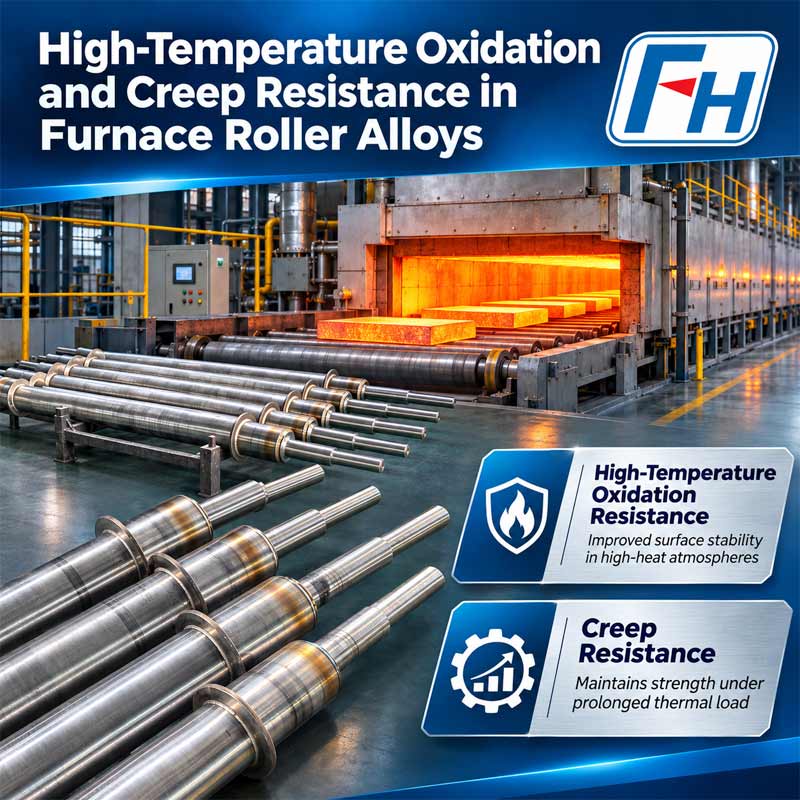
Industrial furnace rollers operate in environments where temperature, mechanical loading, and chemical reactions can affect material performance over time.
Two important factors are high-temperature oxidation and creep deformation.
Understanding these mechanisms is essential when selecting heat-resistant alloys and designing furnace rollers for continuous industrial operation.
1. What Is High-Temperature Oxidation?
High-temperature oxidation occurs when a metallic material reacts with oxygen at elevated temperatures.
This reaction can produce oxide layers on the material surface.
Depending on the alloy and operating environment, the oxide scale may provide some protection against further oxidation.
However, oxidation resistance is not unlimited.
Factors affecting oxidation behavior include:
Repeated heating and cooling may cause oxide scale cracking or spalling.
This can expose fresh metal surfaces and accelerate further oxidation.
2. How Does Chromium Improve Oxidation Resistance?
Chromium is an important element in many heat-resistant alloys.
Under suitable oxidizing conditions, chromium can contribute to the formation of protective chromium-rich oxide scales.
These scales help slow the rate of further oxidation.
However, their stability depends on temperature, atmosphere, alloy composition, and operating conditions.
A high chromium content alone does not guarantee satisfactory performance in every furnace environment.
3. What Is Creep Deformation?
Creep is the gradual and permanent deformation of a material under sustained stress at elevated temperatures.
For furnace rollers, creep may occur when the component continuously supports mechanical loads while operating at high temperatures.
Possible consequences include:
Creep is especially important for long rollers with substantial support spans or uneven loading.
4. Factors Affecting Creep Resistance
Several factors influence the creep performance of a furnace roller.
Material Composition
Alloying elements and microstructure influence high-temperature strength.
Operating Temperature
Creep deformation generally becomes more significant as temperature increases.
Applied Stress
Higher sustained stress can accelerate creep.
Component Geometry
Wall thickness, diameter, length, and support arrangement affect stress distribution.
Operating Time
Long-term exposure under sustained loading is an important factor in creep assessment.
5. Oxidation vs. Creep: Key Differences
| Factor | Oxidation | Creep |
| Main mechanism | Chemical reaction with the environment | Time-dependent deformation under stress |
| Main affected area | Material surface | Component structure |
| Common symptoms | Scale formation and surface degradation | Sagging and permanent deformation |
| Main influencing factors | Atmosphere, temperature, alloy composition | Temperature, stress, time, geometry |
| Prevention approach | Suitable alloy and atmosphere management | Suitable alloy, loading, and roller design |
6. How to Improve Furnace Roller Service Life
A practical approach should address material, design, manufacturing, and operating conditions.
Select Suitable Heat-Resistant Alloys
Evaluate oxidation resistance and high-temperature mechanical properties based on the actual furnace environment.
Optimize Roller Geometry
Proper wall thickness, diameter, and support span help control mechanical stress.
Control Operating Conditions
Avoid unnecessary temperature fluctuations and excessive mechanical loading.
Maintain Proper Alignment
Incorrect installation or support arrangements can create additional stress.
Monitor Roller Condition
Regular inspection can identify deformation, oxide scale problems, and surface damage before they lead to more serious failures.
7. Material Selection for Industrial Furnace Rollers
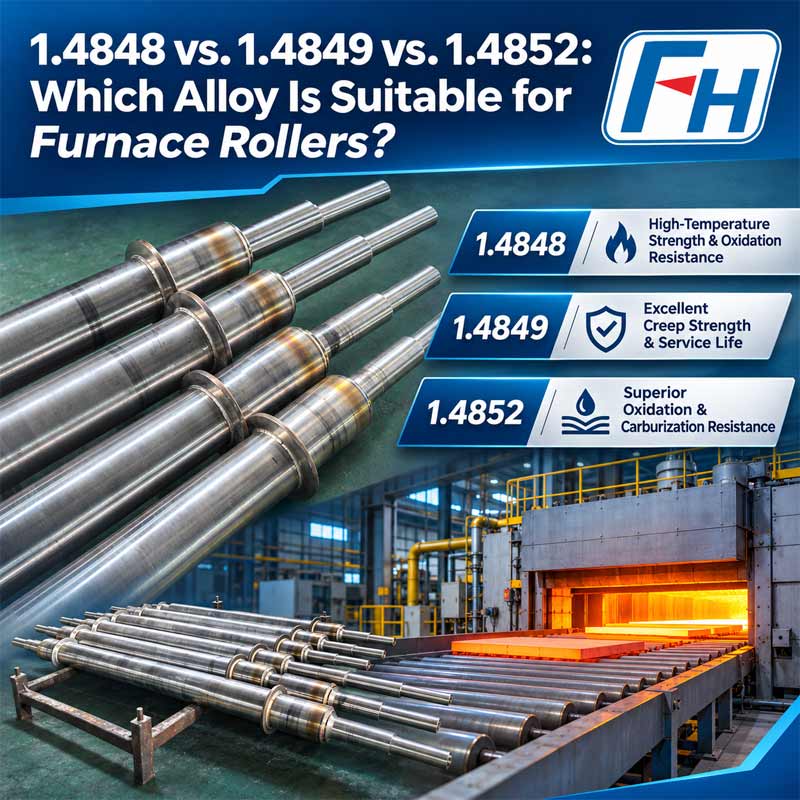
Heat-resistant cast alloys such as 1.4848, 1.4849, 1.4852, and 2.4879 may be considered for different furnace applications.
The selection process should include:
Published temperature limits should always be interpreted in the context of actual operating conditions.
8. FH® Quality Control and Manufacturing
FH® manufactures heat-resistant alloy castings and industrial furnace components.
Chemical composition verification is an important part of our material control process. Incoming raw material samples are checked using spectrometric analysis before further production.
For custom furnace roller projects, material selection, casting requirements, machining dimensions, and inspection criteria should be defined according to the technical specification.
Explore FH® Furnace Rollers.
Frequently Asked Questions
What causes furnace rollers to sag?
Long-term exposure to high temperatures under mechanical load can cause creep deformation. Incorrect support arrangements and excessive loading may increase the risk.
Does oxidation always reduce furnace roller service life?
Excessive oxidation and unstable oxide scale formation can accelerate material degradation, but the impact depends on alloy composition and operating conditions.
Can a higher chromium content eliminate oxidation?
No. Chromium can improve oxidation resistance under suitable conditions, but it does not eliminate oxidation in all environments.
How can creep deformation be reduced?
Appropriate material selection, structural design, support spacing, load control, and operating temperature management can help reduce creep-related problems.
Discuss Your Furnace Roller Requirements
Contact FH® to discuss alloy selection, component geometry, and manufacturing requirements for your high-temperature furnace application.
 CategoryRecent Post

Focus on Designing and Manufacturing Alloy Steel Parts since 2006
 Tel: 0510-83310100
 E-mail: info@alloy-casting.com
 Office Add: Room 1105,Building 6, Jiaye Wealth Center,Wuxi, Jiangsu, P.R.China P.C.:214000.
 Privacy

 English
 Español
 italiano
 Deutsch
 0086-13338774804
