
 Nov 26, 2026
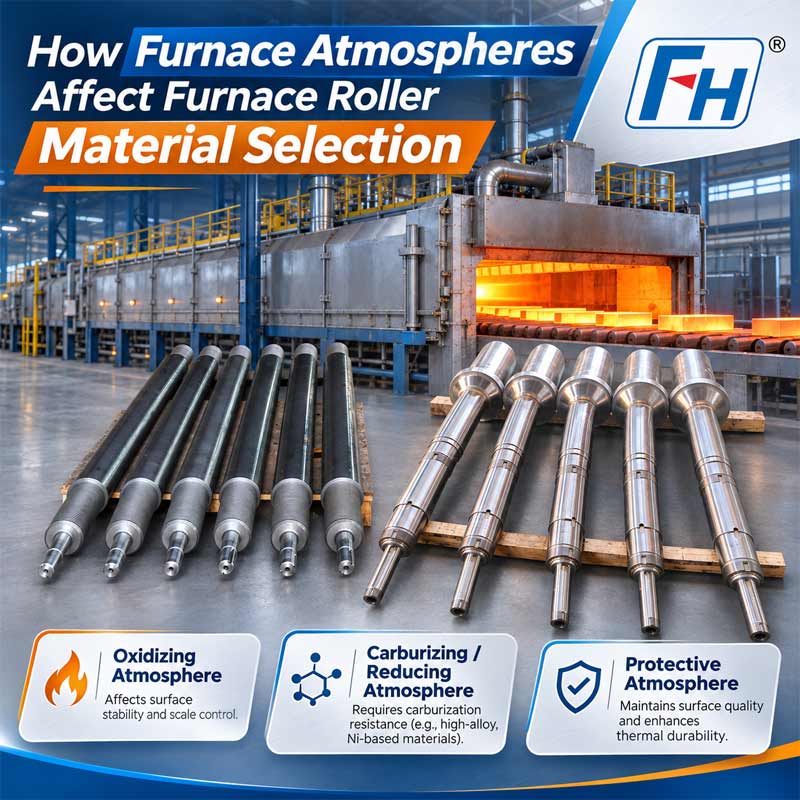
When selecting materials for industrial furnace rollers, operating temperature is only one part of the decision.
The chemical environment inside the furnace can also have a significant influence on material performance.
Oxidizing, carburizing, nitriding, and protective atmospheres may affect heat-resistant alloys in different ways.
A material that performs satisfactorily in one furnace environment may experience accelerated degradation in another.
This guide explains why furnace atmosphere should be considered during furnace roller material selection.
1. Why Does Furnace Atmosphere Matter?
Furnace atmosphere refers to the gas environment inside a furnace during thermal processing.
It may contain oxygen, nitrogen, hydrogen, carbon-bearing gases, water vapor, or other chemical species.
These gases can interact with the surface and internal structure of metallic components.
Depending on the conditions, possible degradation mechanisms include:
The actual reaction depends on gas composition, temperature, exposure time, and alloy chemistry.
2. Oxidizing Atmosphere
An oxidizing atmosphere contains sufficient oxygen potential to promote oxidation reactions.
Furnace rollers exposed to such environments may develop oxide scales on their surfaces.
The behavior of these scales depends on alloy composition and operating conditions.
When selecting a material, consider:
Suitable heat-resistant alloys should be evaluated according to the actual oxidation environment.
3. Carburizing Atmosphere
Carburizing atmospheres are used in heat treatment processes where carbon is introduced into the surface of workpieces.
Depending on the gas composition and carbon potential, furnace components may also experience carbon-related reactions.
Possible issues include:
Material selection should consider carbon activity, temperature, exposure duration, and the alloy's resistance to carburization.
4. Nitriding Atmosphere
Nitriding processes introduce nitrogen into the surface of workpieces.
Furnace rollers and other internal furnace components may be exposed to nitrogen-bearing process gases.
The potential effects on the roller depend on gas composition, temperature, exposure time, and alloy composition.
It is important to evaluate the actual atmosphere rather than assuming that all nitrogen-containing environments have the same effect.
5. Protective and Neutral Atmospheres
Some industrial furnaces operate with protective or controlled atmospheres to limit unwanted surface reactions.
Common gas systems may involve nitrogen, hydrogen, or mixtures of different gases.
Important parameters include:
Even when a furnace is described as having a protective atmosphere, the actual gas chemistry should be confirmed.
6. Comparing Different Furnace Atmospheres
| Furnace Atmosphere | Potential Material Concerns | Selection Considerations |
| Oxidizing | Oxide scale formation | Oxidation resistance and scale stability |
| Carburizing | Carbon absorption and carbide-related changes | Carburization resistance |
| Nitriding | Nitrogen-related surface reactions | Atmosphere compatibility |
| Protective | Residual oxygen and moisture | Gas composition and process control |
| Sulfur-containing | Sulfidation and high-temperature corrosion | Sulfur resistance and alloy chemistry |
This table is a general engineering reference. Actual degradation depends on the complete furnace environment.
7. How to Select Furnace Roller Materials
Before selecting a heat-resistant alloy, obtain the following information:
These parameters help engineers assess whether a proposed alloy is suitable.
8. Common Heat-Resistant Alloy Options
Depending on the application, materials such as 1.4848, 1.4849, 1.4852, and 2.4879 may be evaluated.
However, material selection should not be based solely on alloy designation.
The actual chemical composition, material specification, mechanical properties, and furnace atmosphere must all be considered.
9. FH® Custom Furnace Roller Manufacturing
FH® provides heat-resistant alloy castings and custom industrial furnace components for overseas B2B customers.
For furnace roller projects, we recommend providing detailed furnace atmosphere information along with drawings and operating parameters.
This helps establish a more reliable basis for material evaluation and manufacturing.
Learn more about FH® Furnace Rollers.
Frequently Asked Questions
Does furnace atmosphere affect furnace roller service life?
Yes. Furnace atmosphere can affect oxidation, carburization, and other high-temperature degradation mechanisms.
Is an oxidizing atmosphere suitable for every heat-resistant alloy?
No. Different alloys have different oxidation resistance, and their suitability depends on temperature and operating conditions.
What information should I provide about my furnace atmosphere?
Provide the gas composition, operating temperature, dew point where applicable, carbon potential where relevant, and exposure conditions.
Can one alloy be used in both oxidizing and carburizing furnaces?
Potentially, but suitability must be evaluated against the actual gas chemistry and mechanical requirements of each application.
Need Help Selecting Furnace Roller Materials?
Contact FH® with your furnace atmosphere, temperature, roller drawings, and material requirements.
We can discuss a custom heat-resistant alloy manufacturing solution for your application.
 CategoryRecent Post

Focus on Designing and Manufacturing Alloy Steel Parts since 2006
 Tel: 0510-83310100
 E-mail: info@alloy-casting.com
 Office Add: Room 1105,Building 6, Jiaye Wealth Center,Wuxi, Jiangsu, P.R.China P.C.:214000.
 Privacy

 English
 Español
 italiano
 Deutsch
 0086-13338774804
