
 Jun 22, 2026
 Content
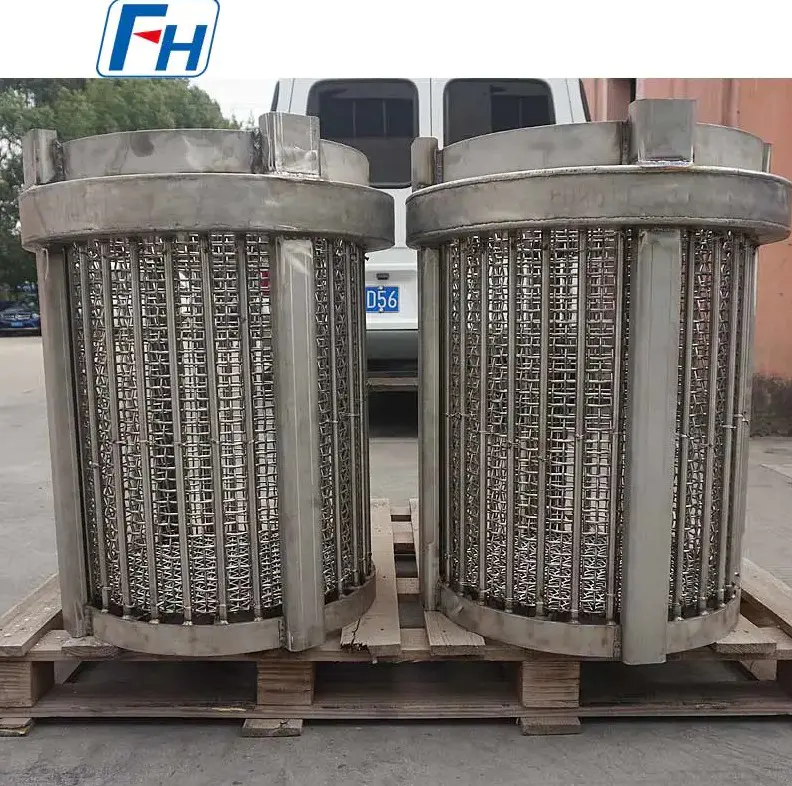
The key to preventing heat treatment baskets from warping or distorting lies in selecting high-temperature alloys with adequate creep resistance, keeping internal support block spacing below 200 mm, using integrated reinforcement ribs with intelligent release joints to enhance structural rigidity, and ensuring geometric compatibility between the basket and furnace components such as radiant heat tubes and furnace rollers. Combined application of these measures can extend basket service life by 30% to 50% and reduce overall energy consumption by approximately 8% to 12%.
The primary cause of heat treatment basket deformation during high-temperature cycling is insufficient creep resistance of the material. When temperatures exceed 900 degrees Celsius, the yield strength of ordinary carbon steel or low-alloy steel drops sharply, leading to irreversible plastic deformation under the basket's own weight and workpiece load. Therefore, heat-resistant alloys specifically designed for high-temperature environments must be used.
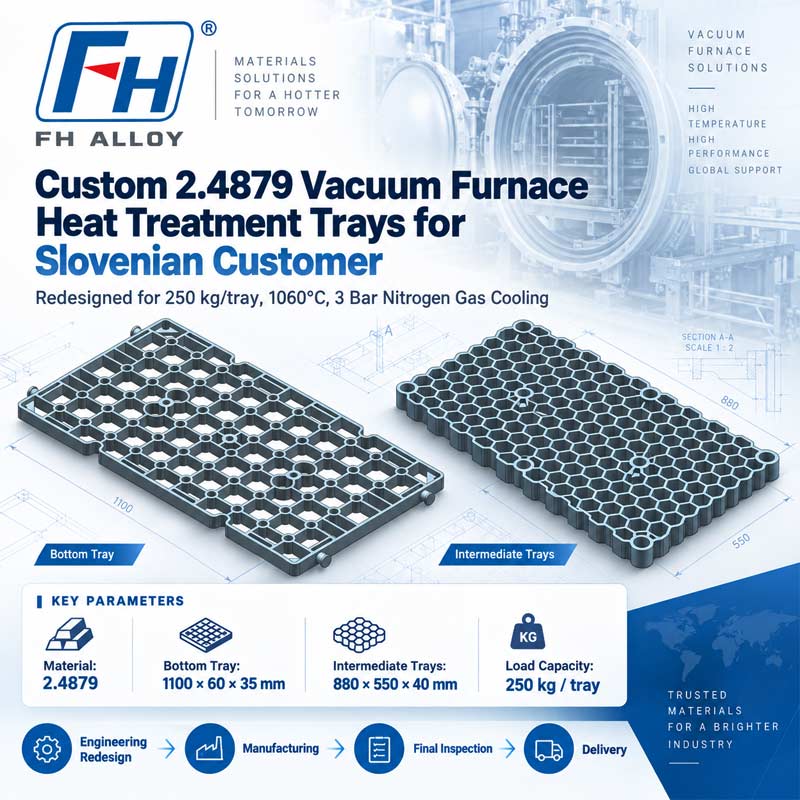
Taking nickel-based superalloys such as grade 2.4879 as an example, they maintain sufficient structural strength even at 1050 degrees Celsius. These alloys form a stable austenitic matrix through the addition of chromium, nickel, and molybdenum, with carbide strengthening phases precipitated to effectively suppress grain boundary sliding and dislocation climbing, thereby significantly reducing creep rate. Baskets manufactured by investment precision casting feature smooth surfaces and precise dimensions, ensuring uniform heat flow distribution across temperature differentials of hundreds of degrees Celsius and preventing warping caused by localized thermal stress concentration.
The structural design of a basket directly determines its resistance to deformation. Verified by 3D laser detection, internal support block spacing should be strictly controlled below 200 mm to ensure continuous and uniform support for long, thin, or flat workpieces, preventing edge warping due to load concentration. This standard applies to heat treatment scenarios involving automotive transmission components, aerospace brackets, and stamped fasteners.
For overall rigidity, reinforcement ribs should be integrated into the basket frame, with intelligent release joints installed at critical connection points. These joints provide controlled flexible compensation when differential thermal expansion occurs between the basket and workpiece, preventing thermal stress from being transmitted directly to the part being treated or the basket body itself. For welding heat treatment fixtures, this controlled thermal compliance is essential for relieving welding residual stress.
Even with excellent material and structural design, improper heat treatment parameters can still cause basket deformation. Excessive heating rates create significant temperature gradients between the basket surface and core, generating thermal shock. Research indicates that thermal shock from cyclic heat treatment is one of the main causes of surface and internal deformation and cracking in baskets. The following principles should be observed:
Working with an FMS intelligent heat treatment management system enables closed-loop control of temperature and heating or cooling rates, ensuring thermal stress remains within safe limits.
Heat treatment baskets do not operate in isolation; their performance is directly linked to the condition and specification of surrounding furnace components. Furnace rollers and furnace piers support the basket base. If roller surfaces are worn or pier heights are inconsistent, the basket rocks during loading and unloading, introducing mechanical stress into the parts. AFC furnace roller rails and rollers must be dimensionally matched to the basket base geometry; a mismatch of as little as 3 mm in rail height causes uneven wear across the basket bottom and accelerates creep deformation.
Radiant heat tubes determine the heat distribution pattern inside the chamber. Their position relative to the basket determines which zones receive maximum radiant input. A basket with poor lateral convection channels creates shadowed zones where workpiece temperature lags, exactly where hot and cold spots develop. Coordinating the basket lattice geometry with the radiant tube layout is a key step in process optimization.
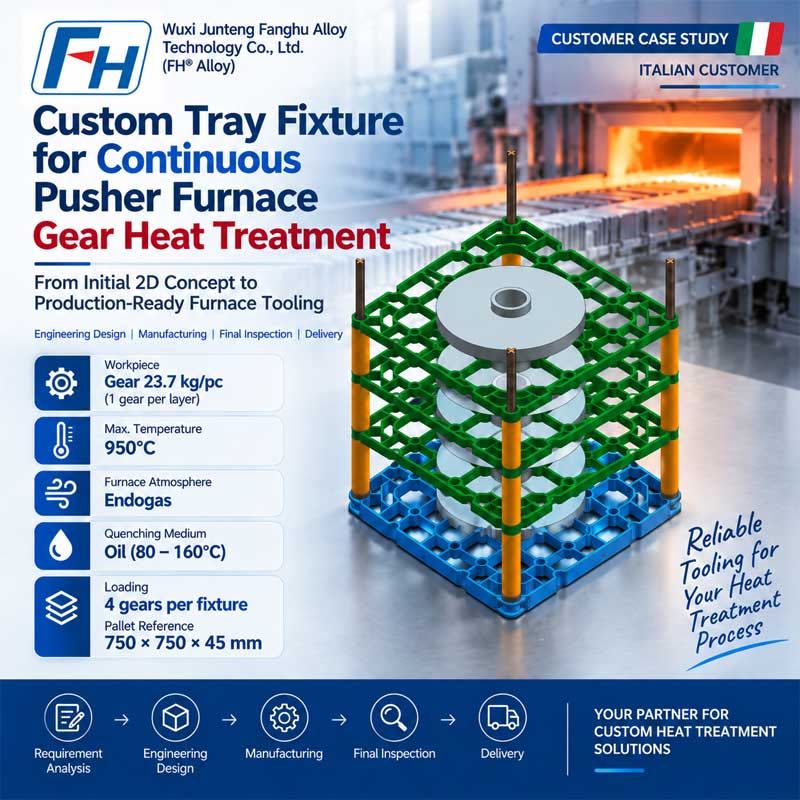
Excessive loading density can exceed the basket's design load capacity, causing excessive deflection of the support structure. Workpiece weight should be reasonably distributed according to the basket's rated load, avoiding concentrated point loads. For precision casting baskets, structures optimized for specific furnace types (chamber, pusher, vacuum, pit, and bell-type) can accommodate more workpieces per thermal cycle, thereby increasing heat treatment capacity per unit time, provided they are used within the design load range.
Workpieces should be placed with stable center of gravity to avoid eccentric loading. For irregularly shaped workpieces, an adjustable tray system can be used to flexibly adjust tray height and tilt angle according to workpiece shape, preventing plastic deformation caused by excessive local pressure.
Establishing a regular basket inspection regime is an important part of deformation prevention. A comprehensive inspection is recommended after every 500 thermal cycles, focusing on the following items:
| Inspection Item | Inspection Method | Acceptance Criteria |
|---|---|---|
| Overall flatness | 3D laser scanning | Deformation not exceeding 0.5% of original dimensions |
| Support block spacing | Vernier caliper or laser measurement | Spacing deviation within plus or minus 2 mm |
| Surface cracks | Visual inspection or penetrant testing | No visible cracks or network oxidation |
| Connection looseness | Manual check or torque test | No looseness or abnormal gaps |
| Bottom wear depth | Depth gauge measurement | Wear depth not exceeding 3 mm |
Baskets with deformation exceeding tolerance should be repaired or replaced promptly to prevent continued use from degrading workpiece quality and increasing energy consumption. For large-scale continuous production lines, baskets with standardized interfaces enable quick replacement within tens of seconds, significantly reducing line changeover time.
On modern continuous heat treatment production lines, integration of baskets with automation systems helps prevent deformation. Positioning holes reserved on the basket surface allow vision-guided robotic arms to achieve precise grasping and placement, ensuring consistent loading positions every time. RFID tags or sensors embedded inside the basket enable real-time tracking of workpiece batches and temperature history, with data uploaded directly to the factory-level FMS system for production monitoring.
Through long-term data accumulation, correlations between basket deformation and process parameters can be analyzed to establish predictive maintenance models, enabling intervention before deformation occurs and extending basket service life by 30% to 50%.
 CategoryRecent Post

Focus on Designing and Manufacturing Alloy Steel Parts since 2006
 Tel: 0510-83310100
  E-mail: info@alloy-casting.com
  Office Add: Room 1105,Building 6, Jiaye Wealth Center,Wuxi, Jiangsu, P.R.China P.C.:214000.
  Privacy

 English
 Español
 italiano
 Deutsch
 0086-13338774804
