 Nov 22, 2026
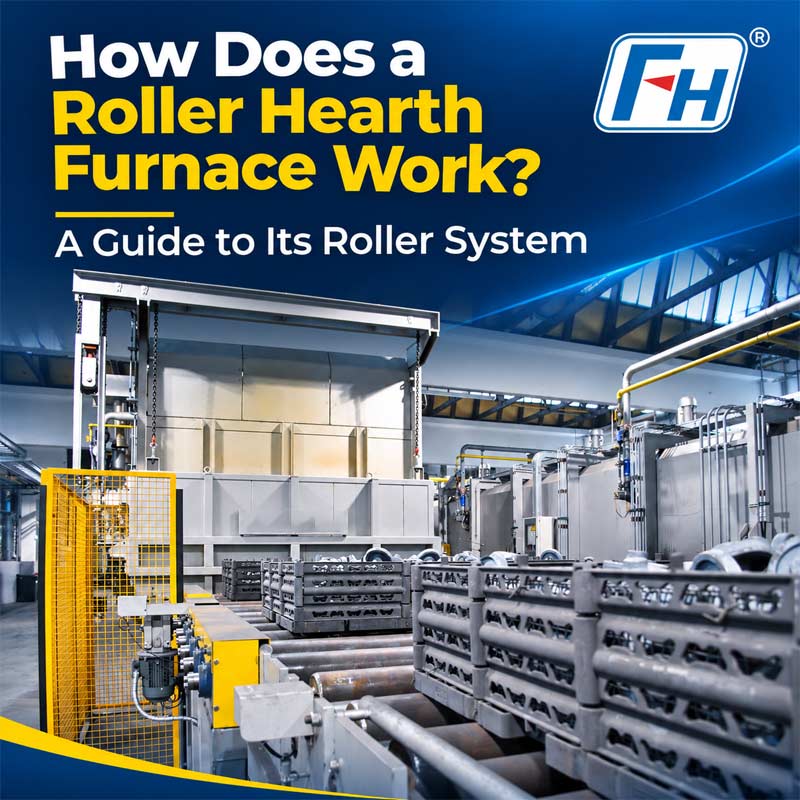
A roller hearth furnace is an industrial heating system designed to transport products continuously through controlled temperature zones.
It is widely used in metal processing, heat treatment, annealing, and other industrial thermal processes.
One of the most important components in this type of furnace is the roller system. Furnace rollers support and transport workpieces while operating under elevated temperatures and mechanical loads.
Understanding how the system works helps manufacturers and maintenance engineers make better decisions about furnace roller selection and maintenance.
1. What Is a Roller Hearth Furnace?
A roller hearth furnace is a continuous furnace in which workpieces move through the heating chamber on a series of rotating rollers.
The rollers are arranged along the furnace length and driven by a mechanical transmission system.
As the rollers rotate, they move products through different processing zones without requiring individual manual handling.
A typical roller hearth furnace consists of:
2. How Does the Furnace Roller System Work?
The roller system performs the main conveying function.
Step 1: Loading
Products are placed onto the roller conveyor at the furnace entrance.
Step 2: Conveying
The rollers rotate at a controlled speed, transporting products through the furnace.
Step 3: Heating
The products pass through designated heating zones where temperature is controlled according to the process requirements.
Step 4: Holding or Soaking
Depending on the production process, products remain within a specified temperature range for a controlled period.
Step 5: Cooling or Discharge
After heating, products move toward the cooling section or furnace exit.
The actual process configuration depends on the furnace type and production requirements.
3. Why Are Furnace Rollers Important?
Furnace rollers directly influence the stability of continuous production.
Their main responsibilities include:
Roller deformation, excessive runout, or misalignment can affect product transportation and potentially cause production interruptions.
4. Operating Challenges for Furnace Rollers
Furnace rollers work under several demanding conditions.
High Temperature
Prolonged exposure to elevated temperatures can reduce material strength and increase the risk of deformation.
Mechanical Loading
The rollers must withstand the weight of the workpieces and their own structural weight.
Thermal Expansion
Rollers expand during heating. The furnace design must account for dimensional changes and suitable installation clearances.
Oxidation and Furnace Atmosphere
The atmosphere inside the furnace affects surface stability and material degradation.
Continuous Rotation
Rollers must maintain dimensional accuracy and stable rotation during extended production cycles.
5. Selecting Suitable Furnace Rollers
When selecting rollers for a roller hearth furnace, evaluate:
The maximum furnace temperature should not automatically be treated as the actual roller metal temperature.
Accurate operating information is important for proper material selection.
6. Materials and Manufacturing
Heat-resistant cast alloys are widely used in high-temperature furnace roller applications.
Depending on the operating conditions, possible material choices include 1.4848, 1.4849, 1.4852, and 2.4879.
Manufacturing requirements may include:
The exact production route depends on the roller design and customer specifications.
7. FH® Continuous Furnace Roller Solutions
FH® manufactures heat-resistant alloy castings and industrial furnace components for demanding thermal processing environments.
Our custom manufacturing approach takes into consideration material grade, roller dimensions, operating temperature, and application requirements.
For customers looking for continuous furnace roller replacements or custom components, FH® can evaluate drawings and technical specifications.
Explore our Furnace Roller Product Range.
Frequently Asked Questions
What is the main function of rollers in a roller hearth furnace?
They support and transport workpieces continuously through the furnace.
What materials are used for roller hearth furnace rollers?
Heat-resistant alloy castings are commonly used, with the grade selected according to temperature, atmosphere, and mechanical loading.
What causes unstable workpiece movement?
Possible causes include roller deformation, excessive runout, uneven roller speed, misalignment, or incorrect roller spacing.
Can furnace rollers be customized for existing equipment?
Yes. Custom rollers can be manufactured based on equipment drawings, samples, and operating specifications.
Request Custom Furnace Rollers
Looking for furnace rollers for a continuous production line?
Send FH® your technical drawings and operating requirements to discuss a suitable solution.
 Category

Focus on Designing and Manufacturing Alloy Steel Parts since 2006
 Tel: 0510-83310100
 E-mail: info@alloy-casting.com
 Office Add: Room 1105,Building 6, Jiaye Wealth Center,Wuxi, Jiangsu, P.R.China P.C.:214000.
 Privacy

 English
 Español
 italiano
 Deutsch
 0086-13338774804