Introduction to Pit Furnace Base Trays (Workpiece Trays/Hearth Plates)
Alright, here is a detailed introduction to the base tray (also known as the hearth plate, basket base plate, workpiece support tray, etc.) in pit furnaces.
The tray is a critical component in a pit furnace. It directly supports the workpieces being processed (such as castings, forgings, precision parts, etc.) and operates under harsh conditions including high temperatures, heavy loads, and atmosphere circulation.
1. Primary Functions and Roles
- Supporting Workpieces: This is the most basic function, bearing the weight of the workpieces, fixtures, and itself.
- Ensuring Furnace Atmosphere Circulation: Designed with regularly arranged holes or slots to allow protective atmospheres (e.g., nitrogen, methanol cracked gas) or reactive gases (e.g., carburizing gas) to flow uniformly from bottom to top, ensuring temperature and atmosphere uniformity throughout the furnace chamber.
- Uniform Heat Transfer: Transferring heat from the bottom heating elements (or hot air) to the workpieces. Its structural design affects heat transfer efficiency.
- Preventing Workpieces from Falling into the Furnace Bottom: Avoiding small parts or scale from falling onto the bottom heating elements or fan, which could cause damage or cleaning difficulties.
- Facilitating Loading/Unloading: Typically used in conjunction with a work basket (or directly with crane lifting tools) to facilitate overall hoisting in and out of the furnace chamber, improving production efficiency.
2. Common Structural Types
Depending on furnace type, process, and load requirements, trays mainly come in the following structures:
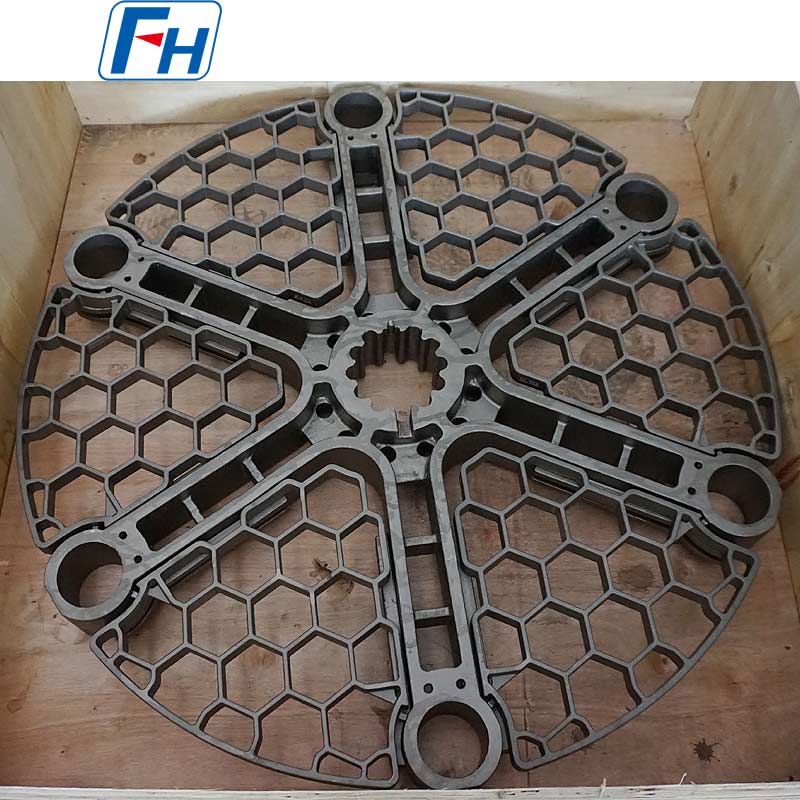
1. Cast Ribbed Plate Type:
- Material: Often made of heat-resistant cast steel (e.g., ZG40Cr25Ni20Si2, similar to ACI HK type).
- Structure: Integrally cast, consisting of sturdy side frames, load-bearing ribs, and a grid or bar-type surface. The open area ratio is designed.
- Advantages: High strength, very high load-bearing capacity, resistant to high-temperature deformation, long service life. Suitable for heavy workpieces (e.g., annealing of large forgings, castings).
- Disadvantages: Heavy weight, relatively high thermal mass leading to slightly slower heating/cooling, higher cost.
2. Welded Grate Type:
- Material: Made by welding heat-resistant round bars or flat bars (e.g., Cr25Ni20, Cr20Ni35).
- Structure: Heat-resistant steel bars welded into a grid or grate pattern.
- Advantages: Relatively lightweight, high open area ratio, low airflow resistance, flexible manufacturing. Suitable for medium loads and situations requiring strong airflow.
- Disadvantages: After prolonged high-temperature use, weld points may develop cracks. Load-bearing limit is lower than the cast type.
3. Perforated Plate / Woven Mesh Type:
- Material: Punching from heat-resistant steel plates or weaving from heat-resistant alloy wire.
- Structure: A single plate with densely punched holes, or multiple layers of woven mesh.
- Advantages: Very uniform airflow distribution, lightweight. Suitable for small parts, bright heat treatment, or processes with extremely high requirements for atmosphere uniformity (e.g., solution treatment of stainless steel).
- Disadvantages: Weakest load-bearing capacity, prone to deformation, not suitable for heavy workpieces.
4. Modular / Split Type:
- For very large pit furnaces, a single-piece tray may be difficult to manufacture and handle. It can be designed as multiple sections assembled together for easier installation and replacement.
3. Key Performance Requirements and Material Selection
- High-Temperature Strength and Creep Resistance: Ability to withstand the load for long periods at maximum operating temperature (e.g., 950°C, 1100°C, or higher) without significant deformation or collapse.
- Thermal Fatigue Resistance: Ability to withstand repeated heating-cooling cycles without cracking.
- Atmosphere Corrosion Resistance: Good chemical stability in carburizing, nitriding, or oxidizing/reducing atmospheres, resisting embrittlement and powdering.
- Good Structural Stability: Design must account for thermal expansion to prevent jamming inside the furnace chamber.
Common Materials:
- Medium Temperature Range (~below 900°C): ZG30Cr18Mn12Si2N (rare earth nitrogen steel), lower cost.
- High Temperature Range (900°C - 1150°C):
- Mainstream: ZG35Cr24Ni7SiN (e.g., similar to ACI HN type), ZG40Cr25Ni20Si2 (e.g., similar to ACI HK type, 2520).
- Higher Requirements/Temperatures: ZG45Cr26Ni35Si2 (e.g., similar to ACI HP type), ZG30Cr26Ni5 (high-chromium steel), etc.
- Very High Temperature or Special Environments: Nickel-based alloys (e.g., Inconel series) may be used.
4. Key Design Considerations
1. Open Area Ratio and Airflow: The open area must match the furnace fan power to ensure smooth and uniform airflow.
2. Strength and Weight: Optimize rib design to reduce weight while ensuring load-bearing capacity and service life, saving energy.
3. Fit with Furnace Body:
-
- Clearance: Appropriate expansion clearance must be left between the tray and furnace wall (typically 10-30mm per side, depending on diameter and temperature).
- Sealing: For pit furnaces with retorts, the tray must have a good sealing or structure with the retort bottom to guide airflow.
4. Lifting Structure: Must have sturdy lifting lugs or a structure that safely interfaces with the basket/lifting tool.
5. Usage and Maintenance Notes
1. Level Placement: Workpieces should be evenly distributed during loading to avoid local overload.
2. Regular Inspection:
-
- Deformation: Check for flatness. Severe warping requires leveling or replacement.
- Cracks: Especially at rib connections on cast trays and welds on welded trays.
- Corrosion/Embrittlement: Check for severe oxidation/scaling or intergranular corrosion.
3. Cleaning: After each furnace cycle, clean scale and debris fallen on the tray to prevent accumulation, clogging of holes, and corrosion.
4. Avoid Thermal Shock: Within process limits, control heating and cooling rates as much as possible to extend service life.
5. Proper Handling: Use dedicated lifting tools and avoid collisions with the furnace chamber wall.
Summary
The pit furnace base tray is far from a simple "pallet." It is a key piece of heat-resistant tooling integrating structural support, atmosphere guidance, and heat transfer. Its material selection, structural design, and maintenance condition directly affect:
- The uniformity and stability of the heat treatment process
- The consistency of product quality
- The utilization efficiency of the furnace atmosphere
- The safe operational life of the equipment itself
Selecting the appropriate tray is a crucial aspect of pit furnace application and maintenance.
Technical Dept.
Harper
Email: harper@alloy-casting.com
WhatsApp/WeChat: 0086 17715681774
Wuxi Junteng Fanghu Alloy Technology Co., Ltd.
Office Add: Room 1105,Building 6, Jiaye Wealth Center,Wuxi, Jiangsu, P.R.China P.C.:214000
Factory Add: No.26 Baoyuan road, Section B Yangjian Industrial Park, Wuxi, Jiangsu, P.R. China P.C.:214107


 Dec 15, 2025
  Category

 Tel: 0510-83310100
  E-mail: info@alloy-casting.com
  Office Add: Room 1105,Building 6, Jiaye Wealth Center,Wuxi, Jiangsu, P.R.China P.C.:214000.
  Privacy

 English
 Español
 italiano
 Deutsch
 0086-13338774804
