
 Apr 17, 2026
 Content
When selecting heat-resistant steel castings for industrial furnaces, the core principle is: first determine the maximum operating temperature, then evaluate the furnace atmosphere and load conditions, and finally match the corresponding grade's chemical composition and microstructural stability. Specifically, for operating temperatures below 850°C, low-nickel high-chromium steels (such as ZG30Cr18Si2) can be selected; for the medium-temperature range of 850°C to 1050°C, the HK series (25Cr-20Ni) or nitrogen-enhanced modified grades should be used; for high-temperature zones above 1050°C and carburizing atmospheres, the HP series (25Cr-35Ni) or niobium-containing modified HP-Nb must be adopted to ensure adequate creep resistance and carburization resistance. Improper material selection leads to direct consequences including: oxide scale spalling and furnace blockage, component embrittlement and fracture due to σ-phase precipitation in the 650°C to 900°C range, and catastrophic carbon corrosion in carburizing atmospheres.
The actual temperature of components inside industrial furnaces is typically 50°C to 150°C higher than the workpiece temperature, and the heat source type (heavy oil, gas, or electric) directly affects temperature distribution uniformity. The performance degradation of heat-resistant steels is not linear but exhibits critical threshold points:
| Grade Series | Typical Composition | Maximum Service Temperature | Key Limitations |
|---|---|---|---|
| HF (19Cr-9Ni) | Cr 18-23%, Ni 8-12% | 870°C | Only suitable for low-stress support components |
| HH (25Cr-12Ni) | Cr 24-28%, Ni 11-14% | 1100°C | Type 1 contains partial ferrite, good high-temperature ductility but low creep strength; Type 2 is fully austenitic, higher strength but requires protection against σ-phase embrittlement |
| HK (25Cr-20Ni) | Cr 23-27%, Ni 19-22% | 1150°C | Good creep and rupture strength, suitable for ammonia reformers and ethylene cracking furnace tubes |
| HP (25Cr-35Ni) | Cr 24-28%, Ni 33-37% | 1100°C | High nickel stabilizes austenite, excellent carburization resistance and thermal cycling performance |
| HP-Nb (Modified) | Cr 24-28%, Ni 33-36%, Nb 0.8-1.2% | 1100°C | Niobium addition significantly improves long-term creep strength, ductility, and weldability |
| HU (17Cr-39Ni) | Cr 17-21%, Ni 37-41% | 1150°C | Best carburization and oxidation resistance, but relatively lower creep strength |
Industrial furnace atmospheres can be classified into six types: oxidizing, reducing, neutral, sulfur-containing, carburizing, and vacuum. The atmosphere type directly determines the failure mode of alloying elements:
Chromium is the foundational element for oxidation resistance in all heat-resistant alloys. The Cr₂O₃ protective film it forms is crucial in oxidizing atmospheres. However, water vapor significantly accelerates oxidation of high-iron alloys, with relatively less impact on high-nickel alloys. In sulfur-containing atmospheres, sulfides penetrate the oxide film causing "sulfidation-oxidation" synergistic corrosion. In such cases, the HL series (29Cr-20Ni) with high chromium and low nickel should be selected, as its sulfidation resistance is superior to the HK series.
In carburizing atmospheres (such as methane or propane cracking environments), carbon atoms infiltrate the steel matrix forming brittle carbides. When carbon content exceeds 2%, most heat-resistant alloys completely lose ductility at room temperature. The HP series, due to its high nickel content (33% to 37%) which reduces the maximum carbon solubility, becomes the preferred choice for carburizing furnace components. For the more severe "metal dusting" — a catastrophic carbon corrosion occurring around 600°C — experience shows that high-nickel alloys such as RA333 and cast-grade Supertherm perform best, while RA330 and 801H perform significantly worse in this environment.
In hydrogen or cracked ammonia atmospheres, decarburization embrittlement must be prevented. Grades with moderate carbon content (0.35% to 0.50%) and stable carbide-forming elements (such as Nb, W) should be selected. In modified HP-Nb grades, niobium forms NbC with carbon, preventing chromium depletion at grain boundaries and inhibiting hydrogen embrittlement.
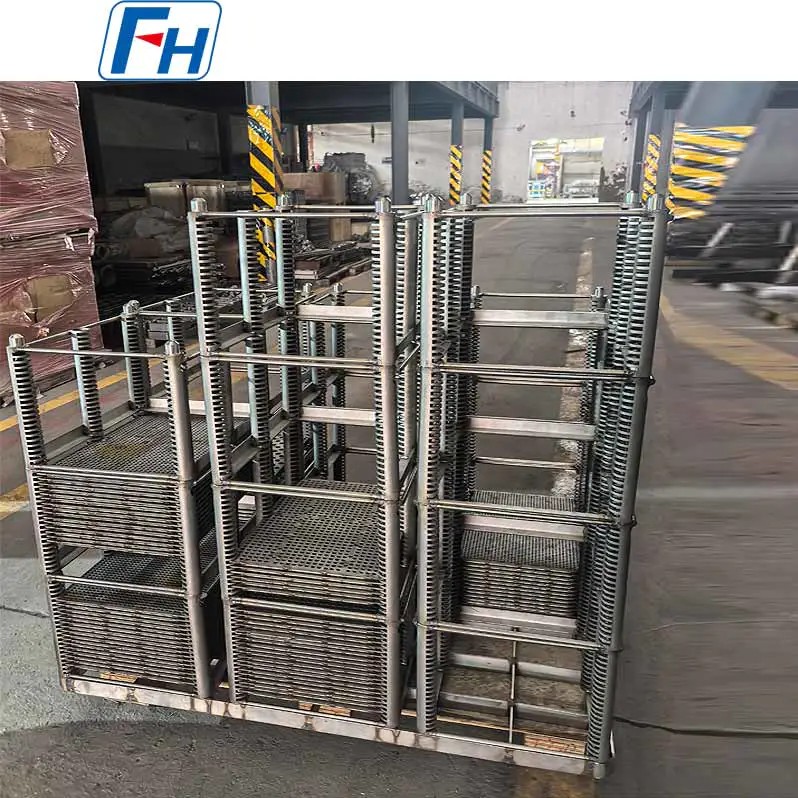
The failure modes of heat-resistant steel castings in industrial furnaces depend not only on temperature and atmosphere, but are also closely related to load type:
For components under long-term static loading (such as furnace tubes and hangers), ISO 204:2018 standard requires: at 800°C and 100 MPa stress, creep rupture time must exceed 100,000 hours. HP40 (25Cr-35Ni) exhibits significantly higher rupture strength than HK40 at 900°C, because its higher nickel content stabilizes the austenitic matrix and promotes the dispersion of fine M₂₃C₆ carbides. If the operating temperature rises to 950°C with 50 MPa stress, nickel-based alloys such as Inconel 617 require rupture life ≥50,000 hours, at which point iron-based heat-resistant steels can hardly meet the requirements.
For components experiencing frequent start-up/shut-down cycles or temperature fluctuations (such as heat treatment trays and radiant tubes), thermal fatigue is the primary failure mode. Through 1,000 thermal cycles between 20°C and 800°C, crack growth rates can be evaluated. HH Type 1, due to its partial ferrite content, exhibits better ductility under such conditions than the fully austenitic Type 2; while the HT series (15Cr-35Ni), due to its high nickel content, has the best thermal shock resistance and can operate up to 1150°C in oxidizing conditions and 1100°C in reducing conditions.
In environments with material erosion such as cement rotary kilns and pellet shaft furnaces, wear resistance must be enhanced on the basis of heat resistance. For ZG40Cr25Ni20, carbon content can be increased to 0.40% to 0.50%, or trace molybdenum (0.5% to 1.0%) can be added to form hard carbides. After replacing ordinary carbon steel with ZG40Cr25Ni20 in a cement kiln lining, service life extended from 6 months to 3 years, fully demonstrating the exponential improvement that proper material selection brings to service life.
There are systematic differences in the compositional specifications for heat-resistant cast steels among major global standard systems. Understanding these differences helps in precise material selection:
ZG40Cr25Ni20 specified in GB/T 8492-2014 corresponds to HK40 in ASTM A297, but with a slightly lower minimum nickel content (18% to 21% vs 19% to 22%). Chinese standards tend to compensate for performance losses from reduced nickel content by adding nitrogen (N, 0.15% to 0.25%) and rare earth (RE) elements, thereby controlling costs. For example, ZG35Cr24Ni7SiN, through nitrogen solid solution strengthening, achieves high-temperature strength close to HK40 at 1050°C, but with material cost reduced by approximately 15% to 20%.
Traditional HP grades (Cr 24% to 28%, Ni 33% to 37%) have evolved into several modified branches:
Composition deviations in heat-resistant steel castings significantly affect performance. For example, silicon content exceeding 3%, while enhancing oxidation resistance, severely reduces room temperature toughness; carbon content exceeding 0.50% accelerates high-temperature embrittlement. Engineering practice recommends using Optical Emission Spectrometry (OES) or Inductively Coupled Plasma (ICP) for composition testing, with error control within ±0.01%. For critical components, 500-hour oxidation testing (GB/T 13303-2020) is also required, calculating average oxidation rate V = (g₂ - g₁) / (S · t), in units of g/m²·h.
The final material selection decision must transcend unit material price and calculate the full Life Cycle Cost (LCC). Taking petrochemical ethylene cracking furnace radiant tubes as an example:
In the ultra-high temperature range of 1095°C to 1205°C, even though iron-nickel-based alloys such as HL, HU, and HX have higher initial costs, their reduced downtime frequency and maintenance labor often recover the material cost difference within 18 months. Therefore, the essence of heat-resistant steel selection for industrial furnaces is finding the optimal balance among five dimensions: temperature, atmosphere, load, service life, and cost, rather than simply pursuing the extreme of any single indicator.
 CategoryRecent Post

Focus on Designing and Manufacturing Alloy Steel Parts since 2006
 Tel: 0510-83310100
  E-mail: info@alloy-casting.com
  Office Add: Room 1105,Building 6, Jiaye Wealth Center,Wuxi, Jiangsu, P.R.China P.C.:214000.
  Privacy

 English
 Español
 italiano
 Deutsch
 0086-13338774804
