
 Nov 25, 2026
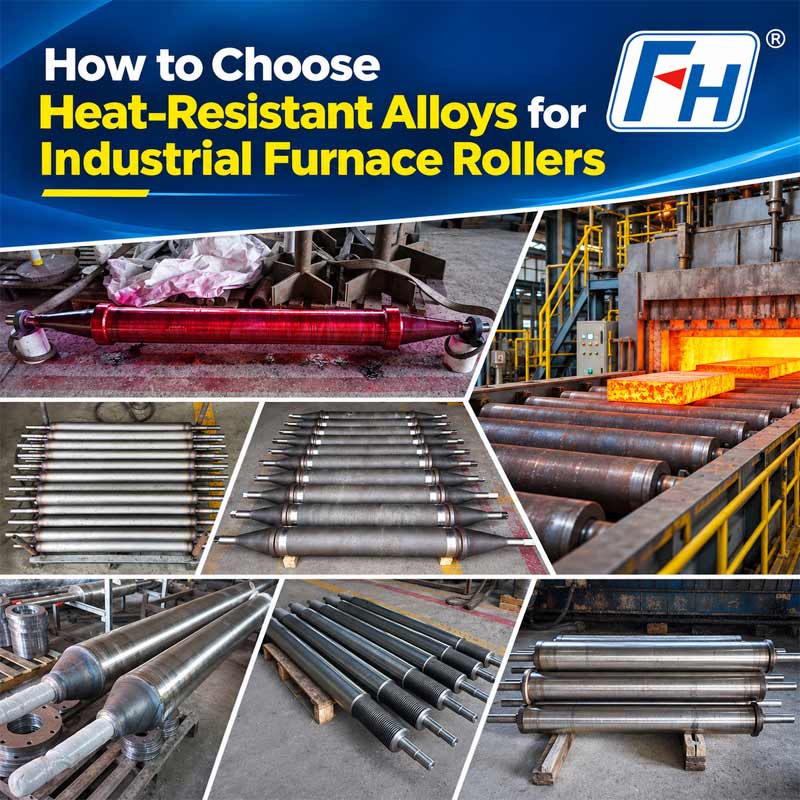
Selecting the correct heat-resistant alloy is essential for the performance of industrial furnace rollers.
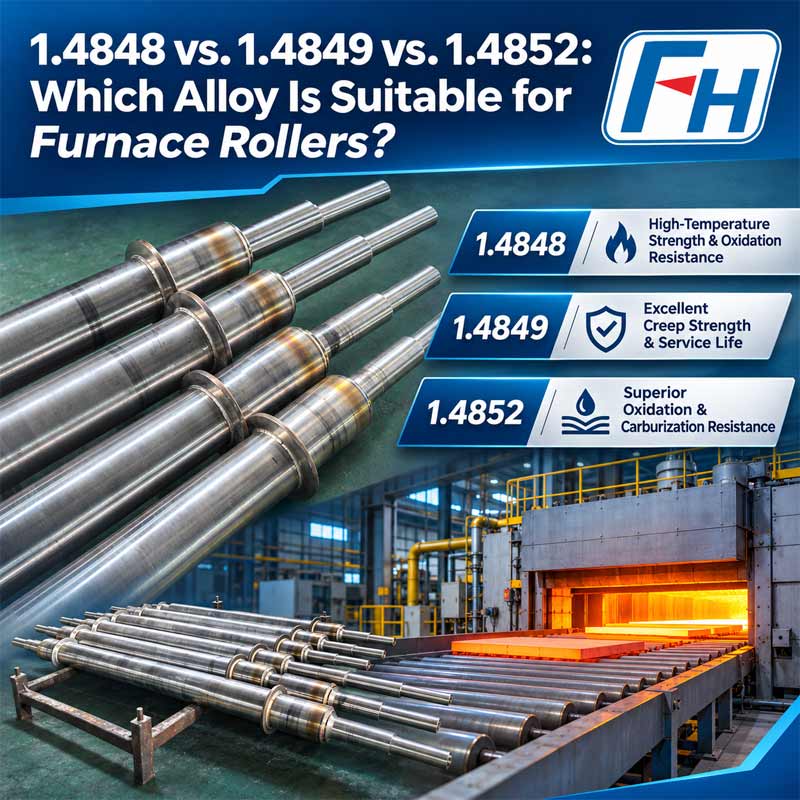
Among the alloy grades used in high-temperature furnace component manufacturing, 1.4848, 1.4849, and 1.4852 are three materials that may be considered for different applications.
Although all three belong to the family of heat-resistant cast alloys, their chemical compositions are not the same.
Understanding their differences helps engineers and purchasing teams make more informed material selection decisions.
1. Overview of the Three Alloy Grades
The following table provides a general comparison of their commonly referenced alloy designations.
| Material Grade | General Alloy Type | Main Characteristics |
| 1.4848 | Chromium-nickel-silicon cast alloy | Approximately 25Cr-20Ni |
| 1.4849 | Nb-containing chromium-nickel cast alloy | Approximately 18Cr-38Ni |
| 1.4852 | Nb-containing chromium-nickel cast alloy | Approximately 25Cr-35Ni |
These figures are indicative composition descriptions, not substitutes for a complete chemical specification.
Actual composition limits must be checked against the applicable material standard and purchase specification.
2. Understanding 1.4848
1.4848 is commonly designated GX40CrNiSi25-20.
Its typical alloy system contains:
The chromium-nickel composition makes it a widely used material for heat-resistant cast components.
Potential applications include:
For roller applications, the actual mechanical loading, wall thickness, and operating environment must be evaluated before selecting this grade.
3. Understanding 1.4849
1.4849 is commonly associated with the designation GX40CrNiSiNb38-18.
Its alloy system is characterized by:
Compared with 1.4848, it has a higher nickel content and includes niobium.
The alloy's performance should be evaluated using its specified chemical composition, high-temperature mechanical properties, and application requirements.
4. Understanding 1.4852
1.4852 is commonly designated GX40CrNiSiNb35-25.
Its general alloy system contains:
It is a high-alloy cast material considered for demanding high-temperature applications.
Its suitability for furnace rollers depends on the actual operating temperature, mechanical loading, furnace atmosphere, and component geometry.
5. Key Differences Between the Three Materials
The main differences involve chromium content, nickel content, and the presence or absence of niobium in the commonly referenced compositions.
| Comparison | 1.4848 | 1.4849 | 1.4852 |
| Chromium level | Around 25% | Around 18% | Around 25% |
| Nickel level | Around 20% | Around 38% | Around 35% |
| Niobium | Not typically specified in its basic designation | Included | Included |
| General alloy family | Cr-Ni-Si | Cr-Ni-Si-Nb | Cr-Ni-Si-Nb |
| Selection basis | Actual application requirements | Actual application requirements | Actual application requirements |
The table provides a general reference only. Confirm the material certificate and governing specification before ordering.
6. Which Alloy Should Be Used for Furnace Rollers?
The correct material depends on the complete operating environment.
Operating Temperature
Evaluate the actual roller metal temperature rather than relying only on the furnace set temperature.
Mechanical Loading
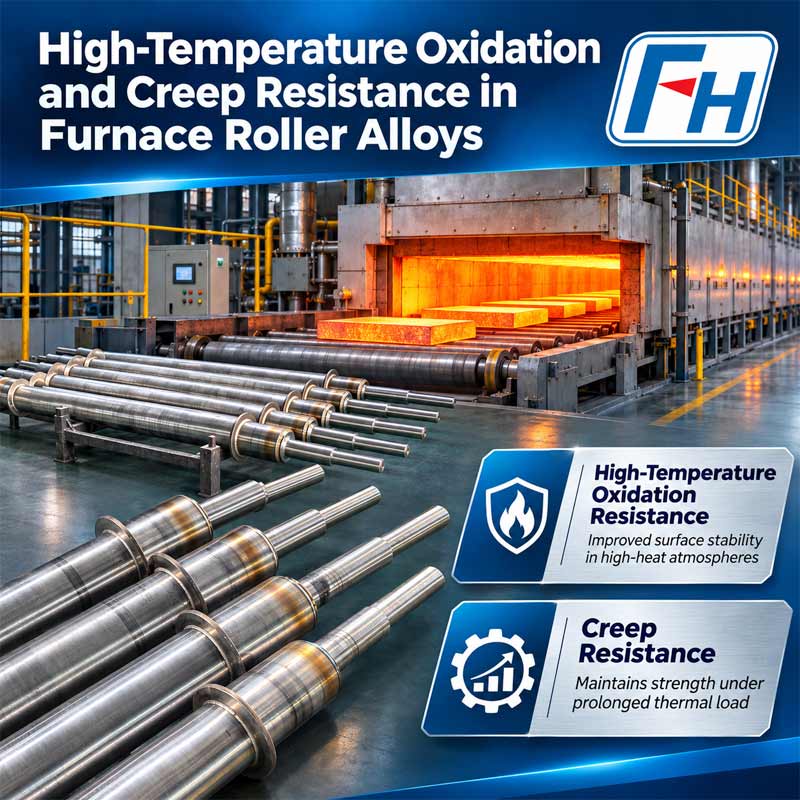
Rollers supporting heavy workpieces require careful evaluation of high-temperature strength and creep performance.
Furnace Atmosphere
Oxidizing, carburizing, and other atmospheres can produce different material degradation mechanisms.
Thermal Cycling
Repeated temperature changes can affect oxide scale stability and contribute to thermal fatigue.
Roller Dimensions
Diameter, wall thickness, length, and support arrangement influence the stress distribution within the roller.
There is no reliable universal ranking in which one of these three grades is always the best choice.
7. What Should Buyers Confirm Before Ordering?
Before purchasing furnace rollers, request or confirm:
This information helps ensure that the selected material is appropriate for the intended application.
8. FH® Heat-Resistant Alloy Furnace Rollers
FH® manufactures heat-resistant alloy castings and custom industrial furnace components.
Our material selection and manufacturing approach considers the specified alloy grade, chemical composition, component dimensions, and operating environment.
For furnace roller projects, customers can provide drawings, existing samples, or technical specifications for evaluation.
Explore FH® Furnace Rollers to learn more about our custom manufacturing capabilities.
Frequently Asked Questions
Are 1.4848 and 1.4852 the same material?
No. They have different chemical compositions and alloy designations. They should not be substituted without engineering verification.
What is the main difference between 1.4849 and 1.4852?
Their commonly referenced compositions differ in chromium and nickel content. Both are niobium-containing grades, but their suitability depends on the actual operating conditions.
Which grade is best for high-temperature furnace rollers?
The appropriate grade depends on temperature, load, furnace atmosphere, roller geometry, and required service life.
Can FH® manufacture furnace rollers using these alloy grades?
FH® can discuss custom manufacturing according to confirmed material specifications, drawings, and project requirements.
Need Help Selecting Furnace Roller Materials?
Send FH® your technical drawings, operating temperature, and furnace atmosphere.
Our team can discuss material specifications and custom manufacturing requirements for your application.
 CategoryRecent Post

Focus on Designing and Manufacturing Alloy Steel Parts since 2006
 Tel: 0510-83310100
 E-mail: info@alloy-casting.com
 Office Add: Room 1105,Building 6, Jiaye Wealth Center,Wuxi, Jiangsu, P.R.China P.C.:214000.
 Privacy

 English
 Español
 italiano
 Deutsch
 0086-13338774804
