
 Jun 29, 2026
 Content
A furnace control thermocouple may confirm the target average temperature, yet significant temperature gradients can still exist side-to-side, top-to-bottom, and front-to-back inside the chamber. As a tray repeatedly heats and cools through these gradients, different zones expand and contract at different rates, generating cumulative thermal stress.
In continuous heat treatment furnaces, the surface temperature of furnace rollers can swing from around 200°C to over 900°C within just a few minutes. Heat treatment trays undergo even more loading and unloading cycles per day than typical furnace rollers, so the accumulated thermal shock is considerable. Once localized stress exceeds the material's yield strength, the tray begins to bow, twist, or warp. If stress continues to concentrate without relief, fracture follows.
| Failure Mode | Typical Cause | Operational Impact |
|---|---|---|
| Warping / Bowing | Uneven furnace temperature distribution; unequal cooling rates | Unstable conveying; workpiece displacement |
| Twisting | Misaligned pusher rods or transfer mechanisms | Accelerated rail wear; equipment downtime |
| Weld Cracking | No expansion gap reserved; stress concentrates at welds | Structural failure; premature scrapping |
| Creep Collapse | Prolonged overloading or operation above rated temperature | Loss of load-bearing capacity; damaged workpieces |
When a tray heats from room temperature to 1,000°C, linear expansion can reach 10 mm to 15 mm per meter of length. If the design does not incorporate expansion gaps or flexible connection structures, that thermal expansion has no release path — stress accumulates directly at weld joints and eventually causes cracking.
Wall thickness is equally important. The main tray wall typically ranges from 8 mm to 20 mm. Walls that are too thin lack strength and oxidize rapidly; walls that are too thick increase thermal mass, extend heating cycles, and intensify thermal stress. Empirical data shows that for every 2 mm increase in wall thickness, tray weight rises by approximately 15%, while high-temperature creep life improves by only around 5%. Optimizing the balance between structural strength and thermal efficiency is therefore essential.
For rib layout, honeycomb structures increase tray stiffness by over 40% compared to conventional radial ribs, while simultaneously reducing weight and improving furnace gas circulation — keeping workpiece temperature uniformity within ±5°C. Bottom track hardness should be 30 to 50 HBW lower than that of the furnace rollers to prevent damage to the expensive roller surfaces.
Ordinary carbon steel trays lose strength and oxidation resistance quickly above 900°C. Heat-resistant alloy steel castings — such as grades 1.4848, 1.4849, 2.4879, and SCH13 — typically contain 10% to 30% chromium with nickel and molybdenum additions, forming a stable austenitic or austenitic-ferritic microstructure. This allows trays to operate reliably in environments between 900°C and 1,150°C, delivering service life three to five times longer than ordinary carbon steel trays.
Chromium forms a dense Cr₂O₃ oxide film on the surface that blocks further oxygen diffusion, slowing both high-temperature oxidation and the onset of thermal fatigue cracking. Additionally, castings that have not undergone normalizing and tempering to relieve residual stress from the casting process will begin to crack much sooner, as operational thermal stress piles on top of pre-existing residual stress.
Even with correct material selection and sound structural design, poor operational practice can shorten tray life significantly. The most common field-level management gaps include:
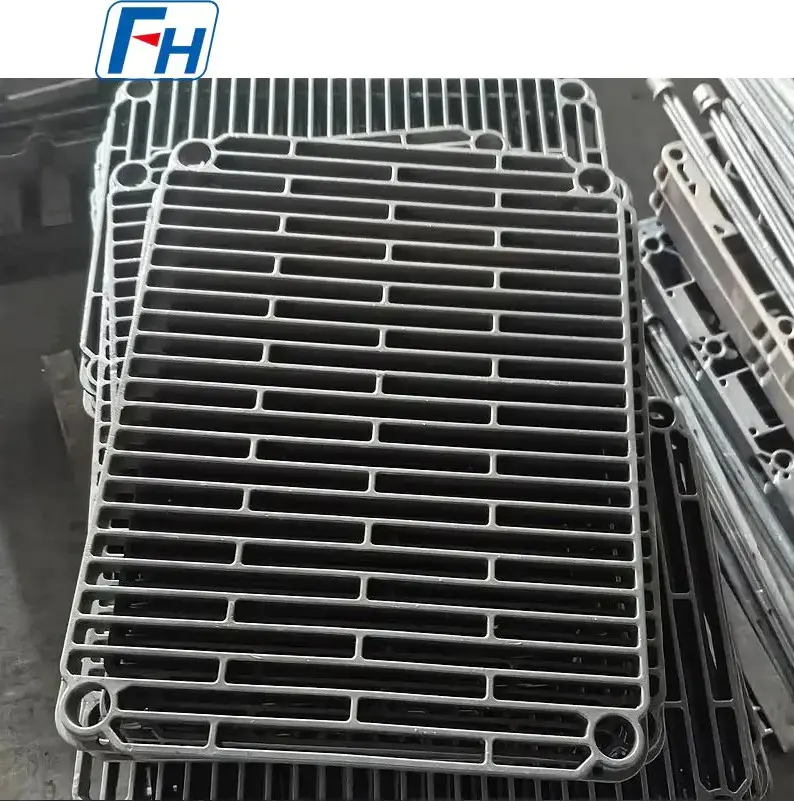
Tray inspection should focus on three dimensions: flatness, squareness, and overall proportional integrity. Trays must remain flat and level across both width and length. Sagging, bowing, warping, or twisting all interfere with smooth material handling inside the furnace and can trigger unexpected equipment stops.
Squareness is best checked with a carpenter's square applied to each of the four corners. Any out-of-square condition can cause tracking problems in the furnace conveyance system, setting off a cascade of secondary failures. Trays showing significant bulges or large breaks that fall outside original dimensional tolerances should be removed from service immediately rather than repaired and reused.
Building tray inspections into the scheduled summer or winter furnace maintenance shutdowns is a practical way to institutionalize this process and catch problems before they escalate into costly production interruptions.
At the material level, specifying heat-resistant alloy castings that have already undergone normalizing and tempering eliminates residual casting stress before the tray ever enters service. At the structural level, ensuring the design incorporates thermal expansion compensation — through honeycomb ribs, flexible joints, and adequate expansion gaps — distributes stress rather than concentrating it. At the process level, gradual heating and cooling ramps reduce thermal shock; oil quenching generates significantly lower thermal stress than water quenching, while air quenching suits applications where distortion control matters more than maximum hardness.
 CategoryRecent Post

Focus on Designing and Manufacturing Alloy Steel Parts since 2006
 Tel: 0510-83310100
  E-mail: info@alloy-casting.com
  Office Add: Room 1105,Building 6, Jiaye Wealth Center,Wuxi, Jiangsu, P.R.China P.C.:214000.
  Privacy

 English
 Español
 italiano
 Deutsch
 0086-13338774804
