
 Jun 08, 2026
 Content
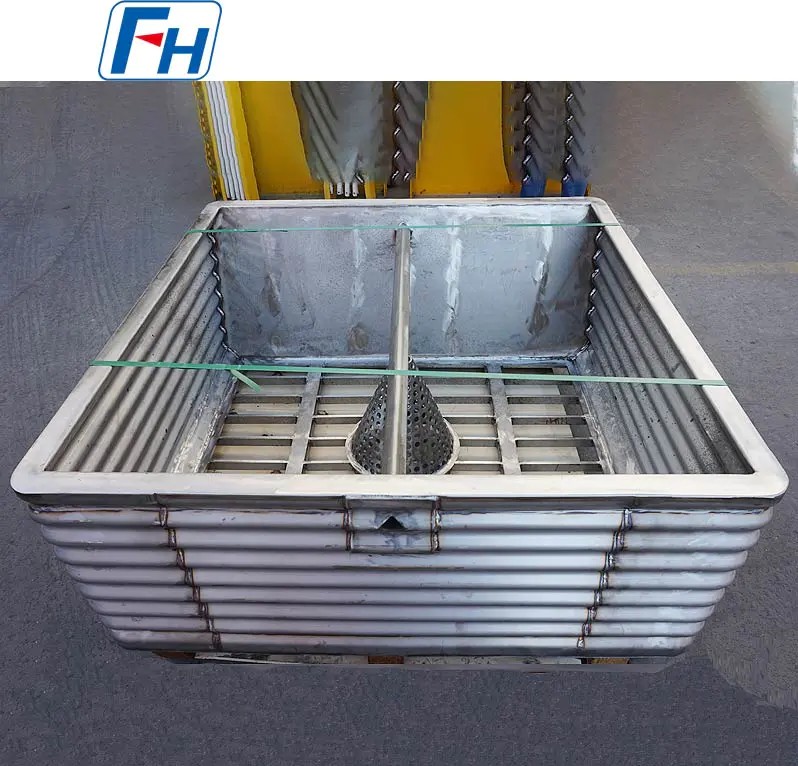
A heat treatment basket is the direct interface between your workpieces and the furnace environment. Get it wrong — wrong alloy, wrong structure, wrong furnace match — and you pay in warped parts, uneven case depth, premature basket failure, and wasted energy. The answer is clear: precision-cast, alloy-matched heat treatment baskets designed for your specific furnace type and process temperature are the single most cost-effective upgrade most heat treatment operations can make.
Heat treating baskets serve three simultaneous functions that are easy to underestimate: workpiece support, heat transfer bridging, and atmosphere management. A heat-treatment fixture that fails at any one of these creates downstream problems that no programming adjustment can fully correct.
Support stability prevents workpiece deformation during thermal cycling. When internal support spacing exceeds 200 mm, long or flat parts risk sagging under their own weight at temperatures above 900°C. A precision casting basket with support ribs spaced correctly for the load geometry keeps every part in its intended orientation from charge to discharge.
Heat transfer bridging matters because the basket sits between the radiant heat tube or convection flow and the part surface. High-thermal-conductivity alloys with smooth surfaces achieved through investment casting (centrifugal casting or lost-wax casting) maintain uniform heat flow even across temperature differences of several hundred degrees Celsius, reducing hot and cold spots that cause inconsistent case depth or hardness gradients.
Atmosphere management is especially relevant in carburizing, nitriding, and vacuum brazing processes. The mesh or lattice geometry of the basket wall directly controls how the process atmosphere contacts each workpiece. An optimally open structure ensures uniform atmosphere exposure without letting parts contact each other — a common source of soft spots in batch carburizing.
Basket alloy selection is not a procurement decision — it is a metallurgical one. The wrong grade costs two to three times more over a five-year operating window than the right grade specified at the outset.
| Material Grade | Max. Service Temp. | Best Suited For | Key Property |
|---|---|---|---|
| 1.4848 (HK40) | 1100°C | Carburizing, neutral hardening | High carbon resistance |
| 1.4849 (HK) | 1150°C | Roller hearth furnace, multi-purpose | Good creep resistance |
| 1.4852 (HP) | 1200°C | High-temp annealing, reformers | Superior oxidation resistance |
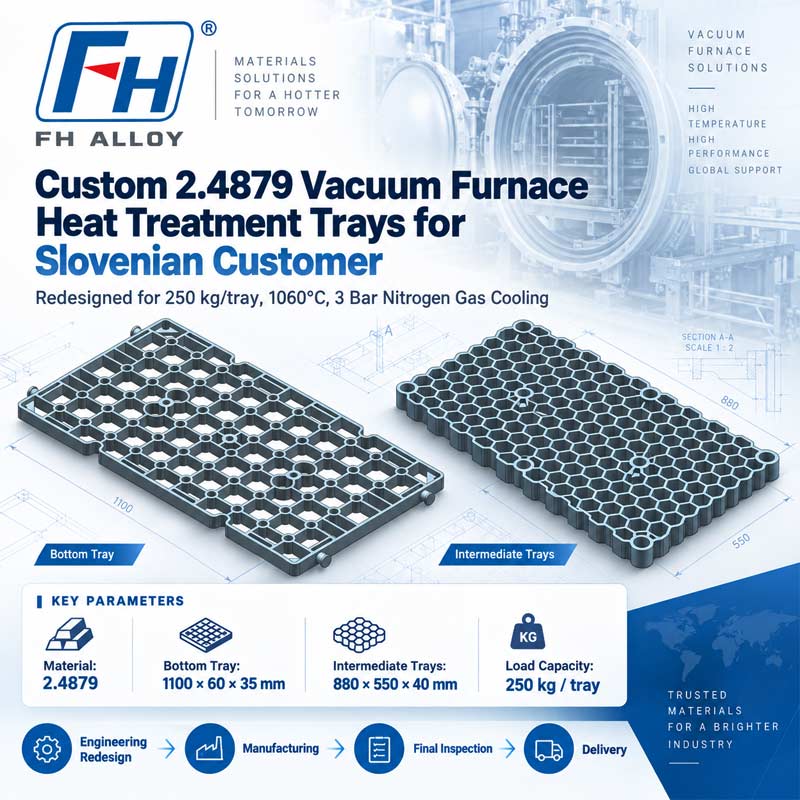
| 2.4879 (Alloy 601) | 1300°C | Vacuum brazing, aerospace | Non-stick surface, Ni-base |
| 330 Austenitic SS | 1100°C | Aerospace components | High nickel content |
| Cr25Ni20 | 1100°C | Salt bath roller hearth furnace | Corrosion + heat resistance |
| HU+Nb | 1050°C | Box-type resistance furnaces | Medium-temp stability |
For vacuum brazing applications, 2.4879 (Inconel 601) is the standard choice because its oxide surface layer actively resists brazing filler adhesion — preventing workpiece contamination without the need for coatings or release agents. For continuous mesh belt furnaces or cast link belt furnaces, the chain plate and hearth roll grades must be matched to the basket alloy to prevent galvanic acceleration of oxidation at contact points.
Two casting processes dominate heat treatment basket production: investment casting (lost-wax) and centrifugal casting. Each has a defined application range.
Investment casting (precision casting basket) produces components with wall thickness control down to ±0.3 mm, smooth internal surfaces, and the ability to cast complex internal geometries — including reinforcement ribs, integrated handles, and drainage channels — in a single pour. The surface finish achieved eliminates stress-concentration sites where high-temperature corrosion preferentially initiates. This process is standard for high-specification heat-treatment fixtures including welding heat treatment fixtures and precision casting baskets used in aerospace or electronics manufacturing.
Centrifugal casting excels in producing rotationally symmetric components with very high structural density and freedom from porosity: furnace rollers, furnace piers, radiant heat tubes, and cylindrical wear resistant liners are typical products. The centrifugal force during solidification drives inclusions to the bore surface while the working surface remains exceptionally clean and dense. For furnace rollers for continuous furnaces — including AFC furnace roller rails and rollers and Ipsen fan blades — centrifugal casting is the manufacturing method of choice.
A basket designed for a pusher furnace will perform differently — and usually worse — in a roller hearth furnace. Furnace-specific design is not marketing language; it is engineering necessity.
| Furnace Type | Key Basket Requirement | Typical Basket Form |
|---|---|---|
| Chamber / Box Furnace | Flat base, stackable, high rigidity | Heat Treatment Base Trays or solid-wall casting basket |
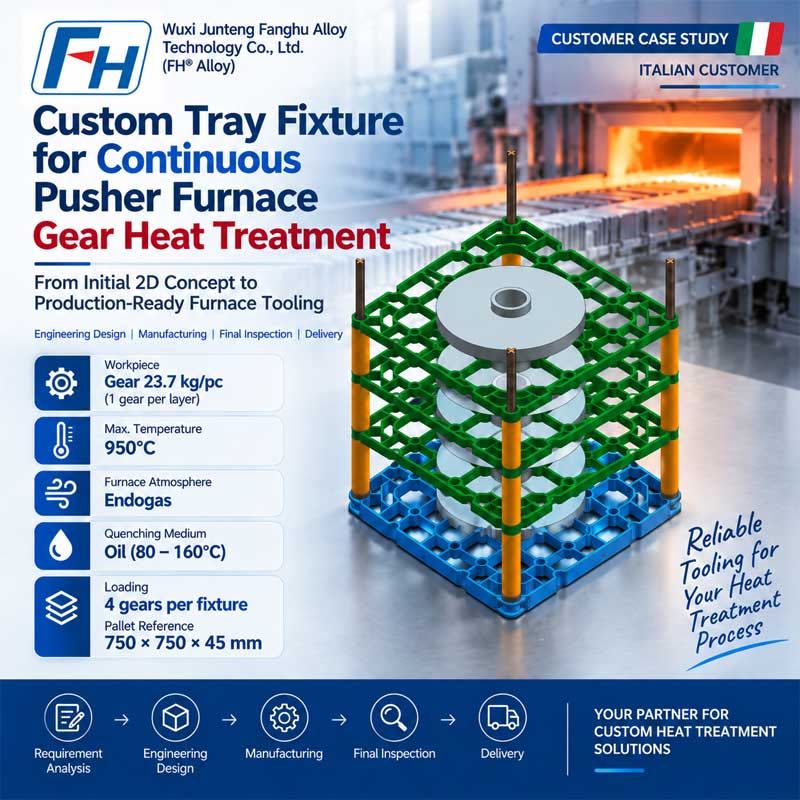
| Pusher Furnace (AFC pusher head) | Wear-resistant base rail contact, flat bottom | Flat-base precision casting basket |
| Roller Hearth Furnace | Low friction base, thermal shock resistance | Oil-cooled charging basket, hearth roll contact design |
| Vacuum Furnace | Non-contaminating, stackable, low outgassing | Stackable heat treatment baskets with 2.4879 or Inconel alloy |
| Pit / Well Furnace | Vertical load stability, deep geometry | Heat Treatment Base Trays with well-type bottom support |
| Continuous Mesh Belt / Cast Link Belt | Low profile, belt-compatible base | Mesh structure basket, chain plate compatible |
| Salt Bath Roller Hearth | Corrosion resistance at high temp | Cr25Ni20 combined charging basket |
For Ipsen, Aichelin, ECM, KGO, AFC, and IVA-Schmetz furnaces, dimensional compatibility goes beyond floor area. The basket must clear internal guides, sit correctly on furnace piers or rail systems, and not obstruct circulation fans such as the Ipsen fan blade. Interference with the fan blade or AFC furnace roller rails is a common source of premature basket damage in retrofits.
Energy savings from optimized heat treating baskets are not theoretical. Experimental data from continuous production lines shows that switching from worn or poorly matched baskets to purpose-engineered precision casting baskets reduces overall energy consumption by approximately 8–12%. The mechanism is straightforward:
First, basket deformation from thermal cycling is eliminated by using alloys with adequate creep resistance. A deformed basket holds fewer parts per cycle and creates uneven gas circulation. Second, improved thermal conductivity of the basket alloy reduces the time required to bring the full load to soaking temperature — directly reducing furnace-on time per batch. Third, increased loading density — achievable when the basket is designed for the exact furnace chamber geometry — means more parts per thermal cycle, reducing the energy cost per part treated.
For large-scale continuous furnaces equipped with radiant heat tubes and furnace rollers for continuous furnace operation, these gains compound across thousands of cycles annually, producing measurable reductions in energy cost and CO2 output.
Deformation during heat treatment is most often traced to three basket-related causes: inadequate support spacing, insufficient basket rigidity, and thermal stress concentration at contact points.
Support spacing should be verified by 3D laser detection before production. Internal support block spacing controlled below 200 mm ensures that long, thin, or flat workpieces — such as automotive transmission components, aerospace brackets, or stamped fasteners — receive continuous support without load concentration. For the heat treatment of fasteners and stamped parts (common in box-type resistance furnaces using grades like 2.4879), even support prevents the edge deformation that causes downstream assembly rejection.
Basket rigidity is maintained through integrated reinforcement ribs and intelligent release joints. These joints accommodate the differential thermal expansion between basket and workpiece without transmitting stress to the part being treated. In welding heat treatment fixtures — used to relieve residual stress in weldments — this controlled thermal compliance is essential to the process outcome.
Heat treatment baskets do not operate in isolation. Their performance is directly linked to the condition and specification of surrounding furnace components. Specifying these together rather than independently avoids the incompatibility problems that reduce basket life and process consistency.
Furnace rollers and furnace piers support the basket base. If the roller surface is worn or the pier height is inconsistent, the basket rocks during loading and unloading, introducing mechanical stress into the parts. AFC furnace roller rails and rollers must be dimensionally matched to the basket base geometry — a mismatch of as little as 3 mm in rail height causes uneven wear across the basket bottom and accelerates creep deformation.
Radiant heat tubes determine the heat distribution pattern inside the chamber. Their position relative to the basket determines which zones receive maximum radiant input. A basket with poor lateral convection channels creates shadowed zones where workpiece temperature lags — exactly where hot and cold spots develop. Coordinating the basket lattice geometry with the radiant tube layout is a key step in process optimization.
Wear resistant liners fitted to pusher heads (AFC pusher head) and contact zones protect both the basket base and the furnace floor from abrasion. Hearth rolls for cast link belt furnaces must also be compatible in diameter and surface finish with the basket underside to prevent surface marking that causes carburizing contamination.
Off-the-shelf baskets serve general applications. Any production process with defined part geometry, specific atmosphere chemistry, or furnace-brand constraints benefits from customization. When placing an order for custom heat treatment baskets, the following parameters should be specified:
Providing these parameters allows the manufacturer to specify the correct alloy grade, casting process (investment vs. centrifugal), wall geometry, and reinforcement layout — delivering a heat-treatment fixture that outperforms a generic solution in both service life and process output quality.
For global buyers in aerospace, automotive, and precision engineering, basket suppliers should hold ISO 9001 and ISO 14001 certification as a minimum. These certifications ensure that material traceability, dimensional control, and heat treatment process records are maintained to a documented standard. For aerospace applications using 330 austenitic stainless steel or 2.4879 Inconel baskets, material certification documents (mill certificates) should accompany each production batch.
Advanced manufacturers use three-dimensional laser measurement for basket dimensional verification, combined with high-temperature alloy testing to confirm creep and oxidation resistance before dispatch. This quality gate eliminates the field failures — basket cracking, warping, or surface scaling — that cause unplanned furnace downtime and scrap product losses in production environments.
 CategoryRecent Post

Focus on Designing and Manufacturing Alloy Steel Parts since 2006
 Tel: 0510-83310100
  E-mail: info@alloy-casting.com
  Office Add: Room 1105,Building 6, Jiaye Wealth Center,Wuxi, Jiangsu, P.R.China P.C.:214000.
  Privacy

 English
 Español
 italiano
 Deutsch
 0086-13338774804
